
N.J. Airport Security Spot, Lose Fake Bomb
By WAYNE PARRY, Associated Press Writer
NEWARK, N.J. - Baggage screeners at Newark Liberty International Airport spotted — and then lost — a fake bomb planted in luggage by a supervisor during a training exercise.
Despite an hours-long search Tuesday night, the bag, containing a fake bomb complete with wires, a detonator and a clock, made it onto an Amsterdam-bound flight. It was recovered by airport security officials in Amsterdam when the flight landed several hours later.
"This really underscores the importance of the TSA's ongoing training exercises," said Ann Davis, a spokeswoman for the Transportation Security Administration, the agency responsible for screening passengers and baggage for weapons and explosives. "At no time did the bag pose a threat and at no time was anyone in danger."
Earlier this month, French authorities lost a bag containing real explosives that were being used to train bomb-sniffing dogs. That led French authorities to prohibit using live explosives in future tests.
The incident at Newark Liberty International was only the latest embarrassment for screeners at one of the airports from which some of the Sept. 11, 2001 hijackers took off.
In October, The Star-Ledger of Newark reported that screeners missed one in four fake explosives and weapons in secret weekly tests conducted throughout the summer by TSA agents.
In Tuesday night's test, a TSA supervisor secretly placed the bomb, which was designed to resemble the plastic explosive Semtex, inside a bag that was put through screening machines, Davis said.
A baggage screening machine sounded an alarm, but workers somehow lost track of the bag, which was then loaded onto a Continental Airlines flight.
Despite the incident, no flights were delayed and the terminal remained open.
Davis said the TSA is still investigating how screeners lost track of the bag.
"It was an error that the bag was not intercepted before it was loaded," she said, adding it was too soon to say if anyone would be disciplined for the failure.
_________________________________________________________________________________
Bill's Comment: The fake bomb was found in Amsterdam, The Netherlands, the next day.
Imcompetency at its finest. When is our government going to get serious, and hire people that fit the bill for airport security?
I work in Security at one of my jobs, and trust me when I say this. It is not meant and made for just anybody! The fact that this incident took place at Newark Liberty International Airport is another story in itself. Thank you, "Mayor For Life" Sharpe James, for making New Jersey another butt for jokes.
Sunday, December 19, 2004
N.J. Airport Security Spot, Lose Fake Bomb
Posted by William N. Phillips, Jr. at 12/19/2004 08:31:00 AM 0 comments
Would-Be Thief Is Duct-Taped to Pole
Bill's Comment: I wonder if somebody brought this to Glenn Beck's attention? Hats off to the family for thinking fast
------------------------------------------------------------------------------
Would-Be Thief Is Duct-Taped to Pole
Tue Dec 14, 1:33 PM ET
GEORGETOWN, Guyana - A would-be thief got a taste of his own medicine in Guyana when he was caught and attached to a utility pole with the same duct tape he intended to use to bound a family and rob them, police said Tuesday.
Sabanah Gravesande, 13, was watching television at her home Monday in the capital of Georgetown when two men entered her family's house and tried to tape her mouth shut, police said.
Neighbors heard her screams as she and her grandmother scuffled with the men, authorities said. Neighbors came to their assistance and caught one of the unidentified men, tying him by the neck to a nearby utility pole with the tape until police arrived and took him away.
His legs and hands were also duct-taped as hundreds of people looked on, some openly guffawing at the spectacle.
Police said they would charge the man later this week, indicating that he was a cocaine abuser trying to raise money to support his addiction.
Guyana, a former British colony in South America, has a population of 700,000.
Posted by William N. Phillips, Jr. at 12/19/2004 08:26:00 AM 0 comments
Taxi Driver Shoots Man in Bin Laden Mask
Taxi Driver Shoots Man in Bin Laden Mask
SAN JOSE, Costa Rica - Osama bin Laden (news - web sites) take note: You wouldn't be safe in Costa Rica. A startled taxi driver shot and wounded a jokester wearing a plastic mask of the al-Qaida leader, police said Tuesday.
Leonel Arias, 47, told police he was playing a practical joke by donning the Bin Laden mask, toting his pellet rifle and jumping out to scare drivers on a narrow street in his hometown, Carrizal de Alajuela, about 20 miles north of San Jose.
Arias had startled several drivers that way on Monday afternoon. But when he jumped out in front of taxi driver Juan Pablo Sandoval, the motorist reached for a gun and shot him twice in the stomach. He was hospitalized in stable condition.
"For me and I think for anybody else at a time like that one thinks the worst and so I fired my gun," Sandoval told Channel 7 television.
Police declined to detain Sandoval, saying he had believed he was acting in self-defense.
--------------
Bill's comment: I bet that, if you were to look up the word "moron" in an updated dictionary, you would find a picture of Mr. Arias with the word underneath.
Posted by William N. Phillips, Jr. at 12/19/2004 08:21:00 AM 0 comments
Paris is the City of Blight for culture-shocked Japanese: report
Paris is the City of Blight for culture-shocked Japanese: report
PARIS (AFP) - A strange illness has descended on Japanese living in Paris, tipping many of them in a state of profound culture shock after realising their ideals about the French capital were unrealistic, a study said.
More than a 100 expatriates a year are sinking into a state called "the Paris syndrome" which is characterised by feelings of persecution or suicidal tendencies, according to the mental health facilities of city hospitals, according to a study in the Liberation newspaper said.
Part of their clinical depression stems from having to reconcile their romanticism about Paris with reality, psychiatrists said.
"Magazines are fuelling fantasies with the Japanese, who think there are models everywhere and the women dress entirely in (Louis) Vuitton," Mario Renoux, the head of a French Japanese Society for Medecine was quoted as saying.
After a relatively short period of only three months or so, Japanese immigrants expecting to find a haven of civilisation and elegance instead discover a tougher existence with many problems dealing with the French.
"They make fun of my French and my expressions", "they don't like me" and "I feel ridiculous in front of them" are common refrains heard by the doctors.
The need to forcibly express one's self to be noticed -- seen as vulgar in Japanese society -- and exposure to a humour sometimes seen as offensive adds to the unhappiness.
"However, not wanting to give up their Paris dreams, the patients refuse to go back to Japan," the newspaper noted.
"The phenomenon manifests itself in those who are unable to adapt to France because of the shock resulting from the confrontation between the two cultures," Dr Ota, a Japanese psychologist treating some of the patients at Sainte-Anne Hospital, said.
He and other experts underlined Japan's ideal of collectivism, or putting the group first, as a barrier for some of the immigrants who suddenly find themselves in a Western society based more on individualism.
Many of those feeling victimised by the experience are Japanese women.
"They are, in general, young ladies who have been spoiled and protected. Ill-prepared for Western freedom, they often go off the rails," the head of the French association Young Japan, Bernard Delage, said.
The Japanese consulate in Paris said there were 14,000 Japanese registered as living in Paris, and thousands more unregistered. Most are students, artists, businessman and employees of international companies.
Posted by William N. Phillips, Jr. at 12/19/2004 08:14:00 AM 0 comments
Trying to Lose Weight? Sleep More, Get Dog
Trying to Lose Weight? Sleep More, Get Dog
Wed Nov 17, 7:33 AM ET
By MARILYNN MARCHIONE, AP Medical Writer
LAS VEGAS - Experts have this unconventional advice for dieters: Don't scrimp on sleep and think about getting a dog.
A very large study has found a surprisingly strong link between the amount of shut-eye people get and their risk of becoming obese. Researchers also found that dog owners who dieted alongside their pets did slightly better than their dog-less counterparts.
Both studies were reported this week at a meeting of the North American Association for the Study of Obesity.
The sleep study found that people who got less than four hours of sleep a night were 73 percent more likely to be obese than those who got the recommended seven to nine hours of rest. Those who averaged five hours of sleep had 50 percent greater risk, and those who got six hours had 23 percent more.
"Maybe there's a window of opportunity for helping people sleep more, and maybe that would help their weight," said Dr. Steven Heymsfield of Columbia University and St. Luke's-Roosevelt Hospital in New York, who did the study with Columbia epidemiologist James Gangwisch.
They used information on about 18,000 adults participating in the federal government's National Health and Nutrition Examination Survey, or NHANES, throughout the 1980s.
It may seem odd that sleeping more would prevent obesity because people burn fewer calories when they're resting, but they also eat when they're awake. The effect of chronic sleep deprivation on the body's food-seeking circuitry is what specialists think may be making the difference in obesity risks.
"There's growing scientific evidence that there's a link between sleep and the various neural pathways that regulate food intake," Heymsfield said.
Sleep deprivation lowers leptin, a blood protein that suppresses appetite, and raises ghrelin, which does the opposite.
It also hurts "executive function" — the ability to make clear decisions, said Dr. Philip Eichling, a sleep and weight-loss specialist at the University of Arizona who also is medical director of the Canyon Ranch, a spa in Tucson that caters to business executives.
"One of my treatments is to tell them they should move from six hours to seven hours of sleep. When they're less sleepy, they're less hungry," he said.
Meanwhile, Chicago doctors are hoping people consider a "buddy system" for losing weight that includes man's best friend. Two-thirds of Americans and one-fourth of pets overweight or obese, so there's huge potential.
According to the first study to put people and their pets on a simultaneous diet and exercise program, experts found both lost weight and kept it off. Dogs did better than owners, but owners said they had fun, something people rarely say about their diets.
"If you're looking for motivation and social support to lose weight, you probably don't have to look any further than the pet in your own home," said Dr. Robert Kushner of Northwestern Medical School, who did the study with Chicago veterinarian Kimberly Rudloff and Dennis Jewell, a nutrition expert for Hill's Pet Nutrition, which makes Science Diet and a prescription diet dog food used in the study.
They tested three groups: 56 people, 53 dogs, and 36 dogs and their owners. The dogs ranged from pudgy poodles to husky Huskies, and target weights were set by a "doggie BMI" based on age and breed.
People attended weekly counseling sessions at Northwestern on diet and exercise, and were encouraged to walk at least 20 minutes and limit calories to 1,400 a day. Dogs were fed the prescription diet and walked with their owners.
All were followed for one year.
The dog owners did slightly better than the dieters who walked and dieted alone. Overall, people lost an average of 11 pounds, or 5 percent of their body weight, in the first four months and kept it off for the next eight.
Dogs lost an average of 12 pounds — 15 percent of their initial weight. Of course, that's easier to do when someone controls your food dish. But the dogs didn't seem to mind as judged by something any dog owner can understand:
"Begging behavior did not go up," Jewell said.
Owners said their dogs had more pep and were anxious to go outside for walks and play.
Kathleen O'Dekirk, a 51-year-old Chicago lawyer, said that certainly was true for her paunchy Cavalier King Charles spaniel, Winston, who lost seven pounds during the study.
"He bounds up the stairs three and four at a time whereas before he used to just crawl up," she said.
She lost 13 pounds, and it encouraged her so much that she joined a fitness class and now does more strenuous exercise than she'd ever done before.
"I had never been on a diet," she said. "I dropped two pant sizes."
____
On the Net:
Science Diet's "pet BMI" calculator: http//www.petfit.com
Posted by William N. Phillips, Jr. at 12/19/2004 08:09:00 AM 0 comments
Friday, December 17, 2004
Bush: Social Security Reform Needed Now
Bush: Social Security Reform Needed Now
By LEIGH STROPE, Associated Press Writer
WASHINGTON - President Bush (news - web sites) said Thursday that "now is the time to confront Social Security (news - web sites)" to deal with a projected $3.7 trillion, 75-year shortfall and give younger workers the ability to invest some of their contributions.
Bush also promised to send Congress "a tough budget" early next year to hold the line on federal spending.
"You will see fiscal discipline exercised inside the Oval Office this coming budget cycle," the president told a White House economic conference.
Bush, who credited his tax-cutting policies with reviving the economy, said his strategy will be "to grow the economy with reasonable tax policy but to make sure the deficit is dealt with by being wise about how we spend money."
"It's not going to be easy," he said. "It turns out (congressional) appropriators take their title seriously."
Bush said he intends to ignore the traditional political perils of meddling with Social Security in order to save the system for future generations.
"This is an issue on which I campaigned and I'm still standing," he said.
All participants on Thursday's panel, including financial service firm officials, supported Bush's Social Security plans.
Away from the conference, AFL-CIO President John Sweeney called Wall Street's support for partial privatization a conflict of interest and "a risky scheme for America but a sure bet for the financial services industry."
In a letter to the Securities Industry Association, Sweeney asked the group to disavow Bush's proposed overhaul. "Will the financial services industry behave as professionals with a duty to speak candidly to the investing public, or will elements of the industry once again seek to make money at the expense of their customers, only this time on a much grander scale?" Sweeney wrote.
Bush was not specific about his own ideas for solving the problem, but he laid out a few do-or-die principles.
He said that for an undefined group of seniors "nothing will change" in their benefit structure, that there should be no increase in payroll taxes, and that younger workers should be moved toward private accounts for some portion of their Social Security contributions.
The audience chuckled as Bush added, "With those principles in mind, I'm open-minded with the members of Congress."
Bush said there are more Americans who have no confidence they will ever see any Social Security benefits than those who are worried their checks will stop coming.
"I think Congress needs to understand that," he said.
Richard Parsons, chairman and chief executive of Time Warner Inc., warned, "We're on a train-wreck course."
"You can't fix this problem with no pain, without making some sacrifices, but the time to start making those sacrifices is now," said Parsons, a chairman of Bush's 2001 committee on partial-privatization.
Democrats say supporters of personal accounts are exaggerating Social Security's funding problem.
Bush "wants to use an ideological solution to a manageable problem," said Rep. Robert Matsui (news, bio, voting record) of California, the top Democrat on the House Social Security subcommittee.
White House press secretary Scott McClellan countered that the problem is real. "Today's guaranteed benefits are an empty promise to our younger workers," McClellan said.
In 2018, the system starts paying out more in benefits than it collects in taxes. In 2042, the system will be able to cover 73 percent of promised benefits, according to Social Security's trustees.
The White House acknowledges that allowing younger workers to invest funds in private accounts would do little to help plug the shortfall.
"It will take more to solve the problem than just personal accounts," McClellan said Wednesday. The transformation would be part of a "comprehensive solution to strengthen Social Security."
Bush is expected to propose details in January, but he won't offer specific legislation. His summit helped bolster his plans by providing a public forum.
Bush has ruled out an increase in payroll taxes to pay for the overhaul. Experts say he would have little choice but to borrow the funds, perhaps $1 trillion to $2 trillion, in order to continue paying benefits for current and near-retirees whose checks are funded by workers' payroll taxes.
Rep. John Spratt (news, bio, voting record) of South Carolina, top Democrat on the House Budget Committee, said Bush's summit was a "pep rally for privatization," when the more urgent problem is the skyrocketing federal budget deficit, which hit $413 billion in 2004.
Tackling Social Security is "putting the cart before the horse" by pursuing a program "with enormous implications for federal borrowing without doing anything about the rest of the budget," Spratt said.
Posted by William N. Phillips, Jr. at 12/17/2004 08:49:00 PM 0 comments
Cheney: Economy Needs Permanent Tax Cuts
Cheney: Economy Needs Permanent Tax Cuts
By JENNIFER LOVEN, Associated Press Writer
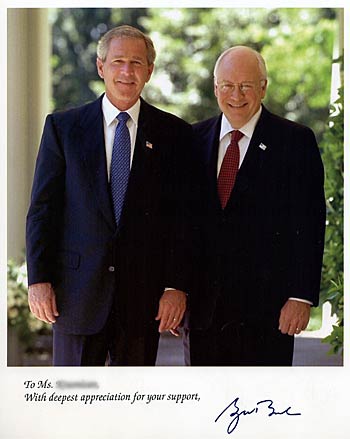
WASHINGTON - Vice President Dick Cheney (news - web sites) said Wednesday that it is critical to make President Bush (news - web sites)'s tax cuts permanent during his second term, while achieving broader reforms in the tax code and bolstering Social Security (news - web sites).
Speaking at the start of a two-day White House conference on the economy, Cheney said the administration would put a top priority on making the tax cuts, which are all due to expire after 2010, permanent as a way of bolstering future economic growth.
Cheney said the administration had accomplished a great deal in its first term but a number of unfinished items remain for Congress to address.
"We still have more work to do, but we believe we are on the right track," Cheney told the audience of business leaders, economists and Washington lobbyists.
The administration is hoping to build momentum for Bush's ambitious second-term agenda during the two-day White House-sponsored conference. Various panels were scheduled to address Bush's proposals on overhauling the tax code and Social Security as well as promoting freer trade and placing limits on lawsuits.
However, the effort is already facing major obstacles with such groups as AARP, which represents millions of retired people, and organized labor, represented by the AFL-CIO, vowing to fight Bush's proposals on Social Security reform in Congress.
Harvard economics professor Martin Feldstein, participating in a panel on current economic conditions, said he believes the country has emerged from the 2001 recession and the prolonged period of weak job growth.
"I'm pleased to say the economy is now in very good shape," Feldstein said. "National income is growing, growing at an above-trend pace, employment is rising, inflation is low. So by all of the key measures, we're in good shape."
"These favorable conditions reflect good policies and also sound economic structure," said Feldstein, a Republican who is a candidate to succeed Federal Reserve (news - web sites) Chairman Alan Greenspan (news - web sites).
"The weakness of the economy we worried about a few years ago is now essentially all gone thanks to supportive, stimulative Fed policy and the combination of personal tax cuts and the tax incentives for business," he said.
He plugged Bush's top domestic priority: reforming Social Security and including a private retirement account option.
As he spoke, Cheney sipped from a coffee mug and took notes.
Bush aides acknowledge new proposals aren't in the cards for the forum on Wednesday and Thursday at the Reagan federal office building near the White House.
Bush planned to listen to a panel on lawsuit reform Wednesday and deliver remarks closing the sessions Thursday afternoon.
The speeches and panels are meant to highlight the president's major plans for boosting the economy: overhauling Social Security and the tax code, making recently passed tax cuts permanent, curbing lawsuit abuse, restraining federal spending, helping educate and train workers in a changing economy, making international trade freer, reducing the regulatory burden on businesses and passing a comprehensive energy plan.
"The president has outlined specific ways that we can move forward to continue to strengthen our economy," White House press secretary Scott McClellan said. "The president has not outlined all the specifics of some of those initiatives, and they (the panelists) will be able to provide some useful and thoughtful insight into how we move forward on implementing those policies."
Creating more jobs is an important task for Bush. The still-recovering job market has been seized upon by Democrats who contend the president's economic policies have failed to induce enough steady hiring expansion by businesses.
The economy added a net 112,000 jobs in November, considerably fewer jobs than analysts had expected and a big drop from the 303,000 positions added in October.
More than 2 million jobs have been created in the past year, but Bush remains 313,000 jobs short of avoiding a net loss of jobs during his presidency.
Posted by William N. Phillips, Jr. at 12/17/2004 08:45:00 PM 0 comments
2004 Year In Review- "ME"
(Written on December 12, 2004, while at work.)
I am currently listening to "Brunch with The Beatles" on Oldies 98.1. I decided to put my black pen to work. With less than three weeks left in the year, I figured that I would start some early reflections of the year 2004.
If I had to describe it in one word, I would probably describe it as "turbulent". It has been like a Boeing 747 going through a bad storm and crossing the jet stream simultaneously. For the sake of this entry, I will try to focus on myself, and try to recap some of the big stories at a later time.
The start of the year was not bad at all. Junior won the Daytona 500 in February, and I was enjoying chatting with folks, both old and new. I finally got a personal computer towards the end of March. (It will make a good write-off on my taxes, since I was still an independent contractor.) April, to me, came in as a lamb, and out like a lion.
Once I turned twenty-nine on the fourth of April, the roller coaster ride began. I do not remember which one occurred first, but here it goes. I lost out on chatting with one of the brightest individuals I have ever come across. She had freaked out over something that was not much of a big deal. She was going through a transition at the time, which may have factored into it. She did mention that she appreciated what I had done for her, but she wanted no further contact. I let the butterfly fly. (Should that individual come across this, you are forgiven. I wish you and your family a very Happy Holiday season!)
As my memory is starting to defog a little, I believe that the aforementioned happened first. Not long after, I dissolved my sole proprietorship. Who knows? Maybe I will do it again at some other time. Doing what I did is similar to those who work in the radio industry. Both take timing and lady luck on your side. If money was not an issue, I would enjoy myself and redo it without much effort. I left it to get a second job that would bring in a more consistent paycheck.
To close out "... the cruellest month." (T.S. Eliot, 1922, The Waste Land), I finally got Yahoo! Instant Messenger, after my friend kept nagging me for a month to install it. I was a little apprehensive at first; but now, I am glad that I did it.
The first night I put myself out there, I was fortunate to chat with a girl for a few hours. We hit it off pretty well from the beginning. When she said that she loves both football and NASCAR, I was extremely happy. I remember the first time I saw her picture, she reminded me a little of Joanie Laurer (aka Chyna in the WWE). I sent her an e-card, expressing both my thanks and appreciation for the fun time I had with her.
As time went by, I grew to like this girl a hell of a lot more. Although she is a Jeff Gordon fan, I am able to overlook that, even to this day. On June 29, 2004, exactly two months after our initial contact, I took a risk and asked her to be my girlfriend. Lucky for me, she accepted. This girl's name is Ashley Moore. Yes, the same girl that I wrote the poem "My Girl Ashley" about. Even though we are not a couple right now, Ashley is a great friend to have; and, maybe we will get back together soon. Only time will tell.
The Ashley angle covers most of the second half of this year. By my own admission, I must say here that it has been one of the best times in my life. I do not know, nor can I imagine, what it would be like right now without having her in my life. Ashley, you have touched me that much. Thank you! (Don't get your mind in the gutter with that one.)
If I can flash back, there is one other ironic twist for me this year. I am going to take the time machine to Memorial Day weekend. To sum it up in a nutshell, I almost got "The Donald", because somebody could not keep their nose out of my business, despite my request to stay out. The irony to this is that now, I am working for the individual. (I am not referring to the third party person here.) In closing the story, the third person that interjected themself into this believes that they committed no wrongdoing, even to this day. The "recipient" and I are co-existing, as far as communication goes.
Should anything change before the end of the year, I will be happy to provide an addendum to this. Thank you for reading. Blessings on your day!
Posted by William N. Phillips, Jr. at 12/17/2004 07:30:00 PM 0 comments
Thursday, December 16, 2004
Groundshaking Book Alert!: Newt's New Book "Winning The Future: A 21st Century Contract with America"
Gingrich Now Seeking a New Contract
Friday, November 12, 2004
by Luiza Ch. Savage
Newt Gingrich is preparing to unfurl a new Contract with America.
The last time he did so, the ideas catapulted Republicans to a majority in the House for the first time in a half century. Now the former House speaker is plotting a way to keep conservatives in power "for a generation or more." Yet it is Democrats who are being urged to look to him for inspiration as they contemplate their future in the minority.
"A 21st Century Contract with America" is the subject of a book scheduled for release in January.
Mr. Gingrich said it is not a platform from which to launch a presidential run in 2008.
"I don't plan to [run]," the former congressman from Georgia told The New York Sun yesterday. But he did not completely rule out a return to elected office. "I never say never," he said. "But it's not something I'm currently thinking about."
The book is to be a blueprint for "Phase Four" of the conservative revolution. The first phase, he said, was Ronald Reagan's "defining" conservatism. The second phase was the original Contract with America a decade ago and the election triumph that "created the majority." The third phase is the George W. Bush presidency, which has "deepened and reaffirmed the majority." The fourth phase of the revolution is to build up the Republican majority.
"I have a lot of good friends who will be out campaigning," Mr. Gingrich said, "and I hope they read the book."
Much of Mr. Gingrich's prescription is not original. Some of his suggestions, such as the inclusion of Hispanics, Asians, Native Americans, and African-Americans in decision-making roles rather than as the subjects of "outreach" programs, sound like familiar lines from the Karl Rove strategy book. Others, such as an exhortation to admit and correct mistakes swiftly, including what he calls "major mistakes" in Iraq, sound like a speech by Senator Kerry. Others, such as the need to "solve problems" and "deliver results," sound like vague common sense.
Mr. Gingrich argues that solving problems and convincing people that Republicans can help improve their lives, including dealing with mistakes that "inevitably" come with the exercise of power, will be critical to the longevity of the GOP majority.
Yet some of the ideas in his new contract call for government spending and involvement. While they may help the party build the "big tent" that he advocates, they hardly appear designed to help their author in a presidential primary run.
Mr. Gingrich runs a health-policy think tank, and he is interested in the promise of technology to revolutionize health care. Despite his past as a fiscal conservative, he was a backer of the president's costly Medicare prescription-drug benefit.
In addition, Mr. Gingrich argues that Republicans must tackle environmental conservation, an issue he said they "are not strong on yet," but one he believes to be "an overwhelmingly popular desire" that cannot be ignored.
"Which does not mean paying off the Sierra Club. It means developing high-tech solutions," Mr. Gingrich said.
He has long advocated finding technological fixes for social problems, once suggesting equipping poor children with government-financed laptop computers.
"I'm not sure his ideas have a lot of resonance with the Republican base," the director of the Center for Representative Government at the free-market-oriented Cato Institute, John Samples, said.
"Newt is not a traditional Republican. I think he sees that as a necessary step to becoming a majority party, but you've got to bring your base along with you or they may be recalcitrant," Mr. Samples said.
At the same time, Mr. Gingrich does work on market-oriented issues, such as the private Social Security accounts that President Bush has said will be a priority of his second term.
"He is playing an interesting role in managing center-right coalitions," the president of Americans for Tax Reform, Grover Norquist, said.
"He is going to be one of the people working with everybody to make it happen - talking to guys on the Hill, talking to the White House ... making sure that the administration doesn't ask Congress to do anything that is politically costly," Mr. Norquist, who spent an hour with Mr. Gingrich last Sunday, said.
Mr. Norquist does not think Mr. Gingrich has any problem with Republicans but said that without a governorship or a Senate seat, he is in no position to make a run in 2008.
There are other obstacles to his electability. He made many foes at Capitol Hill with his strong-arm tactics as speaker, he was the subject of House ethics charges, and he faced allegations of extramarital affairs.
"He begins to look a bit like a Mc-Cain candidate, except weaker, because he doesn't have McCain's appeal to independents and Democrats. Where is he going to win in a primary?" Mr. Samples said, referring to the Arizona senator.
Mr. Gingrich's spokesman, Rick Tyler, calls him a "solution-oriented conservative who is pragmatic."
"A lot of our conservative friends were upset that he was for the Medicare bill," Mr. Tyler said. "But in the long run it will save money."
As for a presidential run, or a rumored appointment in the Bush administration, Mr. Tyler is doubtful. He said the book is not a platform for a political campaign. Mr. Gingrich is busy running the think tank, the Center for Health Transformation; delivering lucrative speeches, and appearing on the Fox News Channel. In addition, he reads two or three novels a week and is a prolific writer of reviews onamazon.com.
Mr. Gingrich stepped down in 1998, beset by Democratic foes fomenting ethics charges and by internal GOP wrangling. Although he led the push for President Clinton's impeachment, the partisan bitterness that colored his relations with Democrats has been softened by time and by comparison.
"Newt looks like a Renaissance man compared to the medieval minds who are now running the House Republican caucus," the president of the Progressive Policy Institute, Will Marshall, said.
And as much as he wants to chart the Republican future, it is the Democrats who are being urged to study and learn from Mr. Gingrich's past.
"Now that they are out in the wilderness, they can look at Newt's model as a guide for how they can come back," a longtime senior aide to Mr. McCain, Marshall Wittman, said.
"I was around Republican circles in the early 1990s, when Republicans thought Newt was fanciful in his schemes to retake Congress. Democrats should learn from that example. Dare to do the impossible," Mr. Wittman, who recently crossed the aisle to join the Democratic Leadership Council, said.
The insurrection Mr. Gingrich launched, with stem-winding speeches in the House blasting Democrats as corrupt, set out a sharp and coherent agenda for change.
The midterm elections of 1994 became less about individual races and more about the concrete list of proposals labeled the Contract with America. The agenda included independent auditing of congressional spending, bal anced-budget amendments, and a line-item veto.
Nine of the 10 items were passed by the House within the first 100 days of the Congress.
"There is real opportunity for Democrats to fashion themselves as an insurgent party for reform," Mr. Marshall, of the Progressive Policy Institute, said.
"We could learn from the Gingrich insurrection about how to use the minority status in the House, when you have no real power, as a bully pulpit, and to use floor speeches to sell to the country a new package of ideas," he added. Mr. Gingrich said, however, that the Democrats cannot follow his example from the 1990s until they have the ideas to sell.
"I think they face a real choice about what kind of party they are going to be," the former college professor said. "To the degree they are dominated by the Pelosi wing, they are out of touch with most Americans. Until they go through an identity crisis, tactics are kind of irrelevant. All they are doing right now is waiting for Republicans to make a big enough mistake."
Winning The Future: A 21st Century Contract with America
by Newt Gingrich
From the Inside Flap
In the twenty-first century, America could be destroyed.
The dangers are manifold: Terrorism. Judges who think they’re God (and who are anti-God). Rising economic challenges from China and India. Immigrants and young Americans who know little about American history and values. Can America survive? Yes, says Newt Gingrich, and we as Americans can do more: We can create a safer, more prosperous, and healthier America for our children and grandchildren. How? By enacting a 21st Century Contract with America. When he was Speaker of the House, Newt Gingrich issued his first Contract with America. What was the result? Sweeping reform that shocked Washington and spurred an economic recovery for the nation, including: the first major tax cut in sixteen years; real, lasting welfare reform; and four years of balanced budgets. But the challenges now are even starker, and Newt is back with a plan for American greatness that includes: · How to win the War on Terror – how Ronald Reagan’s winning strategy in the Cold War can be adapted and modified to win this new global struggle · How to reestablish God in American public life – without God, America ceases to be American, which is why leftists are so keen on banishing our Creator · How to reform Social Security – and improve your retirement earnings – before Social Security bankrupts the nation and the next generation of taxpayers · How to restore patriotism to American schools – and insist on patriotic learning for new immigrants · How to make American health care the global standard for excellence and accessibility – while reducing health care costs · And much more The challenges of the 21st Century are great, says Newt Gingrich, but so are the opportunities. The decisions we make over the next four years will determine our future. And no book can be more important for making the right choices than Newt Gingrich’s Winning the Future: A 21st Century Contract with America
Product Description:
A grass root call to action and will set the debate for the new administration and Congress.
Product Details:
Hardcover: 272 pages
Publisher: Regnery Publishing, Inc. (January 10, 2005)
Posted by Joyce Kavitsky at 12/16/2004 08:43:00 PM 0 comments