
Source: http://www.jewishexponent.com/grzywacz-kahan
September 09, 2010

Beryl and Bill Kahan of Gwynedd, and Willie Grzywacz of Montreal, Canada, announce the engagement of their children, Joshua Harris Kahan and Dr. Kelly Grzywacz. Kelly is the daughter of the late Francine Grzywacz.
Josh earned a law and society degree from American University in Washington, D.C. He also holds a master's degree in environmental policy from the University of Pennsylvania. Josh is co-founder and partner of Freedom Energy Partners, located in East Norriton.
Kelly, who earned a physiology degree at McGill University in Montreal, attended the University of Montreal Medical School. She completed a pediatric residency at the Thomas Jefferson University Dupont Hospital for Children. Kelly is currently serving a fellowship in pediatric gastroenterology at Sainte Justine University of Montreal Hospital.
Sharing in the couple's happiness are brothers David Kahan and Warren Grzywacz.
Josh is the grandson of Pearl Kahan and the late Philip Kahan, and the late Mary and Joseph Orloff. Kelly is the granddaughter of the late Abram and Bronka Grzywacz, and the late Therese Wheaton.
The couple is planning a November 2011 wedding in Montreal.
Thursday, July 12, 2012
Real estate agent Danny Davis makes deals on wheels By Jason Sheftell
Source: http://www.nydailynews.com/life-style/real-estate/real-estate-agent-danny-davis-deals-wheels-article-1.231444
October 12, 2007
 Danny Davis on the phone while riding his trademark Trek 9300 mountain bike.
If you see a guy on a mountain bike riding down the West Side Highway, eating a sandwich and simultaneously having four conversations on his cell phone, chances are its Citi Habitats' top real estate agent, Danny Davis, on his way to see a prospective buyer.
Once the top rental agent in all of New York City earning in the seven figures annually, Davis helped ease Citi Habitats' transition from top rental company to an emerging leader in residential sales.
"I used to tell people to rent, not buy," says Davis, 39, in between meetings at his Sullivan St. office. "I used to say it's best to wait the market conditions out and rent a nice apartment. Now, I'm like, ‘You have to buy. It's the only way to go. You need equity. Renting is just throwing money away.'"
Funny, charismatic, aggressive but never in your face, Davis is a legend among other New York City brokers. For the past nine years, he's been the No. 1 producer in the entire company. An agent since graduating Columbia University in 1991, Davis has a relentless personality, traveling to more than 60 countries, living in a cave in India, going to over 75 Grateful Dead shows, and courting his Dutch wife-to-be on a boat off an island in Bolivia's Lake Titicaca.
He's almost a modern-day discoverer, with unique lofts, townhouses and apartments as his buried treasure. Very confident, but not arrogant, Davis contends to know the city and its neighborhoods better than anyone.
You can thank his trademark mountain bike for that. Davis rides a beat-up Trek 9300. He's gone through 11 bikes in his 16 years on the job. On Valentine's Day four years ago, he smacked head-first into an ambulance van. After two hours in the emergency room, Davis was showing apartments with his head still bandaged and bleeding.
"I've ridden this bike all over and I know pretty much every building in Manhattan," laughs Davis, a native Philadelphian who talks with the definitive air of a native New Yorker. "I remember running around Tribeca going to Blues Traveler concerts when there was nothing there. Today I live there with my wife and kids. But that's New York. Always changing."
Like the rental market. Vacancy rates have hovered around 1% in Manhattan for the past two years. Simultaneously, an increase in real estate agents and the high number of rental and sales apartments available have combined to make this market more competitive than any other. Not to mention the average rental price of a Chelsea one-bedroom has risen to $2,818.
"I have to be first into a newly available apartment whether it's a rental or sale," says Davis. "My job as a broker is to get my client into a space where they're happy. But there are a lot of new young brokers who are smart and high-tech savvy. That may be a problem for the old curmudgeon broker, but I like the competition."
Last year Davis rented an apartment to a client for $50,000 a month. That's a commission of almost $90,000. (For rentals, agents receive a standard fee of 15% of the annual rent.) Davis doesn't just cater to the high end. If it's rentable or sellable, Davis will show it. What he won't do is waste your time or his.
Davis recently received a letter from the CEO of NRT, the international real estate conglomerate that owns Citi Habitats, placing him in the top 1.7% out of a field of 60,000 agents worldwide. Last year, Davis totaled over $75 million in total rental and sales.
"I'm a dealmaker, not an apartment shower," says a constantly busy Davis, with whom it took almost five months to get an interview. "I listen to my clients. I can tell almost immediately what they want. I'll show them three apartments and chances are they'll find two very livable." With that, he's fast to say goodbye, on his way to meet a landlord renting a $5,000 condo in the East Village.
Gary Malin runs Citi Habitats. As the COO, he oversees 16 offices and 900-plus agents and employees. With over 6,000 rental listings online, the company is far and away the leader in New York City rentals. Agents like Danny Davis, who rented apartments before moving to sales, mirror the company's growth.
"Back in 1998, we wanted to move into a rental and sales company," says Malin, who came on board to help run the company started by a University of Michigan college friend Andrew Heiberger, (who later sold Citi Habitats to Corcoran for an estimated $49.6 million in 2004 and now develops residential property in the New York area). "If today's renters are tomorrow's buyers, then aren't today's rental agents tomorrow's sales agents? It just makes sense for us to move in this direction. Our training infrastructure is made for it."
Creating a thousand Danny Davises couldn't hurt any real estate company. Upon joining Citi Habitats, employees go through a comprehensive two-week training program learning the ins and outs of the rental market. Once completed, they work with office managers and top agents renting apartments. Within two years, sometimes sooner, these agents take an in-house sales course preparing them for the next step in becoming a top sales agent handling both rentals and sales.
"Rentals are a fast-paced race," says Malin. "Sales are about building client relationships. You have to understand inventory and market variables for both. Our training allows people to build knowledge and move successfully from a rental agent to a top sales agent."
It's worked so far. At last check, Citi Habitats was doing 45% to 55% sales. In the past five years, however, their sales volume has quadrupled.
If there's a knock on Citi Habitats, it's that they don't have a firm foot in the outer boroughs. Malin aims to change that with an influx of new rental agents who have a stronghold in those Brooklyn and Queens neighborhoods becoming a hotbed of rental activity.
"Our young agents who live there now understand those neighborhoods and have friends who want to live there," he says. "Even without a physical presence of offices in these areas, our agents are showing properties in the outer markets every day. We'll gravitate where the deals are. The boroughs are our next frontier."
Now the only question remains is how fast Davis can hightail it from Tribeca to Bushwick. Like lightning, we imagine, if there's a deal to be made.
Minimum-Wage Laws Are Costly For The Unemployed By Jeff Jacoby
Source: http://townhall.com/columnists/jeffjacoby/2012/07/11/minimumwage_laws_are_costly_for_the_unemployed/page/full/
Jul 11, 2012
CONGRESS ENACTED the first federal minimum wage in 1938. A provision of the Fair Labor Standards Act, it covered about 6 million workers and set a wage floor of 25 cents per hour.
It also cost a lot of people their jobs. The Labor Department reported that as many as 50,000 employees, mostly poor Southern blacks, were thrown out of work within two weeks of the law's taking effect. In the months that followed, the carnage spread. "African Americans in the tobacco industry were particularly hard hit," wrote David Bernstein in his 2001 history of labor regulations and black employment. "In Wilson, N.C., for example, machines replaced two thousand African American tobacco stemmers in 1939."
The economic pain inflicted by that first minimum wage law hasn't stopped Washington from repeating the same folly over and over. In the 74 years since the lowest hourly wage at which most Americans could lawfully be hired was set at 25 cents -- the equivalent in purchasing power of about $4 today -- Congress has raised the amount 22 times. The federal minimum wage is currently $7.25 an hour, and a push is underway to raise it yet again.
On Capitol Hill, Iowa Senator Tom Harkin has introduced legislation that would hike the minimum wage in three steps to $9.80 per hour, a 35 percent increase. A more radical proposal by Representative Jesse Jackson Jr. of Illinois would increase the wage floor immediately, to $10 per hour.
At the state and local level, too, legislators have been pushing for minimum-wage hikes. The lowest legal wage in Massachusetts, for example, would jump to $10 an hour under a bill sponsored by state Senator Marc Pacheco and unanimously approved by a legislative committee in March. In New York City, a "living wage" measure passed over Mayor Michael Bloomberg's veto would require companies that receive public subsidies to pay their employees at least $11.50 an hour, or $10 plus benefits. (Bloomberg plans to challenge the bill in court.)
Yet no matter how much politicians and activists may battle over minimum-wage laws, the real minimum wage in this country has never budged. It is $0.00. According to the Bureau of Labor Statistics, that is the hourly wage being earned right now by 12.7 million Americans -- the 8.2 percent of the work force that is currently unemployed.
The pain of unemployment isn't evenly distributed among all population groups. It is much more severe among those with the least experience and skills. As of last month, the unemployment rate for black Americans had climbed to 14.4 percent; among teenagers it reached nearly 24 percent. And the unemployment rate for black teens -- the least-skilled, least-experienced subset of the workforce -- was 44 percent.
Minimum-wage laws are typically thought of as a mandate on employers. In reality they constrain employees. As it stands now, the federal wage law tells workers that unless they can find a company willing to pay them at least $7.25 an hour, they can't get a job. That may not seem like much of a barrier to Harkin, one of Congress's wealthiest members, but it might as well be the Berlin Wall to an unskilled teen or young adult with no high-school diploma or employment history whose labor is only worth, say, $5.50 an hour. No matter how much that person might leap at the chance to work for what he's worth, the minimum wage forbids it. Should Harkin's bill become law, life will become even harder for those seeking entry-level employment.
With the best intentions in the world, lawmakers cannot raise the value of anyone's labor to $9.80 an hour (or $7.25 an hour, or even 25 cents an hour) merely by passing a law. Making it more expensive to hire workers who are just starting out doesn't advance beginners' prospects; it worsens them. Decades of economic research and empirical studies confirm what common sense should tell anybody: Boost the minimum wage beyond what low-skilled workers are worth, and more low-skilled workers will be priced out of a job. That is why minimum-wage hikes are historically so devastating to those at the bottom of the economic ladder.
Minimum-wage laws are not cost-free. When legislators raise the price of low- and unskilled labor, it's usually low- and unskilled laborers who end up paying the price. As 50,000 Americans found out in 1938, jacking up the minimum wage turns the least employable into the unemployable. It may not be easy to survive on $7.25 an hour. But life gets a whole lot harder when your hourly wage is nothing.
Jeff Jacoby is an Op-Ed writer for the Boston Globe, a radio political commentator, and a contributing columnist for Townhall.com.
Saturday, June 16, 2012
Rabbi Benjamin David comes home to lead Adath Emanu-El By Barbara S. Rothschild
Source: http://www.jewishvoicesnj.org/news/2012-04-18/Home/Rabbi_Benjamin_David_comes_home_to_lead_Adath_Eman.html
2012-04-18
RABBI BENJAMIN DAVID Rabbi Benjamin David is coming home to South Jersey as the new rabbi at Burlington County’s only Reform synagogue.

In what leaders at Adath Emanu-El in Mount Laurel consider the perfect shidduch, the arrival of Ben David as the temple’s newest spiritual leader in July will mark the first time a father and son simultaneously guide two of the tri-county area’s synagogues.
David, 35, grew up in Cherry Hill as the oldest son of Peggy and Rabbi Jerome David, senior rabbi at Temple Emanuel. When the former Temple Emanu-El of Willingboro prepared to move to Mount Laurel in the mid- 1990s, it changed its name to Adath Emanu-El to avoid being confused with the larger Cherry Hill congregation.
A 16-member search committee at Adath Emanu- El unanimously chose David after receiving more than 50 resumes to replace Interim Rabbi Stacy Offner, who will complete her 18-month stint in June.
“We also have tremendous respect for what his father has done for the community. With his background, Ben David was attracted to Adath because of its sense of family – that’s the kind of person he is and that’s what he was looking for.”
The younger David majored in English with concentrations in creative writing and Judaic studies at Muhlenberg College in Allentown, Pa. , spending his junior year in London. After graduating magna cum laude in 1999, he attended Hebrew Union College-Jewish Institute of Religion in Jerusalem and New York, studying Talmud extensively. Following ordination, he taught at the Skirball Center for Jewish Learning and studied Hebrew Literature at the Jewish Theological Seminary and Columbia University before becoming associate rabbi at Temple Sinai in Roslyn, N.Y., a position he has held since July 2005.
“I had it in the back of my mind to become a rabbi even as a teenager,” he said.
“Being a rabbi combines all my passions – teaching, writing, helping and inspiring people, bringing them closer to Torah and Judaism in ways appropriate for each individual.”
Jerry David was a tremendous role model. “I had a bird’s eye view from a very early age. He was a good rabbi, a good dad, a good friend to people. That was a big part of the equation for me, and he remains very much a guide for me,” Ben David said.
Jerry David said he and his wife are thrilled that their oldest son is returning to the area.
Ben David enjoys writing fiction and competitive distance running. He is a co-founder of Running Rabbis, which brings together Jewish clergy to run for causes such as autism research and feeding the hungry.
At Adath Emanu-El, he plans to focus on youth programs, adult education, social action and Torah worship – and, of course, getting to know the community and the congregation.
The Davids are buying a home in Mount Laurel. Ben and Lisa, who is the associate director of camping at the Union of Reform Judaism, have a daughter, Noa, 4, and a son, Elijah, 2, with a third child due in September.
Area native taking the helm of Mount Laurel synagogue By Kristen Coppock
Source: http://www.phillyburbs.com/my_town/mount_laurel/area-native-taking-the-helm-of-mount-laurel-synagogue/article_d9813adb-44c7-557b-85cd-430abc91e7c2.html?mode=image&photo=0
May 28, 2012

Rabbi Benjamin David returning to South Jersey
Rabbi Benjamin David will assume the role of senior rabbi on July 1 at Adath Emanu-El in Mount Laurel. The Cherry Hill native is serving as associate rabbi at Temple Sinai of Roslyn in Roslyn Heights, New York.
MOUNT LAUREL — A New York rabbi is returning to his South Jersey roots as the new spiritual leader of Adath Emanu-El.
Rabbi Benjamin David will assume the post July 1. The former Cherry Hill resident succeeds Stacy Offner, who has led the community as an interim rabbi since early 2010.
About 500 member families worship at the synagogue on Elbo Lane. According to congregation president Ari Levine, Adath Emanu-El members spent a year searching for their next rabbi.
In a prepared statement, Levine said the congregation is “thrilled” to welcome David and his family to the community.
“He brings a youthful vision, a warm and engaging personality, and a sense of himself, both as a rabbi and a scholar, that will make him the ideal religious leader for our congregation,” he said. “As more people get to know our rabbi, we are confident that he will be seen as an inspiring leader, not only for us, but also for the South Jersey and the Greater Philadelphia Jewish community.”
A graduate of Hebrew Union College’s Jewish Institute of Religion and ordained in 2004, David has served as associate rabbi at Temple Sinai of Roslyn in Roslyn Heights, N.Y., for about seven years.
He is credited with nearly tripling the size of Temple Sinai’s Hebrew high school and increasing its number of graduates by 10 times. He supervised youth groups, leading trips to Israel and on missions to assist people in need along the Gulf Coast and in Southern California.
David also developed and facilitated a number of adult education courses and worked with a variety of congregation committees, according to Adath Emanu-El.
In addition, David has contributed to Jewish publications and has been recognized with several awards and nominations for his work.
During a phone call from New York, he said he is looking forward to the move to Mount Laurel.
“This is a great opportunity for me, and it’s something that I’m honored and humbled by,” he said.
David said his “big-picture” goals for Adath Emanu-El include building on existing programs and creating more educational opportunities for the congregation.
“We’re looking to do more with an already strong youth program, and to expand the popular nursery school,” he said. “I have a real passion for teaching, and I’m looking to lead as many discussions and courses as I can.”
David and his wife, Lisa, are enrolling their daughter, Noa, 4, and son, Elijah, 2, in the nursery school while preparing for the birth of their third child. Employed by the Union for Reform Judaism as its associate director of camping, Lisa David plans to take an active role in the synagogue and with other congregation parents.
David said Adath Emanu-El is a “very good match” for him and his family.
“It’s a wonderful congregation. They’ve had a remarkable past and have a bright future. I am thrilled to be a part of that future,” he said. “We’re excited to be raising our kids in Mount Laurel.”
The move back to South Jersey also brings David closer to family members, including his parents, Jerome and Peggy David. His father is senior rabbi at Temple Emanuel in Cherry Hill.
“As parents, we are exceedingly proud of Ben, proud of his accomplishments, and prouder yet of the mensch that he is,” Jerome David said in a prepared statement. “I believe that Rabbi David and Adath Emanu-El are a great match and know that their partnership will be long and fulfilling.”
Benjamin David’s predecessor in Mount Laurel also expressed support for the appointment.
“I have been impressed with Rabbi David from our very first meeting,” Offner said. “He is a thoughtful and devoted Jewish leader and will be the perfect fit for this vibrant community.”
A rabbi for more than 25 years and former vice president of the Union for Reform Judaism, Offner will complete her 18-month service at Adath Emanu-El on June 24. She has been named rabbi at Temple Beth Tikvah in Madison, Conn.
Kristen Coppock: 609-871-8073;email: kcoppock@phillyBurbs.com; Twitter: @kcoppockbct
Father-son rabbis become colleagues By Sally Friedman
Source: http://articles.philly.com/2012-06-14/news/32216267_1_father-son-associate-rabbi-father-and-son
June 13, 2012
 "Reform Rabbi Jerry David (left) of Temple Emanuel in Cherry Hill and his son, Reform Rabbi Ben David of Temple Adath Emanu-El in Mount Laurel play with Ben's son, Elijah, 2. CHARLES FOX / Staff Photographer"
When Rabbi Jerry David wanted to practice his sermons, back when he was still relatively new in his role at Cherry Hill's Temple Emanuel, he always had one willing audience member. His firstborn son, Ben, then a toddler, would sit quietly and listen to his dad, seemingly engaged.
Jerry David, now 38 years into his pulpit, describes how Ben would then walk around the house muttering "Blah, blah, blah."
"I optimistically took that to mean that he liked my sermons," his father said.
While that may be a generous interpretation, something evidently did take for his son. He, too, became a rabbi, ordained in 2004, 30 years after his father's 1974 ordination.
And now, the father and son will reach a new milestone — and a first for the region. Starting July 1, Ben, who has been the associate rabbi at Temple Sinai in Roslyn Heights, N.Y., for the last seven years, will become senior rabbi at a Reform congregation five miles from his father's synagogue with a very similar name.
So it will be Rabbi Jerry David of Temple Emanuel in Cherry Hill and Rabbi Ben David of Temple Adath Emanu-El in Mount Laurel. While some might assume this sets the stage for dueling clergy, this father-son pair have a healthy dose of respect and realism when it comes to their future as colleagues. There will be challenges (inevitable with two rabbis with the same name in same-sounding, nearby temples) and opportunities (like reviewing and discussing each other's sermons).
"People will want to compare us," says Ben. "And I'm entering a rabbinic community where my father has been for nearly 40 years now."
But the goal, Ben said, is not to emulate his father. And Jerry doesn't want to crowd his son.
"Most of all, I want to give Ben the space to develop and grow in his rabbinate, to be his own person. I want him to live the culture of his congregation, to meet the congregation where it is and to grow with it."
So it's not a contest to attract the most congregants, to be the most popular, Ben says. "My father is so well-known, and so well-respected. But we both understand very deeply that we're not in competition with one another. No loving father and son ever would be."
But this story doesn't start here, or even when Ben last year submitted his resumé, which synagogue president Ari Levine says "captivated" Temple Adath Emanu-El's search committee.
It started in 1939, when the seeds for Jerry's curiosity and passion for Judaism were planted. That's when Jerry's parents fled Nazi Germany — many other relatives and friends did not survive — and ultimately settled in Cincinnati.
"My home was first and foremost a home of Holocaust survivors," he says. "I can remember that by the age of about 5, I was asking my mother why I didn't have grandparents like my friends did. When she told me the truth — that the Nazis killed them — I was stunned. I then wanted to know where they were buried — and then why they weren't actually buried."
Yet when he was growing up, Jerry's family was not observant. They joined a Reform synagogue only at his insistence — this after a mortifying visit to a friend's synagogue where Jerry held the prayer book upside down.
"I was a Jew, my grandparents had died because they were Jews, and I didn't have the vaguest idea of what to do in a synagogue."
He became such an ardent student that by the time of his bar mitzvah, his rabbi — and mentor — told the congregation that they were probably witnessing the performance of a future rabbi.
Jerry eventually went to the University of Cincinnati, majored in psychology, and then headed for Hebrew Union College. "This is definitely what I was meant to do," he says.
The draw to be a rabbi was equally strong for the younger David, who once heard a professor in rabbinical school say, "Unless you have to become a rabbi, you shouldn't."
And Ben knew he had to. He was also driven by his great-grandparents' legacy. "So much of who I am can be traced to that history," he said. "I have that consciousness with me all the time. None of us would have been here if Hitler had his way."
By the time he was 8, he had started thinking about becoming a rabbi "and by 19, I was sure," says Ben, who saw close-up what that meant in terms of lifestyle.
"A lot has been written about the travails of being a ‘rabbi's kid,' and it was, at times, challenging. I certainly had to get accustomed to people approaching my dad wherever we were. It's a very public life."
So nobody had to caution Ben, an English major and Phi Beta Kappa graduate of Muhlenberg College, that for a pulpit rabbi, days meld into nights, and personal plans often yield to the needs of others. Plus, his 14 summers spent at Camp Harlam in the Poconos — where he found Judaism, the outdoors, and his future wife, Lisa, at age 11 — deepened his commitment.
 "Jerry and Ben David with the menorah presented to Rabbi Jerry by Temple Emanuel to celebrate his 15 years of service in 1990. CHARLES FOX / Staff Photographer"
These independent experiences are all the more reason why he wants to establish his own name and reputation in the community in which he grew up — and at least live in a different town than his parents. He and Lisa decided to move their family (daughter, Noa, 4; son, Elijah, 2, and one on the way) to Mount Laurel.
"Any concern we had that people might confuse father and son, and therefore conflate our two congregations, was quickly dispelled," said Levine. "Rabbi Ben David is his own man with his own approach. He is, quite simply, the right rabbi for us."
Ben's future congregation is smaller — about 480 families and still growing since a move from Willingboro, where it was established in 1959, to Mount Laurel in 1997.
Jerry's has about 1,000 families, and has a long history in Cherry Hill, where it was founded in 1950 as the town's first Reform congregation. It, too, has moved, but only from one end of Cherry Hill to the other.
The greatest frustration, it seems, will be the men's schedule conflicts.
"As much as I want to see Ben in action, the reality, and irony, is that we're in action at the same time. We work the same hours!"
But at least one thing is certain: For father and son, being back together in Eagles country is a major bonus.
"Long Island was not the best place for a devout fan of the Birds," says Ben. "Now, two rabbis can cheer for them together. Who knows? It may even help the cause."
Friday, May 18, 2012
Dick Clark, the man behind 'Bandstand' By Geoff Boucher

Television's Dick Clark helps cut his 47th birthday cake during a break in rehearsals for an upcoming television special in Santa Monica, Ca., December 1, 1976. Helping him celebrate are (l) singer Barry Manilow and comedian David Brenner. Clark is wearing a smock to protect him while he is madeup.
Source: http://www.mercurynews.com/entertainment/ci_20427084/dick-clark-man-behind-bandstand?source=rss04/18/2012
LOS ANGELES -- Dick Clark, the youthful-looking television personality who literally introduced rock 'n' roll to much of the nation on "American Bandstand" and for four decades was the first and last voice many Americans heard each year with his New Year's Eve countdowns, died Wednesday. He was 82.
Clark died after suffering a heart attack at a Santa Monica hospital following an outpatient procedure, according to a statement by his longtime publicist, Paul Shefrin. Clark's health had been in question since a 2004 stroke affected his speech and mobility, but that year's Dec. 31 countdown was the only one he missed since he started the annual rite during the Nixon years.
With the exception of Elvis Presley, Clark was considered by many to be the person most responsible for the bonfire spread of rock 'n' roll across the country in the late 1950s. "Bandstand" gave fans a way to hear and see rock's emerging idols in a way that radio and magazines could not. It made Clark a household name and gave him the foundation for a shrewdly pursued broadcasting career that made him wealthy, powerful and present in American television for half a century.
Nicknamed "America's oldest teenager" for his fresh-scrubbed look, Richard Wagstaff Clark was born in Mount Vernon, N.Y., on Nov. 30, 1929.
Clark and "American Bandstand" not only gave young fans what they wanted, it gave their parents a measure of assurance that this new music craze was not as scruffy or as scary as they feared. Buttoned-down and always upbeat, polite and polished, Clark came across more like an articulate graduate student than a carnival barker.
He helped transform rock 'n' roll into a cultural force, and in the beginning he did it by introducing artists such as Chuck Berry, Bill Haley and the Comets, James Brown, Buddy Holly and the Everly Brothers for the first time. All made their national television debuts on "Bandstand."
As the music matured through the years, Clark played a potent role in star-shaping, and the Mamas and the Papas and Madonna would join the long and eclectic list of performers who got that first big boost on "Bandstand." Clark himself joined many of his show's guests in 1993 when he was inducted into the Rock and Roll Hall of Fame.
On Aug. 5, 1957, from the no-frills Studio B of WFIL-TV on Market Street in Philadelphia, Clark greeted a national audience for the first time with the backdrop of a faux record store, a concrete floor and a crowd of giddy teens in clean-cut mode: Ties for boys, no slacks for girls and no gum chewing were the rules from the first day.
That 3 p.m. show, broadcast locally, quickly became the first hour and a half of national airtime devoted to teenagers, their music and their fashions. By the end of 1958, it was a full-fledged sensation with 40 million viewers tuning in to ABC to learn about the newest dance step, rock star or fashion style.
The first record on the premiere show was the then-shocking single "Whole Lotta Shakin' Going On" by the ribald Jerry Lee Lewis. The juxtaposition of bracing music such as that with the show's tame trappings -- party games, a roll call of giggling kids, viewer voting on the best couple -- would do more to put the emerging music into the mainstream than any other forum of the day.
While Clark embodied a "safe" aura on camera, off camera he was the prototype for the fledgling music scene's new-model impresario. There would be close to three dozen songs played on the show on any given day, and Clark huddled constantly with record executives and his staff to decide which tunes got the highly coveted airtime.
By 1959, there was grumbling in the industry that "Bandstand" was too beholden to Philadelphia interests, particularly those that intersected with Clark's growing portfolio of companies. From a hit record's birth in the vinyl-pressing shop to its christening on the radio station turntable, Clark had a stake in its business life.
For the fans watching at home, Clark was simply the chaperon on their first date with rock 'n' roll.
"It's got a great beat, and you can dance to it," or some permutation of that phrase, became the mantra of fan life during the "Bandstand" tradition of rating records. Three records would be played, and members of the "Bandstand" dancing brigade would give them a numeric grade anywhere between the odd parameters of 35 and 98. Clark would announce the average, and fame and fortunes could be decided with that calculation.
That staple feature, along with the lip-syncing appearances by new stars and the countdown of the day's hits made the show the template for the entire new television sector of music shows. "Soul Train," "Solid Gold," "America's Top 10" and "MTV's Total Request Live" were among the range of shows that would borrow from the formula. To artists, especially in the show's first decade, a booking on the show was a stamp of career arrival.
Clark would host "Bandstand" until 1989, leaving just a few months before the show's cancellation. Its impact had waned in the music video and MTV era, but Clark, the show's signature name, endured in his role as the unofficial emcee of American broadcasting.
On "Dick Clark's New Year's Rockin' Eve," launched in 1972, he counted down the last seconds of every year from Times Square in Manhattan. He found a surprise hit in the 1980s with "TV's Bloopers & Practical Jokes," a franchise that correctly banked on the appeal of Hollywood stars flubbing their lines. His work and investments went into game shows, among them "$20,000 Pyramid" and "Scattergories," as well as television movies and awards shows.
Ryan Seacrest, who subsequently took over main hosting duties on the countdown show from Clark, said in a statement Wednesday, "I idolized him from the start. He was a remarkable host and businessman and left a rich legacy to television audiences around the world."
"I loved Dick Clark. He was so instrumental in my career as well as all the other Motown acts and so many others in the recording business," singer and songwriter Smokey Robinson said.
Clark is survived by his wife, Kari Wigton Clark, whom he married in 1977. He is also survived by two sons and a daughter from two previous marriages.
In 1981, with "Bandstand" entering its twilight, Clark said that the show was No. 1 on his personal career countdown. "I feel about 'American Bandstand' the way I would about a member of my family.
"I'm sentimental about it. It was the beginning of everything for me."
Tuesday, May 15, 2012
Obama's Gay Marriage Flip Shows How Big Money Sets His Agenda
Source: http://news.investors.com/article/611091/201205101907/big-campaign-donations-fuel-obama-stance-on-gay-marriage.htm?p=full
05/10/2012
Election '12: The one thing that can be concluded from President Obama's sudden "evolving" support for gay marriage ahead of a big Hollywood fundraiser is that money talks. It's how he governs. Just don't call it democratic.
Politicians are often rightly criticized for twisting with the winds of polls. Obama is different, and not in a good way. Instead of making decisions based on principle — which might occasionally go against polls — Obama's decisions are based purely on who donates the most money.
His sudden shift on gay marriage this week proves it.
He changed his stance ahead of a $40,000 a plate fundraiser at the Beverly Hills home of movie star George Clooney where wealthy gay- and gay-oriented donors had threatened to withhold donations, according to a Washington Post blogger.
The Post also reported that one out of six of Obama's campaign bundlers are gay and, as Obama declared his support for gay marriage against his previous vague stances, it was their big money that was talking.
Now, on principle alone, it's a given that Obama has probably always favored gay marriage based on his far-left orientation. But his most loyal constituents — including African-American and Latino voters, along with the majority of the voting public — are dead-set against it. That would explain why he's always hemmed and hawed about the issue, effectively voting "present."
In coming out for gay marriage, Obama showed that something's even more important to him than voter sentiment — campaign donations.
This week's resounding vote against gay marriage in North Carolina, the state that will host the 2012 Democratic convention, would seem to be reason enough for a politician on the fence to support the voters. North Carolina's rejection of gay marriage is nothing special in itself — 32 gay marriage measures have been put on state ballots, and all have failed.
That Obama didn't heed this says a lot about how he governs. Whoever gives him the most cash gets his agenda through, no matter what the public thinks of it.
And this isn't the first time.
Polls show that two-thirds of the public favor building the Keystone XL pipeline to bring Canada's tar-sands oil to U.S. refineries, a move that would seal U.S. energy security for years and create 20,000 jobs.
Obama, who takes big money from environmental groups and wealthy activists in favor of the same, is willing to buck the public to please those donors.
The same holds with the so-called feminist agenda, supported by big-dollar donors in places like San Francisco. Obama's move to let taxpayers pay for birth control under ObamaCare was unpopular with the public.
When a showdown with the Catholic Church occurred over whether it should be forced to pay for it in violation of its religious principles, Obama refused to budge. To him, his wealthy donors' cash is more important than the size of the Catholic vote.
And don't forget Big Labor and its agenda.
Polls show the public detested the Card Check bill, Big Labor's effort to force unwilling workers into unions by ending their right to secret ballot. Obama supported the unions. Why? Big Labor gave $400 million to elect Democrats in 2008 and a similar amount in 2012. Only a poll-driven Congress stopped him.
In all instances for Obama, the campaign money trumped voter sentiment. That's how he rolls.
Is that democratic? Hardly. Instead of consent of the governed, Obama's decision making amounts to rule by plutocrats, whose desire prevails no matter how outrageous their agenda is to the voters.
It also suggests a cynical view of elections — that whoever has the most money necessarily wins, regardless of his political agenda.
And it represents open contempt for the voters — a certainty that they will vote for Obama no matter what distasteful decisions he makes. Interesting.
Whatever comes of his gay marriage stance, one thing is certain — this is how Obama governs: He who has the most money wins.
It's a tad ironic, given Obama's nonstop class-warfare stances supposedly in favor of the 99%. Actually, nobody is more devoted to the 1% than he is.
Sunday, May 13, 2012
Race for VP Candidate Plays Out in Public
Source: http://www.newsmax.com/Politics/vice-president-candidate/2012/05/04/id/438042
04 May 2012
Obama Seeks Sovereignty Surrender Via LOST Treaty
Source: http://news.investors.com/article/610769/201205081849/obama-pushes-law-of-the-sea-treaty.htm?p=full
05/08/2012
Sovereignty: Even if he's not re-elected, the president hopes to leave behind a treaty giving a U.N. body veto power over the use of our territorial waters and to which we'd be required to give half of our offshore oil revenue.
The Law Of The Sea Treaty (LOST) has been lurking in the shadows for decades. Like the Kyoto Protocol that pretended to be an effort to save the earth from the poisoned fruit of the Industrial Revolution, LOST pretends to be an effort to protect the world's oceans from environmental damage and remove it as a cause of potential conflicts between nations.
Like its Kyoto cousin, LOST is an attempt at the global redistribution of power and wealth, the embodiment of the progressive dream of the end of the nation state as we know it and the end of political freedom by giving veto over all of mankind's activities to a global body — in this case something called the International Seabed Authority, located in Kingston, Jamaica.
The ISA would have the power to regulate 70% of the earth's surface, placing seabed mining, fishing rights, deep-sea oil exploration and even the activities of the U.S. Navy under control of a global bureaucracy. It even provides for a global tax that would be paid directly to the ISA by companies seeking to develop the resources in and under the world's oceans.
As Heritage Foundation senior fellow Peter Brookes notes, the U.S. government now can collect royalty revenues from oil and gas companies that wish to drill on our extended continental shelf — the undersea areas beyond 200 miles of our coast. But if we ratify LOST, we'd have to fork over as much as 7% of that revenue to the ISA for redistribution to poorer, landlocked countries.
Maritime and jurisdictional disputes would be settled by the ISA, which presumably would tell the U.S. Navy where it could and could not go. Freedom of navigation has been guaranteed by the U.S. Navy and, before it, the British Royal Navy. Now it would be the ISA. This meets perfectly the definition of the "global test" Sen. John Kerry, a backer of LOST, said in 2004 that our actions must meet.
With a possible new White House occupant and Republican majority returning to the Senate in 2013, LOST is back on the front burner. Kerry is quietly working to recruit Republican votes needed to ratify the treaty. LOST is also backed by Sen. Richard Lugar. It will be brought up soon for ratification, perhaps as early as next month, and was delayed — analysts believe — by Lugar's belief it would hurt him in the Indiana primary.
LOST was a bad idea when President Reagan refused to sign it in 1982 and actually fired the State Department staff members who helped negotiate it. It was drafted at the behest of Soviet bloc and Third World dictators interested in a scheme to weaken U.S. power and sovereignty while transferring wealth from the industrialized to the developing world.
Reagan rightly decided the U.S. shouldn't be a part of this global resource grab and redistribution of wealth. The treaty was co-authored by Elisabeth Mann Borgese, an admirer of Karl Marx and a socialist who ran the World Federation of Canada.
She views the oceans as the "common heritage of mankind" and in a 1999 speech declared, "The world ocean has been and is, so to speak, our great laboratory for the making of a new world order." We prefer the world order under Reagan, where we called our own shots.
Romney wins 3 more primaries By UPI
WASHINGTON, May 9 (UPI) -- Presumptive Republican U.S. presidential nominee Mitt Romney, with three more states in his win column Tuesday night, went after his Democratic opponent.
The former Massachusetts governor, whose list of GOP rivals has been winnowed to U.S. Rep. Ron Paul of Texas through months of primaries and caucuses, picked up bunches of delegates in Indiana, North Carolina and West Virginia, closing in on the 1,144 he needs to clinch the party's nomination at the national convention in Tampa, Fla., this summer.
While he still doesn't quite have the nomination in hand, Romney has started honing his political attack on President Barack Obama, CBS News said. On Fox News Channel's "The Sean Hannity Show," Romney criticized Obama's stance on women's issues and foreign policy while painting the president as a big-money incumbent.
"We've got a long way to go. The first chapter of the process seems to be over and we're coming together," he said. "Against an incumbent with a billion dollars he's raising, with an extraordinary machine that'll be attacking me on a personal basis day by day, that we're the underdogs."
Romney said there would be "incendiary effort on the part of the Obama team" he doesn't think will resonate with the American people.
Romney criticized Obama for trying to "make friends with some of the world's worst actors," such as Syrian President Bashar Assad, instead of trying to "communicate our strength, our determination, and indicate if people want to be friends with America, that they're going to have to hold to the principles that we find dear."
On women's issues, Romney said he found it "misguided and wrong and dishonest" to suggest Republicans don't respect women.
Jersey Girls Don't Pump Gas

By Albert's Gifts.com
New Jersey Typography Map

By Eminjay Design
Pledge of Allegiance to the Flag

"Patriotism" by John Slobodnik

President Donald J. Trump & J.D. Vance

America's First Golden Age
President Donald J. Trump & Vice President Mike Pence

Make America Great Again!
President George W. Bush & Vice President Dick Cheney
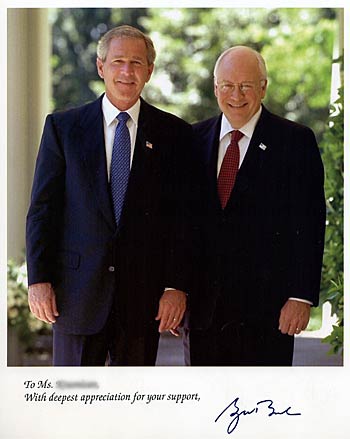
21st Century Champions of Freedom
President Ronald Reagan and Vice President George H.W. Bush
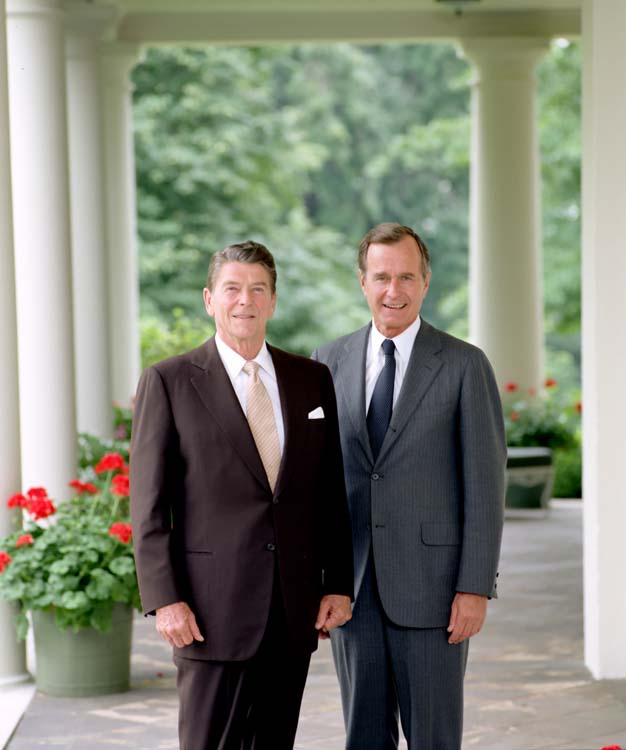
Solidarity for freedom, peace through strength

30th POTUS J. Calvin Coolidge

By Charles S. Hopkinson (1932)
40th POTUS Ronald W. Reagan

By Everett Raymond Kinstler (1991)
Grand Ol' Gang

By Andy Thomas (2008)
Callin' The Blue

By Andy Thomas (2011)
The Republican Club

By Andy Thomas (2018)
Art of the U.S. Capitol Rotunda

Painting stills available here
Statue of Freedom By Thomas Crawford - U.S. Capitol

5" replica statue available here
Lady Justice - U.S. Supreme Court

5" statue available here
Benjamin Franklin By Jean-Antoine Houdon

5.5" replica statue available here
Eagle on Liberty Bell Statue

7" a wing span 3.5" available here
President Abraham Lincoln Statue

7 1/4" polystone statue available here
Concert for Mom

By Konstantin Razumov
Halloween

By John Slobodnik
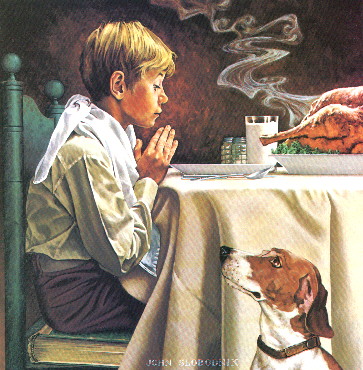
"Gratitude" by John Slobodnik

Christmas Eve

By John Slobodnik
September 1974 cover by John Slobodnik

Tell Me "Bout the Good Old Days by Ken Tate; Paintings by John Slobodnik

By John Slobodnik

Boys & Girls solemnly pledge this:

By John Slobodnik

By John Slobodnik
Mexican Government Sanctions Illegal Border Crossing With Comic Book Instructions

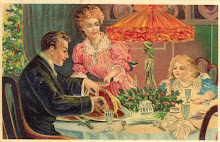
Thanksgiving Greetings

Thanksgiving Greetings 1908 postcard by B. Hofmann

Christmas family dinner





"I Love Philadelphia"

By William Ressler
Political Cartoon

By Jimmy Margulies
Political Cartoon

By Joe Heller
Political Cartoon

By Jimmy Margulies