Lava flows from the Pu‘u ‘Ō‘ō-Kupaianaha eruption sets fire to the Waha‘ula Visitor Center and maintenance shop in Hawai‘i Volcanoes National Park as thin pahoehoe covers the area in 1989.
Lava flows on the Island of Hawai‘i are renowned for their frequent occurrence, relatively easy access, land-building ocean entries, and for Hawaiian names that describe their surface textures—rubbly ‘a‘ā or smooth and sometimes ropey pāhoehoe. Hawaiian lava flows generally advance slowly and can be easily avoided by people. However, lava flows can destroy everything in their paths—rainforests, buildings, roads, utility and communication systems, and whole communities. During the ongoing eruption of Kīlauea Volcano at the Pu‘u ‘Ō‘ō vent, several people have died because of the hazards associated with lava entering the ocean.
A fast-moving ‘a‘ā flow erupted from Mauna Loa in 1950 as it advanced through the forest toward the ocean. During this eruption, a flow reached the ocean (20 km, 12.5 mi) in 3 hours.
The likelihood that future lava flows will interfere with human activity and infrastructure increases as communities and other development encroach on Hawaii's active volcanoes. USGS scientists characterize long-term lava flow hazards based on where and how often past lava inundation has occurred. When a new lava flow erupts, scientists use different methods to estimate where and how quickly it will travel downslope.
Lava-flow hazard zones vary across the Island of Hawai‘i
Lava-flow hazard zones map, Island of Hawai‘i. See Full Map for complete legend.
The first USGS map showing volcanic hazard zones on the Island of Hawai‘i was prepared in 1974 and revised in 1987 and 1992. The latest map divides the island into 9 zones, with lava flows most likely to occur in Zone 1 and least likely in Zone 9. The zones are based on the mapped locations of vents and lava flows, frequencies of past eruptions, written eruption accounts, and oral traditions of Hawaiians (chants and stories about eruptions). The zones also take into account larger topographic features that will affect the paths of future flows. The hazard boundaries are approximate, and the change in the degree of hazard is generally gradual rather than abrupt.
The probability of future lava flows is not the same for all areas of the Island of Hawai‘i. The long-term lava-flow threat is greatest on Kīlauea and Mauna Loa, the two most active volcanoes, followed by Hualālai.
Lava flow forecasts based on past flows and topography
Hawaiian Volcano Observatory (HVO) scientists use two methods to forecast the path of a lava flow: broad inundation zones based on the mapped pathways of previous lava flows, and steepest descent paths based on a digital elevation model of a volcano's topography or surface. Estimates of lava flow travel times are based on known advance rates of active flows and earlier flows from within the same area.
Past lava flows define inundation zones: Mauna Loa
Lava inundation zone map, Mauna Loa, Hawai‘i. Excerpt from Trusdell et al., 2002
HVO scientists have mapped more than 500 individual lava flows on Mauna Loa Volcano. These flows originated from vents in the summit area, rift zones, and flanks of the volcano. Their locations help identify the approximate pathways for future flows that erupt in similar locations. Mauna Loa is divided into 9 inundation zones, each including potential future vent locations and the corresponding downslope areas that could be buried if future lava flows reached the ocean. When an eruption begins, the zones can be used to quickly identify communities, infrastructure, and roads that could be affected by lava flows from the erupting vent(s). However, it is likely that only part of a zone will be buried in a single eruption.
A lava flow moves down the flank of a volcano under the influence of gravity, similar to how water flows downhill through gullies, channels, and valleys. Such low areas can be described as steepest descent paths for flowing water. In the absence of obvious water drainages on active Hawaiian shield volcanoes, scientists calculate steepest descent paths for flowing lava using computer software and digital topographic maps called digital elevation models (DEMs); the paths are shown as lines on a map. DEMs are not perfect representations of the earth's surface, however, which means that steepest descent paths are only approximate. Steepest descent paths in the Puna District, Island of Hawai‘i, published in 2007 were used to forecast paths for a lava flow that spread eastward from the Pu‘u ‘Ō‘ō vent on the East Rift Zone of Kīlauea Volcano in 2014-2015.
Lava flow travel times based on actual flow rates
Travel time estimates for a lava flow are based on the actual advance rate of the flow and, if known, the overall advance rate of earlier lava flows that passed through the same location. However, this method of forecasting travel time is highly uncertain, because factors that control flows are constantly changing—eruption rate, ground slope the flow is moving over, and complex behavior of ‘a‘ā and pāhoehoe flows.
Measured advance rates on the Island of Hawai‘i are as fast as 9.3 km (5.8 mi) per hour for an ‘a‘ā flow erupted from Mauna Loa in 1950, which is slightly slower than typical human jogging speed. Pāhoehoe lava flows typically move more slowly, less than a few hundred meters (or yards) per hour or day. The distance a flow travels ultimately depends on the eruption rate and duration, slope, and evolution of the flow field, including whether and how lava tubes, lava channels, or subsequent breakouts develop and progress.
Domino's Pizza is paving streets across America as part of its "Paving for Pizza" campaign.
(Domino's Pizza)
Domino’s Pizza is hitting the streets to help “smooth the ride home” for deliveries by making pothole and road repairs in towns customers have nominated online.
The “Paving for Pizza” initiative will fill “cracks, bumps, potholes and other road conditions [that] can put good pizzas at risk after they leave the store,” the press release said.
"We know that feeling is heightened when you're bringing home a carryout order from your local Domino's store. We don't want to lose any great-tasting pizza to a pothole, ruining a wonderful meal," said Russell Weiner, president of Domino's USA. "Domino's cares too much about its customers and pizza to let that happen."
So far the pizza chain has helped four different municipalities all over the nation.
(Domino's Pizza)
The pizza chain has already started the road repairs, working with four municipalities including Bartonville, Texas, Milford, Del., Athens, Ga., and Burbank, Calif.
In Milford, Domino’s said its crew helped fix 40 potholes on 10 roads in 10 hours.
“Facing an already harsher winter than usual for Delaware, this is an opportunity to get additional money to stretch our city’s limited resources,” said Eric Norenberg, city manager of the town, on the website, Yahoo reported.
To nominate towns, Domino’s customers can visit the Paving for Pizza website and enter the zip code of their city. If selected, “the city will receive funds to help repair roads so pizzas make it home safely,” the press release stated.
Alexandra Deabler is a Lifestyle writer and editor for Fox News.
Potholes are the lowly annoyance that in fact cause billions of dollars in vehicle damages and a large portion of highway deaths. Here is a run-down of pothole facts, news and views.
According to the National Surface Transportation Policy and Revenue Study Commission of the U.S. Congress, the annual investment required by all levels of government to simply MAINTAIN the nation’s highways, roads, and bridges is now estimated to be $185 billion per year for the next 50 years. Today, the nation annually invests about $68 billion.
The U.S. Congress passed in a rare bipartisan effort (late 2015) the Surface Transportation Reauthorization and Reform Act of 2015, which provides $233 billion for federal highway maintenance over five years. That’s $46 billion per year.
Roads are an integral part of our daily lives
24 million children (one half) of our nation’s k-12 school population ride on 450,000 school buses 180 days per year.
50,000 ambulances make 60 million trips a year.
Trucks carry 32 million tons of goods across the roads every day,
240 million registered vehicles travel 2.9 trillion miles annually.
While potholes can cause hundreds and even thousands of dollars in damage to vehicles, 63% of Americans do not have the cash on hand to pay for those repairs.
The Pothole Facts
Potholes are formed by water, freezing and freeze-thaw cycles, excessive heat, wear and tear – and time.
The areas most prone to pothole development are where drainage is poor (particularly where roads dip, such as the trough under viaducts), where vehicular traffic is greatest – especially heavy vehicle traffic – and where poor maintenance allows small fissures to deteriorate.
The vast majority of America’s highways were built in the 1950s through the 1970s. Most were built to last 50 years. With time, all the factors that compromise pavement add up. By the same token, some roads have lasted much longer than planned in part due to good maintenance.
Potholes are not limited to cities in the Snowbelt. According to TRIP*, the cities with the worst road conditions in the U.S. (population 500,000 or greater) are as follows:
$2.7 trillion: That’s how much the American Society of Civil Engineers (ASCE) believes it would cost to fix crumbling highway and bridge infrastructure in the U.S.
The average annual cost for vehicle repairs due to rough pavement for individual motorists is $377 – which varies by market. Repairs typically involve tires, shock absorbers, suspension systems, struts, rims, wheel alignment and catalytic converters.
The cost of bad roads to American business between now and 2022 is estimated to be $240 billion, according to the ASCE.
Failure to spend $1 in road repair typically results in $7 of cost five years later. Whole road rebuilding costs 14 times as much as repairs.
The U.S. Chamber of Commerce listed the rebuilding of America’s infrastructure as one of their five top priorities in 2012.
The Federal gas tax currently stands at 18.4 cents per gallon, set in 1993. This money is put into the federal Highway Trust Fund, but because the tax was not indexed to inflation its purchasing power has diminished by 48 percent since 1990. States and municipalities add their own gas taxes to cover building and maintenance costs.
A gas tax is just one way to fund infrastructure. In fact, with increasingly fuel efficient and electric cars, a generation (Millennials) that are driving less and owning fewer cars, and even the possibility of drone deliveries, all erode the idea that the future of highway funding is in a gas tax.
Improved fuel economies of all types of vehicles means that less gas tax is collected even while miles driven by vehicles rise. Alternative funding methods are under consideration such as a vehicle miles traveled (VMT) system.
In some areas, road deterioration is so great and repairs unaffordable that they are being returned to gravel.
Personal injury lawsuits due to potholes are very expensive to public and private property owners.
Only about one-third of voter referenda that call for an increase in taxes are passed. Of those that do pass, they are more likely to support funding for education than infrastructure. Failed funding votes to illustrate this were in Missouri in 2014 and Michigan in 2015.
Of approximately 33,000 traffic fatalities each year, one-third involve poor road conditions.
27 percent of major urban roads (interstates, freeways and other arterial routes) are deemed substandard and provide unacceptably rough rides for motorists. Only 31 percent of roads are deemed to be in good condition (source: TRIP, 2013).
Vehicular traffic overall is expected to increase by 25% by the year 2030. Large commercial vehicle traffic is projected to increase over that time by 64 percent.
The grave danger that potholes present to bicyclists can also be costly to municipalities that fail to fix hazardous potholes and face multi-million dollar lawsuits as a result.
Pothole Solutions
The methods and materials used to build and maintain roads – including pothole repairs – are evolving and varied. What works in warmer climates is different from the four-season regions.
In northern climates, most wintertime pothole repairs are temporary, with permanent fixes happening in warmer, drier times of year. Some types of asphalt can allow permanent repairs in cold, wet conditions.
Citizens are taking action and getting involved in pothole reporting through phone apps.
Justin Cunningham, a British technical journalist and host of the UK Discovery Channel show "Incredible Engineering Blunders,'' recently dubbed New Orleans' streets the worst in the United States.
"When you think of Louisiana, you think of New Orleans and Mardi Gras, but the state has become famous for a whole other reason...Louisiana has the most poorly engineered roads in all of America,'' Cunningham says on the show.
Watch a video from the show of Cunningham intrepidly motoring through what appears to be the rocky terrain of Lakeview and other environs, with snacks and a drink sloshing across his dashboard.
The roads are "chassis smashers,'' he says.
Last year, NOLA.com asked readers what they thought were the worst streets in New Orleans. Here's what some of you said.
As lightning rods go, former FBI agent Peter Strzok was a doozy. The now famous text messages he thumbed out to ex-FBI lawyer Lisa Page whipsawed official Washington and caused ordinary Americans to wonder if the FBI was being used by one political party against the other. The storm only intensified after Strzok’s self-serving appearance before Congress last month and an Inspector General report, released in June, that cited his “bias” and (apparent) “willingness to take official action to impact (Donald Trump’s) electoral prospects.”
Suffice it to say, none of that is in the job description of an FBI agent.
This week, the FBI finally fired agent Strzok. Andrew McCabe’s successor, Deputy Director David Bowdich, made the call, reportedly overruling a lesser penalty recommended by the bureau’s internal disciplinarian, which would have left the impression that the FBI really didn’t understand the magnitude of Strzok’s perfidy. Bowdich protected the FBI and, in turn, the country — a leadership ingredient that went missing under the previous director and his deputy.
Three weeks ago, the FBI turned 110 years old. That’s a lot of history, most of it storied, some of it less so. But it would be hard to find another period more devastating to the reputation of the FBI than these past two years when a small cabal at the top of the bureau’s leadership structure embarked on a series of actions and decisions that unnecessarily exposed the FBI to concerns about its most precious core values: trust and impartiality. These high officials failed to protect the FBI’s immutable compact with the American people.
James Comey, Andrew McCabe, and Peter Strzok conspired to personally run two investigations with off-the-chart political ramifications out of the director’s office, contrary to common FBI protocols — and run both of them in very odd ways. All three men have been fired for cause. Each man, in his own way, emitted indicators of bias. Whether they acted on that bias is beside the point; the indications of bias were sufficient to arouse suspicions of politically motivated decision-making. They failed to protect the American people’s trust in the FBI.
Former director James Comey recklessly inserted himself into a presidential campaign, causing chaotic disruptions that a Russian spy could only dream of. He made up responsibilities not in his job description and got fired for it. His appearances before Congress laid bare an outsized ego obvious to everyone but himself. His damage to the FBI was immense and, perversely, he made sure it continued after his firing.
He prolonged his betrayal of the American people’s trust in the FBI by upchucking a book in record time with the pious title “A Higher Loyalty,” in case we still missed the point that he possesses a more finely tuned conscience than the rest of us. He exploited his experience as FBI director, even inappropriately commenting on an investigation that is ongoing.
And he took money for it. If he’d titled his book “A Higher Royalty,” we’d be closer to the truth of his motivations. He yukked it up on “The View” and made sure his Facebook and Twitter voice was in fine tune. He then told America to vote Democrat. Thanks for all that, Jim. Why would anyone think the FBI was biased under your “leadership”? In three-and-a-half years, you breezed in and undermined what a century of FBI agents spent the better part of their adult lives trying to protect.
Andrew McCabe, Comey’s deputy, made critical errors in judgment that left him open to concerns of bias. His wife’s Democratic campaign for Virginia state Senate accepted an unusually large amount of cash directly from a PAC controlled by Clinton acolyte Terry McAuliffe shortly before the election; McCabe led the investigation into Hillary Clinton’s handling of emails and later initiated a counterintelligence investigation of the Trump campaign.
McCabe stubbornly refused to acknowledge the obvious conflicts of interest and recuse himself until it was too late. He can continue to maintain, to anyone who will listen, that his wife’s politics had no bearing on his official actions, but it doesn’t matter. What matters is that the conflict existed and he did not protect the FBI from perceptions of biased motivations. In the end, he lied under oath and was fired.
Peter Strzok was brought in by McCabe and Comey to personally involve himself in both of the controversial investigations that the three of them would run out of their headquarters perch. At every key turn — affidavits, interviews, FISA applications, informant taskings — there was agent Strzok. His Gump-like ubiquity made his disturbing text messages all the more ominous.
They culminated in his now famous assurance that “We will stop” Donald Trump from becoming president. Who is “we”? Look at the team he was on. Now all of them have been fired. The bureau can begin to heal from the wounds they each inflicted.
The FBI exists to ensure equal treatment for all under the law, not to decide who deserves to be president. The deputy director’s decision to fire Peter Strzok was correct — and needed. It bolstered the message that an impartial FBI is an ideal worth protecting on behalf of the American people and that no one in the FBI, at any level, should have the ability to disrupt its sacred trust.
Kevin R. Brock, former assistant director of intelligence for the FBI, was an FBI special agent for 24 years and principal deputy director of the National Counterterrorism Center (NCTC). He is a founder and principal of NewStreet Global Solutions, which consults with private companies and public-safety agencies on strategic mission technologies.
In one of the more stunning revelations contained in the report compiled by the Justice Department’s watchdog, former FBI Director James Comey claimed he doesn’t remember the moment he decided – and put down in writing -- that Hillary Clinton had committed crimes.
We know that on or about May 2, 2016, Comey composed a statement summarizing Clinton’s mishandling of classified documents, concluding that she was “grossly negligent.” Those pivotal words have a distinct legal meaning, and are drawn directly from a federal statute, 18 U.S.C. 793(f), which makes it a felony to handle classified documents in a “grossly negligent” manner.
Comey used the exact phrase not once, but twice.
Based on Comey’s finding, Clinton should have faced a multiple-count criminal indictment, since the FBI discovered that she had stored 110 classified emails on her unauthorized, private computer server. Other people had been prosecuted for similar conduct that jeopardized national security in violation of the law. Yet, Comey – despite characterizing Clinton’s actions with the clear language denoting violation of the law - saw to it that no charges were ever brought against Clinton.
Based on Comey’s finding, Clinton should have faced a multiple-count criminal indictment, since the FBI discovered that she had stored 110 classified emails on her unauthorized, private computer server.
Under questioning, Comey admitted to the Inspector General Michael Horowitz that he authored the May 2 statement and penned every word of it himself. But then he offered the implausible claim that “he did not recall that his original draft used the term 'gross negligence,' and did not recall discussions about that issue.”
Comey’s amnesia is preposterous. He would have us believe that, as FBI director, he memorialized in print his decision that the leading candidate for president of the United States had committed crimes, yet later could not recollect anything about the most important decision of his career.
The truth is that Comey well remembers what he wrote, because he participated in subsequent discussions with top officials at the FBI about Clinton’s “gross negligence.” Several meetings were held on the subject and contemporaneous notes prove that Comey was in attendance. Those records show that although Comey was convinced that Clinton was “grossly negligent” in violation of the law, he was determined to clear her notwithstanding. To achieve this somersault and absolve the soon-to-be Democratic nominee, the legally damning terminology would have to be stricken from his statement.
Just as Comey, Strzok, Page and company conspired to clear Hillary Clinton, they likewise concocted their “insurance policy,” a scam investigation of then-candidate Donald Trump.
Metadata shows that on June 6, the FBI’s lead investigator on the case, Peter Strzok, sat down at his office computer to cleanse his boss’s statement of the vexing term, “gross negligence.” With the help of his paramour and FBI lawyer Lisa Page, the words “extremely careless” were substituted to make Clinton appear less criminally culpable. Page told the IG that “to use a term that actually has a legal definition would be confusing.”
It most certainly would. After all, how could Clinton be exonerated under the “gross negligence” law if that very phrase was used to describe her behavior? The phrases mean the same thing, but only one appears in the statute.
Strozk and Page also expunged from Comey’s statement his reference to another statute that Clinton had plainly violated. She should have been charged under the statute’s “intent” provisions. With Comey’s consent and encouragement, the pair sanitized his findings of fact and contorted his conclusions of law. Clinton, who had not even been interviewed by the FBI yet, was free and clear. The investigation was a sham.
Comey may not have remembered writing the words that should have indicted Clinton, but he had complete recall of his inability to read the law. He told the IG he thought “Congress intended for there to be some level of willfulness present even to prove a ‘gross negligence’ violation.” If Comey had ever read the legislative history, he would have known that in 1948, Congress amended the original Espionage Act of 1917 to add a “gross negligence” provision that did not require intent or willfulness.
Amnesia must be contagious at the FBI. Testifying before Congress, Strzok feigned no recollection of using his computer to make the critical alteration that cleared Clinton. He did, however, directly implicate the FBI director.
“Ultimately, he (Comey) made the decision to change that wording,” said Strzok.
But wait, how could Comey order a change in the words he doesn’t remember writing? Their stories don’t jibe. At least one of them is lying.
Strzok’s memory repression must be acute. He also informed Congress he does “not recall writing” the infamous text message to his lover, Page, vowing to “stop” Trump from being elected president.
“What I can tell you is that text in no way suggested that I or the FBI would take any action to influence the candidacy,” Strzok insisted.
That is a remarkably dexterous explanation for something he does not remember doing. When confronted with a myriad of other messages extoling Clinton and disparaging Trump, Strzok had the temerity to say, “I do not have bias.” Later, “Those text messages are not indicative of bias.”
No one with an ounce of intelligence could possibly buy the self-serving rubbish that Strzok was peddling. This includes the inspector general who, after an exhaustive investigation, concluded that the Strzok-Page communications “are not only indicative of a biased state of mind but imply a willingness to take official action to impact a presidential candidate’s electoral process.”
Just as Comey, Strzok, Page and company conspired to clear Hillary Clinton, they likewise concocted their “insurance policy,” a scam investigation of then-candidate Donald Trump. The FBI had no legal basis to initiate its investigation into Trump and his campaign. Facts were invented or exaggerated. Laws were perverted or ignored. The law enforcers became the law breakers. Comey’s scheme to leak pilfered presidential memos in order to trigger the appointment of his friend, Robert Mueller, as special counsel was a devious maneuver by an unscrupulous man. Comey’s insinuation that the president obstructed justice was another canard designed to inflame the liberal media. Sure enough, they became his witting accessories.
Compare all of this – that there was never any credible evidence that Trump or his campaign collaborated with Russia to win the presidency – with the fact that there was ample evidence that Clinton had broken the law.
Gregg Jarrett joined FOX News Channel (FNC) in 2002 and is based in New York. He currently serves as legal analyst and offers commentary across both FNC and FOX Business Network (FBN).
President Trump on Thursday called for an investigation into allegations that the Obama administration tried to give Iran access to the U.S. financial system by sidestepping sanctions.
"The Obama Administration is now accused of trying to give Iran secret access to the financial system of the United States. This is totally illegal," Trump tweeted.
The Obama Administration is now accused of trying to give Iran secret access to the financial system of the United States. This is totally illegal. Perhaps we could get the 13 Angry Democrats to divert some of their energy to this “matter” (as Comey would call it). Investigate!
A draft report by the Senate’s Permanent Subcommittee on Investigations found that, in early 2016, the Obama Treasury Department issued a license to Bank Muscat to authorize the conversion of Iran’s rials to euros through “any United States depository institution.”
According to the subcommittee, Iran had $5.7 billion in assets in the Omani bank, and wanted to convert it via the U.S. financial system as it was the most efficient means, “even though U.S. sanctions prohibited it,” according to the report.
The report says that government officials said in subsequent testimony to Congress, though, that Iran would not be granted access to the financial system.
The report found that the plan failed only when the two U.S. banks refused to participate, citing the complexity and the unwanted appearance involved in processing an Iranian transaction.
By itself, the Obama Treasury Department's issuing of a license to allow Iran to convert $5.7 billion it held at a bank in Oman was not illegal. If the Omani bank had allowed the exchange without such a license, it would have violated sanctions that bar Iran from transactions that touch the U.S. financial system.
But the Senate report revived criticism of how the Obama administration sought to accommodate Iran in connection with the nuclear deal. Trump suggested Thursday that Special Counsel Robert Mueller should be looking at this instead of the Russia probe.
“Perhaps we could get the 13 Angry Democrats to divert some of their energy to this 'matter' (as Comey would call it),” he said. “Investigate!”
Republicans have pointed to the revelation as proof that the Obama administration was "desperate" for the Iran deal.
"The Obama administration misled the American people and Congress because they were desperate to get a deal with Iran," said Sen. Rob Portman, R-Ohio, who chairs the panel.
But a former administration official disputed the subcommittee's conclusion, saying the Treasury Department never authorized Iran to access U.S. investments or markets, conduct commercial transactions in U.S. dollars or open correspondent accounts at U.S. banks.
“This specific license cannot be described as ‘granting access to the U.S. financial system,’” the former official said. “This specific license was in fulfillment of JCPOA commitments to give Iran access to pools of its money held overseas. It was aimed solely to allow the movement of Iran’s own funds stranded at an Omani bank into euros at a European bank, where Iran could then make use of them.”
Fox News’ Rich Edson and The Associated Press contributed to this report.
Adam Shaw is a Politics Reporter and occasional Opinion writer for FoxNews.com. He can be reached here or on Twitter: @AdamShawNY.
When it came time to update his hugely popular painting of Republican presidents, Andy Thomas struggled with how to fit Donald Trump in, but he knew that he belonged at the center of the frame.
A self-taught cowboy painter in southwest Missouri, Thomas stressed that he’s no political expert, so he wasn’t quite sure how the 45th president would be received by his predecessors in an imagined meeting.
“He’s outside the norm of Republicans and that makes it kind of interesting,” he told TIME. “Is he going to end up going in history as a great Republican or an abnormality or something? So it’s interesting. I just put him at the table, more or less the center of attention. We’ll let history decide. Or let the people decide. It’s not up to me.”
Thomas said Trump was a little hard to paint because his light hair, tan skin and lack of dark recesses under his eyes make his face mostly just “a light warm color.” He also found it hard to give Trump a “genuine smile,” and had to redo the painting after his first take seemed off.
Titled “The Republican Club,” the painting features Trump sitting at a table with GOP presidents Abraham Lincoln, Teddy Roosevelt, Dwight Eisenhower, Richard Nixon, Gerald Ford, Ronald Reagan and both Bushes. History buffs can also spot lesser-known GOP presidents such as Warren G. Harding in the crowd in the background as well.
The addition of a crowd in the background also led Thomas, an independent-minded Midwesterner who’s a fan of both Reagan and Bill Clinton, to add a subtle feminist message: A woman with indistinct features walking directly toward the table.
The same woman also appears in a separate painting, “The Democratic Club,” that Thomas just finished.
Image of "The Democratic Club" painting courtesy of Andy Thomas
“That will be the first Republican female president and the first Democratic female president,” he explained. “As I was doing the painting, I was thinking that these guys are kind of intimidating in a way. That’s the kind of woman that will be our first woman president; she’ll walk right up to that table.”
Prints of the two paintings, revealed exclusively to TIME for the first time, will go on sale sometime before the summer.
Thomas began the paintings a little before the holidays, but he said the decision to include a woman was not a commentary on Trump or the revelations about sexual misconduct among political and business leaders at the time.
Instead, he said it grew out of a more artistic decision. Made in 2008 at the suggestion of a gallery owner, his first political paintings featured eight Republican presidents and eight Democrats playing poker around a table at what appears to be a political convention. When giclee prints of those paintings turned out to be extremely popular in gift shops and galleries, he did a follow-up of the presidents playing pool, but he felt it was too closed-off and a little undemocratic.
That led him to the decision to add a group of people in the background, which along the way led him to decide a woman would approach the table.
“I’m an old-fashioned male,” he said. “But there’s a feeling of a good old boy’s network that I wanted to dispel. It just kind of came about.”
Thomas, who has a son, three daughters and two stepsons, did admit one inspiration for the idea, however: His daughter, Jenny, who works in management at a manufacturing company.
“Jenny would do that,” he said. “She’d walk right up there.”
Illustration by Alvaro Dominguez; Photographs by ZargonDesign/E+, via Getty Images, and Renaud Philippe/EyeEm, via Getty Images
I know many liberals, and two of them really are my best friends. Liberals make good movies and television shows. Their idealism has been an inspiration for me and many others. Many liberals are very smart. But they are not as smart, or as persuasive, as they think.
And a backlash against liberals — a backlash that most liberals don’t seem to realize they’re causing — is going to get President Trump re-elected.
People often vote against things instead of voting for them: against ideas, candidates and parties. Democrats, like Republicans, appreciate this whenever they portray their opponents as negatively as possible. But members of political tribes seem to have trouble recognizing that they, too, can push people away and energize them to vote for the other side. Nowhere is this more on display today than in liberal control of the commanding heights of American culture.
Take the past few weeks. At the White House Correspondents’ Association dinner in Washington, the comedian Michelle Wolf landed some punch lines that were funny and some that weren’t. But people reacted less to her talent and more to the liberal politics that she personified. For every viewer who loved her Trump bashing, there seemed to be at least one other put off by the one-sidedness of her routine. Then, when Kanye West publicly rethought his ideological commitments, prominent liberals criticized him for speaking on the topic at all. Maxine Waters, a Democratic congresswoman from California, remarked that “sometimes Kanye West talks out of turn” and should “maybe not have so much to say.”
Liberals dominate the entertainment industry, many of the most influential news sources and America’s universities. This means that people with progressive leanings are everywhere in the public eye — and are also on the college campuses attended by many people’s children or grandkids. These platforms come with a lot of power to express values, confer credibility and celebrity and start national conversations that others really can’t ignore.
But this makes liberals feel more powerful than they are. Or, more accurately, this kind of power is double-edged. Liberals often don’t realize how provocative or inflammatory they can be. In exercising their power, they regularly not only persuade and attract but also annoy and repel.
In fact, liberals may be more effective at causing resentment than in getting people to come their way. I’m not talking about the possibility that jokes at the 2011 correspondents’ association dinner may have pushed Mr. Trump to run for president to begin with. I mean that the “army of comedy” that Michael Moore thought would bring Mr. Trump down will instead be what builds him up in the minds of millions of voters.
Consider some ways liberals have used their cultural prominence in recent years. They have rightly become more sensitive to racism and sexism in American society. News reports, academic commentary and movies now regularly relate accounts of racism in American history and condemn racial bigotry. These exercises in consciousness-raising and criticism have surely nudged some Americans to rethink their views, and to reflect more deeply on the status and experience of women and members of minority groups in this country.
But accusers can paint with very wide brushes. Racist is pretty much the most damning label that can be slapped on anyone in America today, which means it should be applied firmly and carefully. Yet some people have cavalierly leveled the charge against huge numbers of Americans — specifically, the more than 60 million people who voted for Mr. Trump.
In their ranks are people who sincerely consider themselves not bigoted, who might be open to reconsidering ways they have done things for years, but who are likely to be put off if they feel smeared before that conversation even takes place.
It doesn’t help that our cultural mores are changing rapidly, and we rarely stop to consider this. Some liberals have gotten far out ahead of their fellow Americans but are nonetheless quick to criticize those who haven’t caught up with them.
Within just a few years, many liberals went from starting to talk about microaggressions to suggesting that it is racist even to question whether microaggressions are that important. “Gender identity disorder” was considered a form of mental illness until recently, but today anyone hesitant about transgender women using the ladies’ room is labeled a bigot. Liberals denounce “cultural appropriation” without, in many cases, doing the work of persuading people that there is anything wrong with, say, a teenager not of Chinese descent wearing a Chinese-style dress to prom or eating at a burrito cart run by two non-Latino women.
Pressing a political view from the Oscar stage, declaring a conservative campus speaker unacceptable, flatly categorizing huge segments of the country as misguided — these reveal a tremendous intellectual and moral self-confidence that smacks of superiority. It’s one thing to police your own language and a very different one to police other people’s. The former can set an example. The latter is domineering.
This judgmental tendency became stronger during the administration of President Barack Obama, though not necessarily because of anything Mr. Obama did. Feeling increasingly emboldened, liberals were more convinced than ever that conservatives were their intellectual and even moral inferiors. Discourses and theories once confined to academia were transmitted into workaday liberal political thinking, and college campuses — which many take to be what a world run by liberals would look like — seemed increasingly intolerant of free inquiry.
It was during these years that the University of California included the phrase “America is the land of opportunity” on a list of discouraged microaggressions. Liberal politicians portrayed conservative positions on immigration reform as presumptively racist; Nancy Pelosi, the House minority leader, once dubiously claimed that she had heard Republicans tell Irish visitors that “if it was you,” then immigration reform “would be easy.”
When Mr. Obama remarked, behind closed doors, during the presidential campaign in 2008, that Rust Belt voters “get bitter, they cling to guns or religion or antipathy to people who aren’t like them,” it mattered not so much because he said it but because so many listeners figured that he was only saying what liberals were really thinking.
These are the sorts of events conservatives think of when they sometimes say, “Obama caused Trump.” Many liberals might interpret that phrase to mean that America’s first black president brought out the worst in some people. In this view, not only might liberals be unable to avoid provoking bigots, it’s not clear they should even try. After all, should they not have nominated and elected Mr. Obama? Should they regret doing the right thing just because it provoked the worst instincts in some people?
This is a limited view of the situation. Even if liberals think their opponents are backward, they don’t have to gratuitously drive people away, including voters who cast ballots once or even twice for Mr. Obama before supporting Mr. Trump in 2016.
Champions of inclusion can watch what they say and explain what they’re doing without presuming to regulate what words come out of other people’s mouths. Campus activists can allow invited visitors to speak and then, after that event, hold a teach-in discussing what they disagree with. After the Supreme Court ruled in 2015 that states had to allow same-sex marriage, the fight, in some quarters, turned to pizza places unwilling to cater such weddings. Maybe don’t pick that fight?
People determined to stand against racism can raise concerns about groups that espouse hate and problems like the racial achievement gap in schools without smearing huge numbers of Americans, many of whom might otherwise be Democrats by temperament.
Liberals can act as if they’re not so certain — and maybe actually not be so certain — that bigotry motivates people who disagree with them on issues like immigration. Without sacrificing their principles, liberals can come across as more respectful of others. Self-righteousness is rarely attractive, and even more rarely rewarded.
Self-righteousness can also get things wrong. Especially with the possibility of Mr. Trump’s re-election, many liberals seem primed to write off nearly half the country as irredeemable. Admittedly, the president doesn’t make it easy. As a candidate, Mr. Trump made derogatory comments about Mexicans, and as president described some African countries with a vulgar epithet. But it is an unjustified leap to conclude that anyone who supports him in any way is racist, just as it would be a leap to say that anyone who supported Hillary Clinton was racist because she once made veiled references to “superpredators.”
Liberals are trapped in a self-reinforcing cycle. When they use their positions in American culture to lecture, judge and disdain, they push more people into an opposing coalition that liberals are increasingly prone to think of as deplorable. That only validates their own worst prejudices about the other America.
Those prejudices will be validated even more if Mr. Trump wins re-election in 2020, especially if he wins a popular majority. That’s not impossible: The president’s current approval ratings are at 42 percent, up from just a few months ago.
Liberals are inadvertently making that outcome more likely. It’s not too late to stop.
Gerard Alexander is an associate professor of politics at the University of Virginia.
Or, everything you ever wanted to know about hashtags but were afraid to ask your teenager.
Let me guess: you’re reading this post because you just did a search on “hashtags explained” or “how to use hashtags in social media.”
You see other people and businesses tossing around hashtags like #seo, #smallbiz, or #b2bchat, and in your mind it’s as accessible as juggling chainsaws.
There’s probably no easier way to tell a digital native from a digital naïve than their ability to use the hashtag. Trying to use hashtags when you don’t understand them sounds as natural as cursing in another language.
Whether it’s during Q&A at social media events, in the comment sections of other posts, or in emails, I’ve fielded a lot of questions about how to use hashtags in social media. I figured I’d try and answer all of them in this comprehensive guide.
Now, there are already a lot of great articles on how to use hashtags. I’ll reference a number of them throughout this article. However, most of them aren’t geared to small businesses and entrepreneurs. (More on that later.) So, I wanted to put together an exhaustive guide to using hashtags in social media as it stands today.
What is a hashtag?
A hashtag is the pound sign. The sharp note in musical notation. A tic tac toe board. This: #
When it comes to social media, the hashtag is used to draw attention, to organize, and to promote.
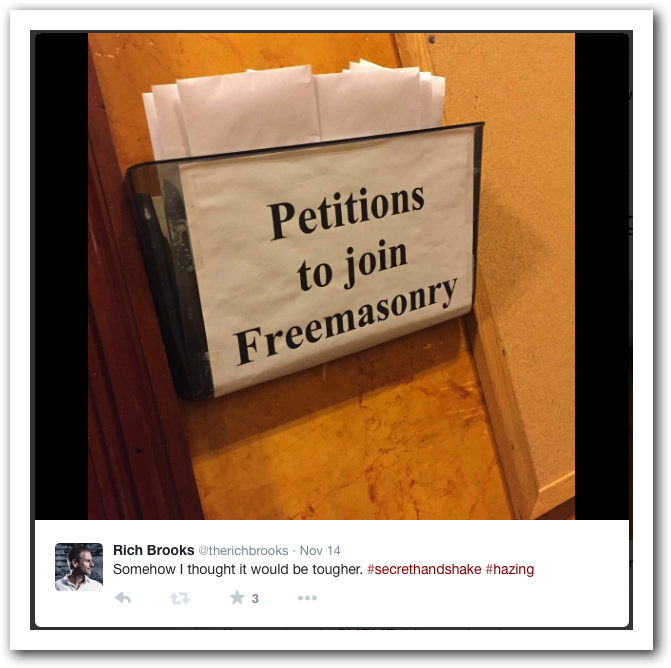
Hashtags got their start in Twitter as a way of making it easier for people to find, follow, and contribute to a conversation. Archeologists have unearthed this early tweet, and believe it to be the first time the hashtag was used for this purpose.
You don’t need any special software, coding experience, or even a college degree to create a hashtag. The only thing you need to do is put the pound sign directly in front of the word or phrase you want to turn into a hashtag and follow these simple rules:
No spaces
No punctuation
No special characters
Another thing to keep in mind: capitalization only matters for readability. #KnowWhatIMean?
Why use hashtags?
There are a number of reasons why you want to use hashtags in social media.
Hashtags help you get found by your target audience. Many people do research by searching on specific hashtags. By using the hashtags that are of interest to your ideal customer, you can increase the chances of being found.
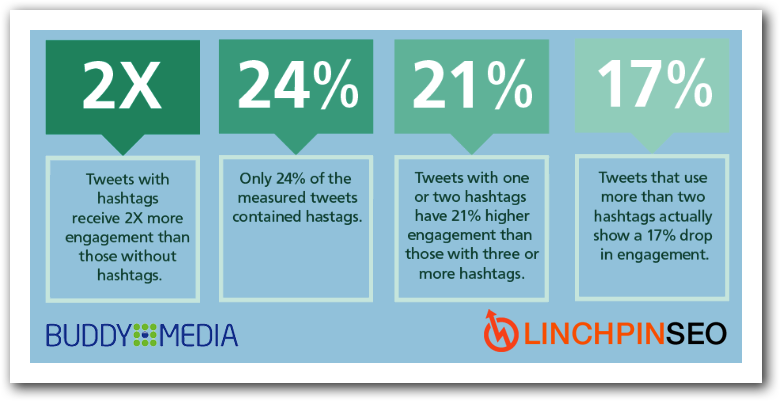
Hashtags improve your clickthrough rates. According to research from Buddy Media, tweets with hashtags receive twice as much engagement as those that don’t. Put another way, you can double your engagement and increase clickthrough rates by including hashtags. Interestingly, there does seem to be an upper limit. Tweets with more than two hashtags saw engagement drop by 17%. Perhaps because too many hashtags look spammy. This research is for Twitter; there doesn’t seem to be the same bias on Instagram.
Hashtags are great for research. If you are doing research, it’s easy to find great, relevant content by search on specific hashtags. I’ve found that tweets with hashtags are generally more focused on a topic than a tweet that just mentions the phrase.
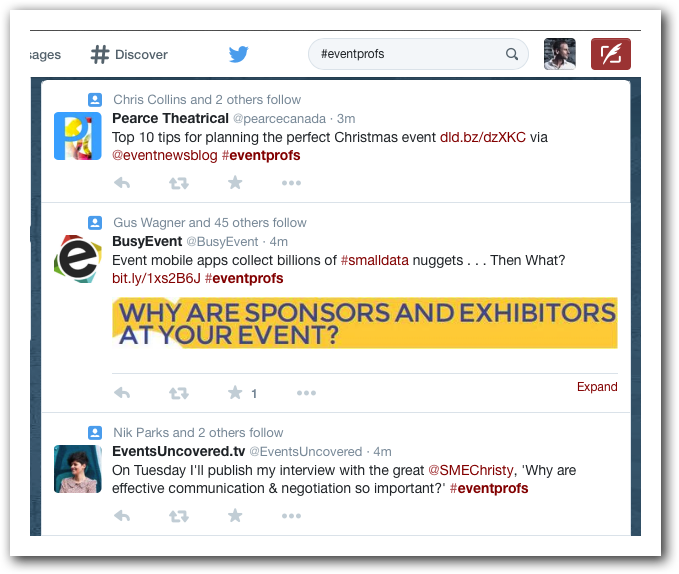
#Eventprofs is a hashtag for event professionals, in case you weren’t sure.
Hashtags become links to search queries. So, while someone might click your hashtag and take them to a search query, at the same time, that search is garnering a lot more views, and will lead more people to see your post.
Hashtags can be used for humor. The hashtag is the social media equivalent of the aside or rimshot. While this may not help you get found in social media, it can certainly show your personality and help engage (or repel) your audience.
How #smallbiz can use hashtags effectively.
Many articles about how to use hashtags effectively reference a campaign from Esurance called #esurancesave30. The insurance company ran an ad after the Superbowl promoting the hashtag. As reported in Search Engine Watch, the hashtag was used 1.4 million times within an hour of airing the ad. Esurance also gained 40,000 followers within minutes and 250,000 followers in the next few days.
So, let me get this straight…Step 1: get a budget big enough to advertise right after the SuperBowl….
OK, so that’s not going to work for you. So, what can a small business do when it comes to marketing with hashtags?
Uncover the hashtags popular in your industry. Kevan Lee, over at the buffersocial blog, suggests using the tool Twitalyzer to find out which hashtags the influencers in your industry are using as a starting point. My experience with this tool is mixed.
According to it, @therichbrooks often uses #am (a hashtag I used once a couple of days ago only because autocorrect didn’t like #SMBME,) and #puffpuffpasstuesday, which a Google search shows I’ve never used.
Or at least that I never inhaled.
Another approach is to use Twitalyzer to find the hashtags your ideal customers are engaging with or using.
Make hashtags part of your regular posts. For Twitter, consider using a tool like Hootsuite to schedule a week’s worth of tweets beforehand, using industry-specific hashtags and links. For Instagram, make sure your photos and your follow up comments, include plenty of relevant hashtags. For more on platform-specific hashtag tactics, see the breakdown below.
Start with some popular, established hashtags. An easy way to get started is using popular hashtags. For example, #throwbackthursday, or more popularly, #tbt, is a weekly theme where people and brands share things from their past. This is one of the few hashtags to gain any traction on Facebook.
Although not as popular any more, #ff, short for Follow Friday, is a good way of giving props to people or companies you feel are worth following.
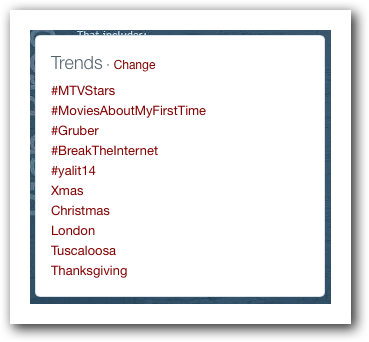
Jump on trending hashtags. You can also take a look at which hashtags are trending on a certain social channel and work those into your own tweets. The image to the right was a snapshot in time on the trending topics on Saturday, 11.15.2014. It appeared on the left hand column of Twitter.com. I could get more visibility by working one of the words or hashtags into my tweets.
However, while hopping on a trending hashtag may put you in front of more people, most won’t care about your message, and your tweet will be quickly swept away in the torrent of tweets using the same hashtag.
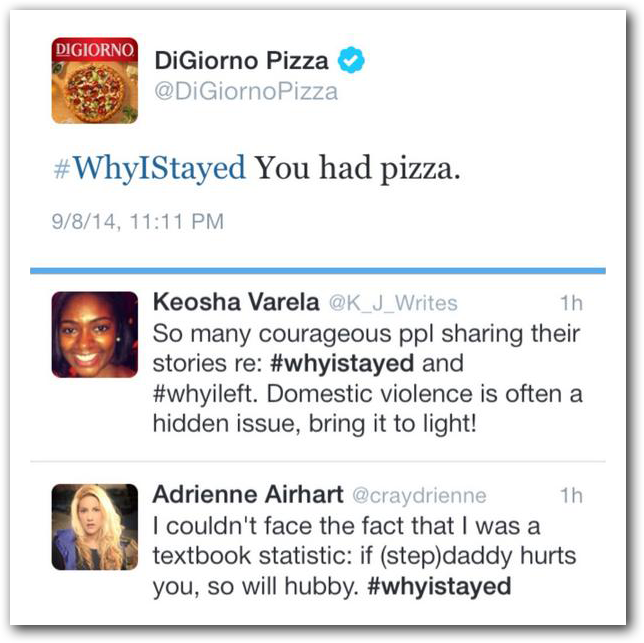
More importantly, if you don’t know what a hashtag is about, your tweet may come off as completely insensitive. More on that later.
The dangers of hashtags.
Hashtags have been known to get some brands into trouble.
Look before you leap. It’s a common tactic to use trending hashtags to gain visibility in social media.
While they did a good job of apologizing profusely, there’s no denying damage was done to their brand. That’s just one of hundreds of examples of brands not looking before they leap when it comes to trending topics.
Going too broad with hashtags. While a broad hashtag may seem like casting a wide net, chances are broad terms will either not be searched on, or your tweet will be lost in the shuffle.
How to use hashtags on Twitter.
While hashtags are expanding in popularity and use throughout social media, I feel that Twitter is their natural habitat. Most of the advice above was written with Twitter in mind, but let’s dig a little deeper.
Twitter chats.
As we saw above, hashtags can be used to focus Twitter conversations around a given topic. Popular twitter chats include #beerchat, #edchat, and #blogchat.
Chats are great ways of connecting with people on subjects you care about, whether it’s cooking or marketing or hang gliding. You can search on hashtags you’re interested in learning about, or on topics where you can establish your expertise.
Events.
Every year we put on The Agents of Change Digital Marketing Conference here in Portland, Maine. One of the ways we build excitement and engage the audience during the conference is through the use of hashtags.
Each year, we update the hashtag: #aoc2012, #aoc2013, #aoc2014 (and so on.) In all of our promotional tweets and other social shares, we include the hashtag. After people purchase tickets, we send them to a page where they can click a button to tweet out they’re attending, and that tweet goes out with the appropriate hashtag.
During the conference, we actively promote the use of the hashtag. In the “pre-roll,” the slides we show before the first speaker and during all the breaks, we actively promote the hashtag. We also had two of our employees “live tweeting” the event on our flyte new media and Agents of Change twitter accounts…each tweet including the most recent hashtag.
We also followed the hashtag that day, and retweeted what other attendees were saying and sharing about the event.
After the event, we were able to capture some of the best moments by searching the conference hashtag.
How to use hashtags on Instagram.
Hashtags are the secret sauce of Instagram marketing. Because there’s no easy method to share someone else’s post, (known as “regramming,” similar to “retweeting” on Twitter,) hashtags become the number one way of reaching a new audience on Instagram.
“In order to attract your ideal follower on Instagram you have to have a hashtag strategy. Start with broad hashtags that represent your service or products then niche down to what keywords your clients would use to find you. For example I teach Instagram to business owners so these are my popular hashtags:
#Online Marketing
#Social Media
#Entrepreneur
#BusinessOwner
“More narrow target would be:
#InstagramMarketing
#InstagramforBusiness
#LearnInstagram
“Then specific to me:
#InstagramGal
#suebtips (see image below)
#suebmademedoit
“Hashtags become Hubs of content and you want to be a part of the Hub, i.e. the conversation.”
People tend to post a lot of hashtags on Instagram. How many is too many?
Sue says, “you can use up to 30 hashtags per post but I don’t recommend this. It looks spammy and desperate when you do. You should put your hashtags in the secondary comments, NOT the initial description, so that you can refresh your hashtags. I keep my hashtags in my notes on my iPhone and in Evernote to make them easy to grab and post.”
By refreshing your hashtags, Sue is talking about replacing your older hashtags with newer ones, thus pushing you back to the top of the Instagram search for specific hashtags, which shows results based on time.
She goes on to say, “when you are a newbie you should post your hashtags soon after you post. When you get more engagement and followers (over 500) you can post your hashtags hours later. I typically post in the morning before 8 am then go in at noon to add 6 hashtags. Days later I will delete the hashtags (follow my YouTube channel to see how) to refresh my post.”
What are ways to get new followers?
Since that’s always the question on everyone’s mind, I asked Sue. She responded, “a great way to gain new followers is to follow the hashtags of events you attend.
“For example #AOC2014 is a community that Rich attracted at his live conference in Maine. By curating content on Instagram with this hashtag a community with a common interest was formed.”
How to use hashtags on Pinterest.
When it comes to using hashtags on Pinterest, the experts recommend brand over bland. In other words, make sure your hashtags are branded for your company, not broad terms like “#marketing.”
“If you use hashtags, use one that is unique to your business. For example, if I use one I’ll use #OhSoPinteresting,” says Cynthia Sanchez of Oh So Pinteresting. When the hashtag is clicked by a user, Pinterest “will search for pins with that word used in the pin description or in the URL that the pin links to. When someone clicks on my hashtag most of the results that appear are pins that link back to my blog.”
Vincent Ng of MCNG Marketing shares that, “when a generic hashtag is clicked on Pinterest, you’re more likely to see some pins with the hashtag in it and some with the similar keywords like social media, or social media marketing. The results shown from # are based on factors like repins and linking activity, not timing of when the hashtag was used.”
“If you are going to use a hashtag, ensure that it’s truly unique. This way when people do click on it, it will be much more likely to show your pins that contain the unique hashtag.”
It’s also important to remember that hashtags are only clickable on the web version of Pinterest; the mobile versions are unclickable.
“You can add as many hashtags as you like, but if you go too ‘unrelated’ you could look a bit spammy, so I tend to add three.
“You can ‘set a frame’ of a post using the image and the title, but also by using hashtags too – vaguely amusing ones can be used to tell people you are in the mood to play!”
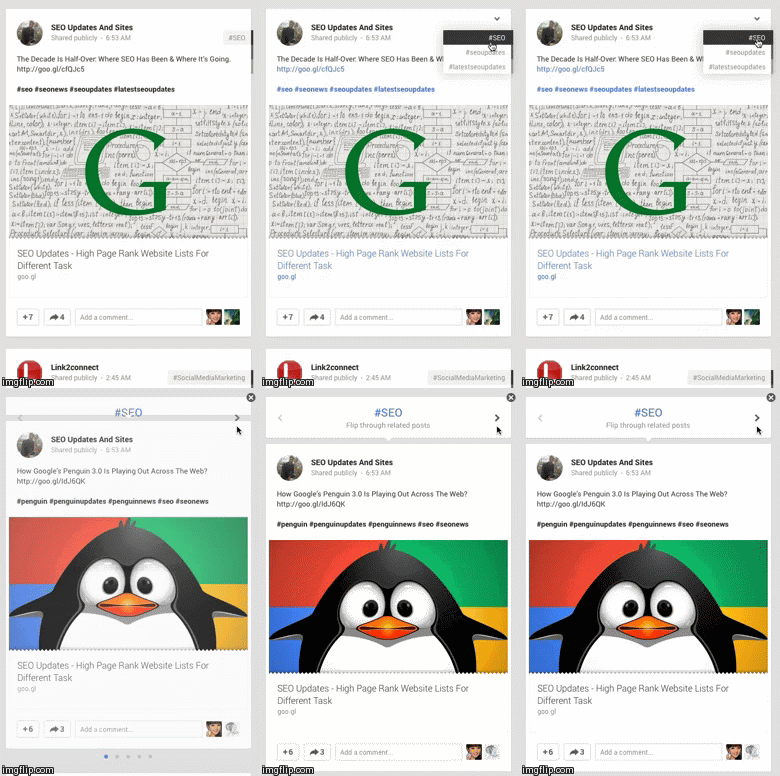
And you don’t always have to come up with the hashtags yourself. “The super cool thing is how Google will naturally add hashtags (up to 3) when you don’t add them yourself.” Don’t like Google’s suggestions? Just click the ‘x’ to remove them.
If you’re looking to do some research around a topic on Google Plus, hashtags can come in handy then, too, says Martin. “Click on the hashtags in the corner of any post and [Google+] will ‘flip the card’ and you will see related content, i.e. posts.” (See the animated gif to the right.)
Consistency can help, too. “Once you’ve been active for a while on Google+, we are finding that when you post consistently Google is associating hashtags to people too.”
How to use hashtags on Facebook.
Don’t.
Don’t believe me? Just look at what the Interwebs have to say about hashtags on Facebook.
And this crosses all language barriers.
Why, do you ask? (Or, perhaps “porque?”)
So, in conclusion…
Jimmy Fallon shows you how to use hashtags.
No complete guide to hashtags would be complete without Jimmy Fallon’s video on hashtags.
Next steps
Hopefully now you feel comfortable with hashtags. If you’d like to dig a little deeper, I might recommend:
But what you really need to do, is #justdoit! Don’t wait to read a dozen more articles or research too deeply. You can continue to do that as you learn by doing.
Instead, start adding what you feel are appropriate hashtags to your tweets and other social shares, and take a look at the hashtags the influencers in your industry are already using.
If you’ve got any additional tips, advice, or stories about hashtags, please share them in the comments below.
A friend of mine whose mother died recently was going through her parents’ memorabilia and unearthed a Western Union telegram from 1954 that her father sent her mother just before they married. Here’s what it said:
Darling, I shall be waiting for you at eight. With a lifetime of expectancy. My heart will be coming with you down the aisle. May God be with us tonight as we pray we will always be with Him. Thank you for becoming my wife. My love forever yours, Henry
Several days after I’d read this note, I came across this miserable tripe on Facebook: “Chivalry is harmful to both men and women,” relays the woman in the video. “because it reinforces this idea that women need to be helped or saved by a stronger man. And it takes away a woman’s agency.”
The video is part of an "Unpopular Opinion" series on Facebook, a concept that in theory I’d support. But there’s nothing unpopular about a video that sells the same tired message feminists have sold for years and subsequently became the status quo: that men and women are “equal” and should therefore be treated the same.
Women can open their own doors, pull out their own chairs and take care of themselves, women have argued for years. “I’m strong enough to do all these things,” notes the woman in the video, who identifies herself as Emily Panic, as she flexes her arm muscles to viewers.
Men only changed because women did. That’s because men are born to please women. Modern woman don’t know this, for they’ve been conditioned to think of men as oppressors. But it’s true.
“And what’s the deal with guys giving up their seats on the subway?” she adds. “If you do give me your seat, and I take it, I don’t have to talk to you. Please don’t talk to me, okay? I got like 20 podcasts loaded on my iPod that I would rather listen to than you. That’s not meant to be mean. I just don’t want to talk to you.”
The stark contrast of the Western Union telegram and this video depicting modern gender relations speaks volumes.
If there’s one common theme in the media today about the relationship between women and men, it’s the claim that there are no good (read: marriageable) men left. Well, gee, I wonder why that is?
It’s clear as day why that is. The relentless message from women and society that men have nothing special to offer—that not only is their income unnecessary, so is their chivalrous behavior—has built a wall between the sexes the size of Mount Everest.
Funny thing, though, the equality meme hasn’t translated to women paying for their own dinner or asking men to marry them. Why is that? Could it be that deep down, women know something’s lost when men and women are viewed as the same? Could it be there was something special about men being men and women being women?
In the days when men were chivalrous, women held a different kind of power than they do today. Feminine power is far more potent than the power a woman gleans in the marketplace. But women don’t access it. And they reject masculinity as well. Today’s universities are in fact offering programs specifically designed to quash male nature.
And still women wonder why there are no more Henrys. Mature, respectful, marriage-minded men like him have vanished. Can we blame them?
Fortunately, as I wrote back in 2012, women have the power to turn it all around—because they are the relationship navigators. Men only changed because women did. That’s because men are born to please women. Modern woman don’t know this, for they’ve been conditioned to think of men as oppressors. But it’s true.
Any woman who wants what Henry and his wife had—and who wouldn’t?—can have it. It will take time because women have made a real mess of things. Nevertheless, they can begin by rejecting the narrative in this video. Instead, embrace chivalry. Praise chivalry. Praise men, for God’s sake!