Tuesday, May 13, 2008

Manilow the lobbyist

Source: http://scootertalk.blogspot.com/2006/08/audio-home-recording-act-of-1991.html

THE AUDIO HOME RECORDING ACT OF 1991
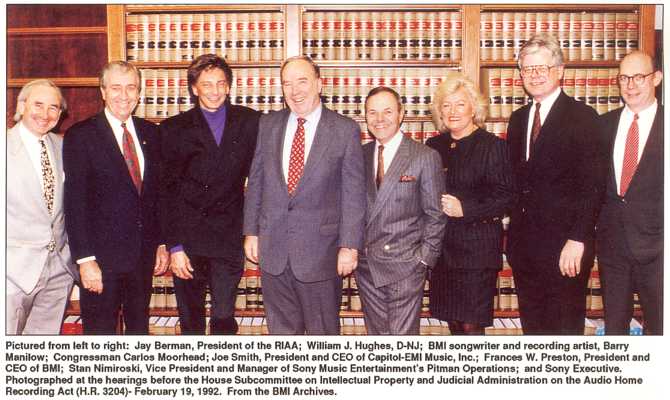
ON H.R. 3204
THE AUDIO HOME RECORDING ACT OF 1991

Before the Subcommittee on
Intellectual Property and Judicial Administration
House Committee on the Judiciary

February 19, 1992

Mr. Chairman, members of the subcommittee, my name is Barry Manilow. I want to thank you for the opportunity to be here today to testify in support of H.R. 3204, the Audio Home Recording Act of 1991. I come before the subcommittee today as a BMI songwriter, but I am also a musician, recording artist, music publisher, and consumer. I am also here today to represent thousands of others in the music industry.

In the time I've been allotted, I would like to stress three reasons why this legislation is of paramount importance to the music community and to consumers. First, this bill provides compensation to the creators, producers and performers of music for the home copying of our works.

Second, it will provide consumers with access to the most innovative and exciting new digital audio technologies that the market has to offer; in addition, the bill protects consumers from copyright infringement lawsuits for home copying of music for their personal use.

Finally, it will continue the great tradition of America's copyright law in fostering the creative spirit by preserving incentives for songwriters, musicians, performers and record companies to produce music. By ensuring a fair return on our investment of time and talent, Congress will guarantee that America's music community will continue to be the world leader in the production of recorded music.

Let me return to my first point as to why compensation to creators and producers of music is so important, by giving you a little insight into this crazy business of music. Like any other profession, it takes a great deal of work to achieve any degree of success. Not to mention a whole lot of luck. I've been very fortunate in my career. I'm proud of my achievements and my music. But I'm not here on behalf of myself. I've made it. My career started over twenty years ago, at a time when technology only presented new horizons, not fears. I'd like to speak to you on behalf of the thousands and thousands of American songwriters, musicians and performers who are struggling right now and who may or may not make it; and even more importantly, for the next generation of talent who will start with the same basic gifts I did and who must have the same opportunities.

As you probably know, success in the music business is a rarity. For every songwriter or performer that you can identify - there are hundreds of names that you'll never hear; hundreds of people who will never achieve any degree of financial success as a songwriter or performer. In addition, there are many other people who contribute to an artist's efforts who will never gain the attention of the public - other songwriters, publishers, recording engineers, mastering engineers, producers, background vocalists and musicians, A & R executives, promoters, marketers, distributors, and, of course, the record retainer - these are just some of the people who help bring music to the public. It is for these faceless and nameless individuals that I appear before you today to support this important legislation.

As songwriters, performers, and musicians we earn our money pennies at a time. We want our fans to enjoy our music, yes, but we also want to be paid for our work. When you're struggling to make ends meet, every little bit helps. For every record we well, we earn some money - a few cents. These pennies add up to be our salary. Only a few of the biggest superstars get paid up front. Most of us only get paid when the record sells. If we are lucky enough to get a hit, it's great news - that people like our songs.

The bad news is that it's the "hits" that get taped. Don't get me wrong. I'd rather have a hit, but when someone makes a copy of our work instead of buying it, this takes money out of our pockets and bread off our tables. Home copying threatens our very livelihood.

Never before has this threat been greater than today, as we enter an age of digital technology. The irony is that, as a producer and an artist, no one appreciates the advance of new technologies more than I. It has been really exciting to work with digital recording in the studio.

However, the advent of new digital audio recording devices for consumer use, such as DAT, Digital Compact Cassette (DCC), recordable CD, and Mini-Disc (MD), has a different meaning for me. DAT, for instance, permits consumers to make perfect copies for many generations. With digital technology, the 100th copy is as perfect as the first. If perfect copies can be made for only the cost of a blank tape, why purchase an original? Why pay for a prerecorded cassette or compact disc when you could get a digital copy from a friend that is as perfect as the original?

It is not a pleasant exercise, Mr. Chairman, to read about blank tape sales. That is why I am so pleased to be here today on behalf of this legislation. In my view, it brings only positive benefits to us all. This legislation will effectively remove the fears associated with digital recording technologies and permit songwriters, musicians and performers to join hands with consumers in embracing these new products. In addition to royalties, this bill provides for a limitation on the ability to make digital copies of digital copies through a requirement that all nonprofessional models of such equipment incorporate the "Serial Copy Management System" ("SCMS").

This leads to my second point, that consumers will gain access to exciting new technologies, free from the legal entanglement of the past. I want to address this point, first as an artist, then on the part of the consumer.

First, musicians want the best possible equipment available to deliver our music. The higher the quality of the equipment, the better our music sounds. No one in the music community has enjoyed being labeled as "anti-technology" just because we were concerned about the need to protect our rights - our copyrights. We've always wanted our fans to hear what we create in a setting as close to studio perfect as possible.

In the past, the consumer has been denied access to developing new technologies because of the legal climate surrounding introduction of DAT and other products. This bill changes the landscape, permitting manufacturers of new digital audio recorders to bring their products to the market without fear of lawsuits or the problems of the past. And, as it should be, the market will dictate the success or failure of these technologies. As an avid music fan, I am excited about all the possibilities that await us. The only dilemma will be for the consumer to decide among all the available technologies. But isn't that the way it should be?

Finally turning to my third point, this legislation will preserve the incentives for American songwriters, musicians, performers and record companies to continue to create music, thus maintaining our pre-eminence in the world market. When American music is played abroad we're not just exporting U.S. product, we're exporting American culture and ideals.

In these tough economic times, American music continues to dominate world trade. This means songwriters, musicians, and performers can continue to work at this business we all love. This legislation fuels investment in a diversity of music - music designed to meet all the tastes and interests of our pluralistic society, such as jazz, classical, gospel, folk, country, rap, and yes, even good old fashioned rock and roll.

By protecting our livelihoods, H.R. 3204 will provide the financial nourishment necessary to produce the quality and diversity of music we've all become accustomed to enjoying. Without this bill, our music industry could be on a downhill spiral that would result in a uniformity of music and career changes for songwriters, musicians, and performers.

Imagine this - without the protection this legislation offers, the music community would surely lose more revenue from home copying at an ever increasing rate. This translates into fewer dollars available to invest in new talent. We could lose a whole generation of young songwriters, musicians and performers solely from lack of adequate protection for our copyrights. Record companies would be less willing, and much less able, to take chances on new talent. Songwriters would be forced to write only those songs that they think would sell. Less popular genres of music, such as jazz, folk or classical, would fall by the wayside. And we'd all be bored and uninspired!

In conclusion, Mr. Chairman, and members of this committee, you have taken the opportunity and provided the leadership necessary to prevent this dismal future by introducing H.R. 3204. Please now take the final step by enacting this measure as soon as possible so that American music, in all its richness and diversity, will be around for generations to come.

Thank you.

~~~~~~~

Note: On October 28, 1992, President Bush signed the Audio Home Recording Act into law. The Act, an historic compromise between the consumer electronics and music industries, became effective immediately.


Originally posted 8/06/2006 10:14:00 AM

Dear Abby 1981 Column From Manilow Fan

Source: http://scootertalk.blogspot.com/2006/08/dear-abby-indianapolis-news-december.html


DEAR ABBY

Indianapolis News
December 15, 1981

Dear Abby

By Abigail Van Buren

Dear Abby:

I recently attended a Barry Manilow concert, and I haven't been able to get him out of my mind since. Abby, I am perfectly in tune with all the feelings Barry expresses! All my life I've had the feeling that God put me on earth to love and fulfill the needs of someone like Barry Manilow, someone who has everything in the world but happens to be very lonely. Please don't get me wrong. It's not the money, fame or glamor I'm looking for. I just want to devote my life to someone who wants more than anything in the world to be loved for himself, but has never found that person.

If Barry is involved already, I would like the chance to make Burt Reynolds happy. In spite of his macho confident manner, I sense that Burt is also a very lonely person who needs love.

I am not a fat, ugly old woman who has never had a date. I am 22, attractive and have no trouble getting dates. I just need help to do what the Lord wants me to do.

Can you help me meet Barry Manilow or Burt Reynolds?

Signed: Needs An Introduction....

~~~~~~~~~~

Dear Needs:

Superstars such as Barry Manilow and Burt Reynolds work very hard, and their schedules are so demanding they have very little time to become lonely. However, if the good Lord wants you to meet either one of these gentlemen, trust him to provide the introduction.


Originally posted 8/11/2006 09:09:00 AM

Playboy December 1965 Advice Letter From Barry Manilow

Source: http://scootertalk.blogspot.com/2006/08/playboydecember-1965vol.html

PLAYBOY
December - 1965
Vol. 12, No. 12

Letter:

Music has always been a vital part of my life. Due to financial difficulties, however, I had to stop attending music school and accept a job at a leading radio-and-television network. Through enormous good fortune, I have been promoted very rapidly and at the age of 22 I hold a junior executive position with a very generous salary. The only drawback is that this position has absolutely nothing to do with music.

During these past few years, between working and attending college, I have managed to musically direct and conduct three full-scale musicals at various theater workshops in New York. I now have an offer to take this last musical out of town for a period of six to eight months at a good salary with the promise of a permanent position as a musical director.

My musical wild oats are screaming to be sown, but it means giving up my secure job. Leaves of absence are rare, so it looks like it's either one or the other. Any suggestions?

--B. M., Brooklyn, New York.

~~~~~~~~~~~~~

Answer:

Follow your real interest and take the musical out of town. At your age, your financial responsibilities are few. If you remain in the secure job, you may regret for the rest of your life that you didn't sow your notes. You can always go back to radio and television; your ability was recognized once; chances are it would be recognized again--if not with your former employer, then elsewhere.


Originally posted 8/09/2006 12:04:00 PM

Saturday, May 10, 2008

Barry Manilow's Revealing 1979 Scar Photo

Source: http://scootertalk.blogspot.com/2006/07/one-voicep.html

ONE VOICE
P.R. PHOTO


Photographer: Victor Skrebneski
1979
This shot was used in ads for the One Voice album, and sometimes had the negative flipped, I suppose to better fit the ad format. The one above is shown as it should be. I always liked it better than the Skrebneski photo used on the album cover. Sometimes black and white shots are really nice.


Originally posted 7/04/2006 03:10:00 PM

Roger Wall, Former Assistant To Barry Manilow

Source: http://scootertalk.blogspot.com/2006/07/manilows-man-friday-us-magazine-may-7.html

MANILOW'S MAN FRIDAY
US Magazine - May 7, 1984

Roger Wall bubbles over with enthusiasm. A native of North Carolina, Wall was on his way to becoming a civil engineer when he detoured and became road manager for music biggies Tom Jones, Rita Coolidge, Tanya Tucker and his present employer, Barry Manilow. "I was road-managing for Barry's tour of Mandy," he says. It became a huge success overnight. I wasn't prepared and I quit."

Three years ago, Manilow called him and over lunch they became boss and assistant. Getting the job is luck, says the 35-year-old bachelor. Staying there takes personality, not secretarial skills. "You need the ability to get along with people and make everyone feel comfortable. There's a lot of work to do." And Manilow is a perfectionist, his assistant reports. "Barry wants things done right."

Wall lives in West Los Angeles and maintains an office in chic Beverly Hills, but he can often be found working out of Manilow's Bel Air home. Fringe benefits include going to the best restaurants in the world and flying first class. "For my last birthday, Barry gave me a beautiful watch and took me on a safari to South Africa. You can get spoiled very quickly," he notes.

"Roger Wall," says Manilow, "is my best friend and the best assistant I ever had. He also has enough dirt on me to send me up the river!" he adds teasingly.

----

NOTE: Roger left Barry's employ in 1984 not long after this article ran, and went to work for Elizabeth Taylor. Marc Hulett replaced him. In 1991 Roger passed away. He was honored with a plaque on the West Hollywood Memorial Walk benefiting Aid for AIDS. His plaque is located at 8619 Santa Monica Blvd.

On the In A New Light AIDS TV special in 1992, Barry said losing Roger was like losing a brother. May he rest in peace.


Originally posted 7/16/2006 09:00:00 AM

1980 Ladies Home Journal Interview With Barry Manilow

Source: http://scootertalk.blogspot.com/2006/07/ladies-home-journal-this-article-by.html


LADIES HOME JOURNAL

By Stephen E. Rubin April 1979

---
BARRY

There's a golden-haired string bean from Brooklyn who might, in the vernacular of his hometown, affectionately be called a shnook. He's not handsome (some would say ugly), he's not sexy (some would say androgynous-looking) and his singing voice is not mellifluous (some would say it's not a voice at all, but a croak). No matter. When Barry Manilow comes bounding out onstage in outrageous costumes reminiscent of Liberace's, Brooklyn can cheer because its boy, 32, boldly leaps the yawning chasm between sad sack and superstar.

Even more surprising is that he started behind the scenes and only became a performer by a fluke. Barry is a musical jack-of-all-trades - arranger, conductor, writer, singer, pianist, producer. Everybody thinks he wrote the famous McDonald's jingle ("You deserve a break today") - he didn't, he only sings it. But he did write the Bowlene Toilet Cleaner, State Farm Insurance, Chevrolet and Band-Aid commercials, and arranged materials, masterminded the stage act and co-produced the albums of a certain "Divine Miss M." No one will ever know for sure how much of it was Bette Midler, but together their chemistry produced flamboyant, extraordinary music, and it was surely from Bette that Barry learned what torrential energy and shameless gall really mean.

In 1973, for lack of anything better to do, he claims, Barry invested $5,000 of his own money into making a demo record. It earned him a recording contract and, two years later, Mandy was released, his first hit single. There followed a succession of runaway singles - I Write the Songs, Looks Like We Made It and Copacabana, to say nothing of seven solid platinum albums and a television contract with ABC.

The eye of this hurricane rejoices that he is commercially one of the most superior of superstars in pop and - more important to Barry - that what he considers his unique personal message is coming across loud and clear. Barry knows of his reception because of the unusual mail he receives.

"You cannot believe the letters," he avows, his voice going squeaky. "I cry over most of them, honestly. One girl wrote me about her mother dying of leukemia and that the only time she reacted was when my voice came on the radio.

"I don't know how this is happening, because why would anybody think I'm a nice guy just by listening to my albums?" Barry asks, further pondering the depths of his acceptance by an audience that knows no age, sex or socio-economic limitations. "When I listen to Frank Sinatra, I don't know what kind of person he is. I think Sinatra's a good interpreter and singer, but I wouldn't write to him and say you changed my life, you helped me get through the day, you saved me from suicide."

Barry's remarkable success and his own breathless astonishment and endearing manner of deriding himself rescue this particular Brooklyn fairy tale from becoming maudlin. And Barry knows it. Ask him whether he emits sexuality on stage, and he grins, "Not on purpose I don't." He also scoffs at his considerable flair for playing pop-singing superstar. "I'm in this ridiculous stratosphere," he mock boasts with the ingenious bravado of a smart street kid. "I'm playing with Monopoly money." And winning - scnookdom be damned.

In line with the well-heeled potentates of pop who make mini-fortunes every time they show their faces in public, Barry has established himself as a two-coast person. He owns a co-op in New York with a terrace that takes in a panorama of the city worth the expensive price tag of a famed, old guard apartment building, and he recently purchased the de rigueur Bel Air house ("for tax reasons") with "this ridiculous view of mountains and canyons."

Barry talks like he comes from Brooklyn, and never lets you forget it as he's seated near the Mickey Mouse phone at the corner of a bright, multicolored couch of spectacular proportions in the otherwise coolly decorated music room of his New York digs. Neatly hanging behind him is a dazzling display of gold and platinum records - Barry's hits (including a quadruple platinum for Barry Manilow Live, which sold over four million copies). The music room appears to double as a den and, aside from a handsomely equipped kitchen with informal high stools, is the only room that gives a feeling of being lived in.

The formal living room is stark and modern, antiseptic and uninviting - a wonderful wall fish tank is devoid of inhabitants. There are no books on the bookshelves in an office of sorts - they're on the West Coast. The game room has a pinball machine, but not much else. The bedroom is off limits to the press.

Before we begin talking, Barry, his cuddly, redheaded girlfriend Linda Allen, his assistant, his press agent and I sit around the kitchen waiting for the coffee to perk. Barry and Linda are in coordinated getups: dark jeans and maroon sweaters. Barry's is a particularly dashing ensemble and, as he facetiously points out to Linda, "very Ivy League" because of a tie neatly peaking out from under the crew neck top. Linda and Barry are chatty and friendly, as are the personal if not physical surroundings. There's a lot to be happy about in the Manilow abode these days, including his third ABC-TV special next month (the first two were both smash hits).

But for all his cheering levity, Barry is troubled enough once we're alone to keep a mini-cassette tape recorder running throughout our long conversation. And he is not joking when he voices concern that certain people are reading him wrong, that his image is awry.

"It's important to me," he says soberly, if somewhat melodramatically, "that you reinforce the thinking that I am, in fact, a living, breathing, feeling, sensitive, gentle man. Because of this incredible amount of success, a lot of people have begun thinking and writing that Barry Manilow's ego is out of hand. I read these stories and think, 'Oh, my God! People really believe I am going crazy, taking this success to heart.' Yeah, I'm successful; yeah, I enjoy the success. I enjoy all of it. But the thing I work on most is keeping my feet on the ground in his hurricane. It's very difficult. The wind can knock you over."

Barry often talks the way song lyrics sound. His innate show biz jargon and panache rise naturally to the fore, even when he is attempting to reach out and, on a personal level, touch and encompass his followers in exactly the same fashion his hit songs do - directly. He wants them desperately to believe that if ever there was an honest man, he is it. That what they see on stage is nothing more than a magnified, souped-up version of "The Real Barry."

But "The Real Barry" is far more complex than his charming, offhand, unpretentious manner suggests. So, while he's out to prove himself as being on the level, he's also anxious because he thinks his fans might be sorely disenchanted with the genuine article.

"Most fans of mine," Barry almost whines, "would be very disappointed if they realized I don't walk around in my rhinestone top all the time and do not sing all day long. That I sit around in blue jeans and watch television and don't shave sometimes and don't have witty things to say. From the letters I receive, you'd think I was really hot stuff. Well, I'm not hot stuff. I'm just a regular person.

"Sometimes I don't even want to meet fans because I'm afraid I'll disappoint them. Certainly a lot of people I used to idolize weren't all I thought they were when I met them. Heaven knows I never met Laura Nyro (the white-soul diva of the Sixties, author of Wedding Bell Blues and Stoned Soul Picnic, which were recorded by The Fifth Dimension). Her music changed my life. I fantasized about her for so long. Then I kept hearing reports about what it was like to work with her, to be with her, what she was really like. And it wasn't anything like I wanted her to be. After I heard all that, I didn't want to meet her."

Barry confesses, with a tinge of resignation, that bubbles started bursting early for him. "Most people I've admired have turned out to have faults," he says quietly. "Starting with my mom. I worship Mom, I do. I still love her, she's the greatest, but when I was growing up I always thought she was a sophisticated, martini-drinking woman of the world.

"But as I grew older, and I think we all go through this, we begin to see our parents and our idols as just human beings. I got angry when I first realized Mom was just another human being. I had thought she was superhuman."

Perhaps Barry's excessive adoration of his mother stemmed from his father's desertion when he was a tot of two. His mother supported herself and her son as well as her parents in the slum Williamsburg section of Brooklyn. "Ask a cab driver to take you there now, and he'll run away." Barry boasts. The picture Barry paints of himself as a youngster helps considerably to illuminate the household name today.

"I was really ugly, the ugliest kid in school. I have pictures that would make your hair curl. I was a street kid, but not a street punk, not a Billy Joel. I lived in the streets, my hangouts were alleys and deserted parking lots that were filled with inner tubes. Any games I played were in the gutters. I didn't have a lot of friends; I had two really good ones (one of whom he married - they split up a year later when Barry was 22) and many acquaintances that got me through my life. That's why friendships now are as important to me as they are. I wasn't very good at sports. I wasn't Mr. Popularity at school, but I had these fabulous friends. I developed a sense of humor about myself and about life through them.

"You become smart on the streets of New York - common sense smart. You learn how to survive. My being smart also comes from my family, which had an incredible amount of common sense, especially my grandparents. They drilled logic into my head. So I'm not a street kid looking over his shoulder waiting for the next mugger to attack. I'm a different kind of street kid - with a down-to-earthness, a focus on reality. It's the thing that will stop me from thinking I really am a 'Hot Stuff Superstar.'"

Barry also snubs the accepted extra-curricular aspects of life among the pop culture elite - show biz friends (his only entertainer chums are singers Bette Midler and Melissa Manchester), show biz parties and show biz drugs. He whoops with laughter as he recalls his first interview, five years ago, with a leading rock magazine. "The interviewer came back to my dressing room. She had masses of frizzy hair, was very skinny and wore black lipstick. Her first question was:

"'What's your favorite dope [drug]?'

"'You dear,' I said, 'get out!'

"I tried smoking joints [marijuana]. I liked it for a month, but then I started to get nauseous. And I could not stop getting sick. So for about a month, three or four years ago, I had a very nice time getting pleasantly you know . . . . Frankly, I didn't enjoy it. I would fall asleep or sit like a puppet listening to records and maybe I'd hear a horn line a little clearer, but it wasn't any revelation. The few encounters I had with the drug were no more or less pleasant than having a couple of drinks, which I don't like either. It does the same thing to me, affects me physically and I get nauseous. I cannot be out of control. So I have a social drink, but mostly it's mineral water with a lime twist."

Barry, unsurprisingly, finds more traditional means of relaxation most satisfying. "A good book, a good rhythm and blues record, conversations with friends having nothing whatsoever to do with the music industry, a movie. When I'm on the road (he finished one of his grueling cross-country tours at the close of last year), I go out with my two best friends from my group and we just do anything - like go shopping. I relax by doing the ordinary things that most people do all the time," he laughs, "but that I don't often get a chance to do."

If Barry's lifestyle appears a little too prim to be believed, it's best to understand that, given his high-voltage performances, both his body and his mind shriek for the kind of unstructured, rather staid existence he seeks. "There's a whole energy trip when I'm onstage," Barry explains, "and I'm spent at the end of it. It's certainly a great release. My only entree into analysis years ago had me punching a pillow and beating up the bed, and God, it got all my frustrations out in ten seconds. Now I take out the frustrations of the day in the songs. Sometimes I'm not even thinking of the lyric, but of a passionate emotion - joy, frustration, anger, loneliness - and it comes right out in the middle of these songs. The audience is affected by it, and I feel much better after I'm done. I find I can deal with people a lot better because of it."

Barry is fast to point out that during a tour ("tours drive you nuts") he is less successful in dealing with people. "I'm volatile," he admits. "I blow up all the time." Even with Linda? "No, never. But now and again I'll blow up with my assistant when he thinks he's representing me and he'll yell at a waiter - 'Mr. Manilow needs a rare hamburger. How dare you?' I say, 'Paul, please don't talk to people like that, what's the matter with you?'

"My manager puts up with a lot from me. I'm crazy when it comes to doing a job right. I like to be involved in every area of my life and that's hard, so when I feel I'm being left out of a decision, I start screaming."

Recently a TV crew came to tape three numbers during Barry's live show in Philadelphia. When the agreed-upon songs were performed, Barry still saw the cameras with their red lights focused on him from all directions. He became incoherently furious and relives the episode with comparable passion. "My energy and adrenaline levels are up so high during a performance, I could probably lift a car. There were 20,000 people out there screaming their heads off. I was having a great time, but I kept seeing those cameras and their lights.

"At one point, while I was introducing a band member who was doing a solo, I ran into the wings where one of these guys was and grabbed him by the shoulders and threw him further into the wings and yelled, 'STOP IT!' The guy sorta bounced around.

"Then, when I went back onstage, I saw him crawling around to the other side. So I introduced another band member, ran offstage, shoved him again and said to my stage manager, 'Get this man the [expletive deleted] off my stage! I don't know what he's doing here.' What was coming out of my mouth was energy, not fury, but then they had said they were only going to tape three songs. I blew up like crazy and when the show was finished, I was still the same way. Because when I come offstage, if something is funny it's incredibly funny, if something is sad I'm dissolved into tears, if something is upsetting it's double, triple the upset.

"The director came out and gave me a perfectly logical explanation why those cameramen were onstage, but I was not listening. I went CRAZY. Slammed the door in his face. I know he must have thought I was a total maniac and hated my guts. The next day the TV show called and apologized and I said, no don't apologize. I had no right to scream like that. That cameraman was a big person; he could have banged me on the head and killed me. But I was on this energy trip and actually threw him into the wings. I'm not a fighter, it's just this insane energy that takes over."

Barry is a creature of all those B-movies we love - the entertainer whose performances, whose songs, whose vigorous hawking fuel his very being. He is a sweet-natured fellow offstage, but compared to the theatrical dynamo, the real Barry pales. And, as opposed to lesser luminaries who are sometimes more interesting away from the glare of the limelight, Barry is at his most alluring when dispensing his wares in his shiny, bauble-laden fantasy costumes.

When the two worlds collide, there is an impact that is more pathetic than fateful. "I must say," Barry reports, "I get very uptight when I go to places with lots of people. Even if they don't stop and talk, a lot of people stare . . . it gets to you. I'll be going down an escalator in a department store and I'll be looking at faces watching me go down. There's just so much you can block out. I'll be with Linda just talking, pretending it's not happening, but when they're all looking up and down at you . . ."

This subtle form of star-gazing is almost welcome compared to the full-scale drama that forced Barry to move out of his former, far less resplendent New York apartment. "Who's Who printed my home address," Barry snarls uncharacteristically. "Without my permission, I might add. We've got a lawsuit out against them. First the letters started coming, I had no idea how. Then they started piling up in front of the door. Until then I had had a wonderfully private life there: My records were No. 1, yet I was able to lead a normal existence. Then suddenly this Who's Who thing came out and fans started to camp outside the door. It was hellish, just hellish, so I had to move. I live in this building under a pseudonym. Today the doormen were told you'd be asking for me, but if you come here tomorrow and ask for Barry Manilow, they will shoot you in the nose."

Barry doesn't want to be misunderstood. He wants to be the nice guy his followers think he is, he wants their letters, their devotion, their gratitude. But from a distance.

"The private Barry is a quiet type," he insists, "private and quiet and grateful. I think I'm sorta in awe of what's happened to me - still. I don't know what synagogue to donate money to first. I am a very fortunate man. If it all stopped tomorrow, I have had a wonderful ride, a great time. I'd be disappointed and I'd probably be very unhappy, but I wouldn't die."

Barry dismisses outright the innuendos in the press and among the tongue-wagging Cassandras of popdom that behind all the flamboyant success, there is, in the flesh, one small, lonesome man. He smiles his smart, Brooklyn, street-kid grin: "If this is 'lonesome at the top,' I'll take it."


Originally posted 7/13/2006 12:32:00 PM

Thursday, May 08, 2008

Playgirl 1983 Interview With Barry Manilow

Source: http://scootertalk.blogspot.com/2007/02/playgirl-march-1993-cover-blurb-barry.html

PLAYGIRL
March 1983

Photobucket - Video and Image Hosting


Cover Blurb: BARRY MANILOW: POURS HIS HEART OUT

Barry Manilow: King Of Schmaltz,
With A Touch Of Class !

By Henry Schipper

It's an hour before show time at the Omni, Atlanta's classy new 14,000-seat entertainment arena, and Barry Manilow is in his dressing room, psyching himself up for another night on stage. A rail-thin fellow with a nose-heavy Brooklyn face that few would recognize in a crowd, he needs to spend this hour alone in his dressing room before the show, charging himself full of the energy and charisma needed to pull off the pop-star role.

"I have to make myself bigger," he had told me in his hotel room a few hours earlier, trying to explain the technique that facilitates the nightly metamorphosis. "I pump myself up like I'm pumpin' air into a tire. I couldn't go out there otherwise. I don't think anyone would notice me."

Manilow is, of course, noticed immediately by the sellout crowd of suddenly shrieking, bouquet-tossing fans as he strides across the runway and onto the circular, revolving stage. This is their Barry, no doubt about it, the one they know and love and came to see, the golden boy of Beautiful Music, whose songs like Mandy, Could It Be Magic and Tryin' To Get The Feeling Again have filled the airwaves since the early seventies.

In person, Manilow seems the living image of his misty album covers and pinup posters and the soaring, tidal wave sound. His voice billows to the far reaches of the Omni, and beyond. His long arms open to include the most distant fans. His smile is beatific, an intimate, majestic welcome. Barry, his music and his fans are one.

And then something strange begins to happen. After the opening number, and between every song, Manilow talks to the crowd, not quiet pastel talk that sets the ballad mood, but loud, palsy-walsy hamming that almost immediately breaks the spell. He clowns, wiggling an index finger high above the piano keys with a look of goofy staginess. He kvetches -- "So whaddaya want me to sing, already?" He cheerleads -- "I can see we got a HOT one tonight," skipping around, clapping, finishing every second song with a punch in the air and a look of toy challenge. He slips in a few mild but jarringly incongruous off-color cracks -- "I got a special surprise for you tonight; ya want me to whip it out?" He slaps himself upside the head -- "Gee, did I really say that?"

One can feel the letdown, the confusion, the loss of electricity in the crowd, but Manilow persists with this yucksterish spiel until it becomes apparent that this, and not the splendiferous superstar role, is what his hour of pumping was all about, that Manilow was pumping himself up into this kibbitzing Brooklynesque character, a larger-than-life version of his actual self with which to communicate with a coliseum full of people.

"Don't get me wrong, it's definitely me out there," Manilow would later tell me, concerned that I had misunderstood his earlier comment about preparing himself for the concert role. "I don't turn myself into this totally different person when I go on stage. I just make myself bigger, broader. That's just a larger version of me you see."

I met with the smaller, life-size version of Barry Manilow in his Los Angeles office a week after the Atlanta show. True to his word, he is much more like his gabby concert self than his exalted, love-entranced image. His energy is staticky, New Yorkish. He flops down in a cushy chair, throws one leg across the other, spreads his arms as he speaks, rearranges himself constantly. Manilow listens closely, with quick interest and no trace of guardedness or reserve.

He is wearing a billowy pastel-pink shirt and neatly creased jeans that accentuate his extremely long, extremely thin legs. He looks interesting -- not so pretty as his album covers but much more real. A chronic anxiety hovers about his looming blue eyes. The face is funny, thin, with orange-tinged hair carefully arrayed across his forehead and a dominant, low-hanging nose -- an ill-proportioned face that shifts at times into strikingly handsome place and reminds one, of all people, of Yve Montand.

The walls of Manilow's office are decorated with innumerable magazine covers celebrating his enormous success. Manilow has had no fewer than 27 consecutive top-40 hits since Mandy, his first release in 1974. All 10 of his albums have gone platinum, selling over a million copies. Most of them have sold 2, 3 and even 4 times that number.

In England, as well as in America, he has been a fabulously popular star. In 1978, some tens of thousands of ticket orders poured in within 24 hours of an announced performance at the 8,000-seat Royal Albert Hall; and, a few weeks later, a Manilow recording of the concert premiered at the top of the charts.

While Manilow's popularity, which peaked in the mid-seventies, has undoubtedly tailed off some in recent years, with his last two albums selling a mere million copies each, he has nonetheless held on to legions of fans who have remained loyal to him through the succeeding challenges of disco and New Wave.

At the time of our interview he was at the midway point of an 80-city tour, playing to sold-out 15,000-plus houses in such havens of Manilow-mania as Boise, Idaho, and Billings, Montana, venues where more hard-core rock or New Wave acts fear to tread.

But despite his huge success, and no doubt largely because of it, Manilow has never been treated kindly by critics, most of whom routinely deride his work as gushy and simpy, a soaring, orchestral, grandiose kind of emotional Muzak -- in a word, schmaltz.

"Sometimes I think I'm not cocky enough for them," Manilow tells me, speculating on the subject with an air of helpless self-acceptance. "I don't put up enough walls. I just throw it out there without couching it at all. I yell, 'I MISS YOU. COME HOME.' I don't think the critics are comfortable with that. They'd rather hear some guy sing, 'Take it or leave it.'

"I've never been fashionable. All those people at the Omni are closet cases, closet Manilow fans. I've never heard anyone say they like my music." A trace of a blush surfaces as Manilow laughs. "And yet, we're the biggest act on the road. I have this image of people closing the doors and pulling the blinds and then putting my records on really soft, or putting earphones on so no one will know they're listening to me."

Manilow assesses his critics and fans without harshness. If he is a touch defensive, it is a quiet, puzzled defensiveness that occasionally sharpens into a kind of amazed pique. Manilow, a born musician who was improvising at the piano as soon as he could walk, and listening to jazz radio under his pillow before he started junior high, is genuinely fond of his music -- as music -- and it perplexes and offends him to be dispatched as a romantic vulgarian.

"I never think of my music as romantic. I think if I thought of it that way it would come off even more cloying and saccharine than the critics already say it does. I think of it as passion. I think of it as reality. I try to give these songs as much dignity as I can. I try to pump them full of class.

"I never imagined I would wind up being thought of as the King of Schmaltz. I mean, me, who came out of loving Laura Nyro and Edgar Winter and Joni Mitchell. I wasn't a hippie, but I was real close, you know. I was such a snob when it came to pop music. I was so insulted when they began calling me that."

Considering Manilow's fair-haired, treacly image and middle-American appeal, it comes as something of a surprise to discover that he was born and raised in the rough-and-tumble bowels of Brooklyn, New York -- Williamsburg, Brooklyn, to be exact -- a lower-middle-class neighborhood he now compares to Dresden after the Second World War.

The son of working-class Jewish parents who divorced when he was 2, Manilow was largely brought up by grandparents until he was 13, with his mother living in Manhattan and managing a toy factory to provide for them all. Things became easier when she remarried, but not much. Although Manilow was passionate about music and obviously gifted, he could not afford further study beyond high school. As a child, he never even daydreamed of one day finding fame and fortune as a musician or of pursuing any kind of musical career.

"You must realize where all this started," he says, with a gesture that includes the magazine covers on his left and a wedding-cake-white piano on his right. "This is not a silver-spoon-in-the-mouth story. I come from nothing, from very poor people who said, 'You go do your thing but hey, we gotta survive.' 'You can't go to college. I'm sorry Barry,' my mother said. 'You have to go out and earn your living now.' There was no money to send me to Juilliard.

"I was musical. Everyone knew it, even me. I knew I was the most musical person I'd ever met. I could always sit at a piano and play anything. I understood everything musically. But it never occurred to me to make my living at it. After high school I got married [to a high school sweetheart from whom he separated after a year and a half. Manilow is currently single and unattached], went to New York City and got a job in the mailroom at CBS. You come from where I come from and you don't go into show business. You need that Friday-afternoon check. You need that security. I mean, the last thing on my mind at the time was music."

As fate would have it, however, the mailroom at CBS, where every second worker was an aspiring entertainer, and where pianos beckoned on every floor, was a hothouse of musical activity. Before he knew what was happening, Manilow found himself accompanying countless singers at auditions and in great demand as a musical coach. He had started working toward a degree in advertising at City College ("it was the first subject listed in the catalog; it seemed like a safe, secure career"), but his heart was elsewhere.

Finally, after much indecision, he summoned the courage to go for the music and passed an entrance exam at the New York College of Music. The school, which later merged with Juilliard, threw Manilow even more completely into New York's vast, multifaceted musical scene. His former CBS employers called him back to direct the music for a local television series. He began a lucrative sideline writing commercial jingles (You Deserve a Break Today; State Farm Is There; Join The Pepsi People are all his).

Then, in the spring of 1972, Manilow got a call from an agent who wanted to know if he would be interested in something different, accompanying singers at an offbeat sort of venue -- a gay steam house-nightclub called the Continental Baths. Manilow agreed and soon found himself paired with an up-and-coming young singer who was making a name for herself as the most outrageous chanteuse in town -- Bette Midler. Despite their obvious differences, Manilow and Midler had much in common.

"'Two Jewish egomaniacs,' that's how she describes it," Manilow says, smiling broadly at the memory of those days. "It seemed like it would never work -- Bette's so wild and I'm so clean-cut. But that was exactly what we both needed. I needed someone to bring me out, and she needed someone to hold her back and organize her. She says she always relaxes when she's with me. And I always laugh when I'm with her. I didn't have any problem with her sense of humor. I find it very, very warm. I laughed at everything she did. I tell you, I was the laughing piano man."

And also, before long, the singing piano man. When the unlikely duo began to tour, Manilow who was working on his first album, opened the act with some of his own songs. One of them, Mandy, was released as a single. It became the monster hit of 1974, not only launching his enormously successful solo career, but turning him into an overnight pop idol as well, a male torch singer whose fans were literally fainting in the aisles. The transition, he recalls, was not entirely happy.

"Suddenly my life was out of control. Success literally exploded over me, wrenching me out of what had been a normal life and thrusting me into something quite different. My roots were pulled up, out of New York, out of my apartment and into Beverly Hills, limousines, hotel rooms, running around with bands. The first three or four years after Mandy were insane, with records going gold every 10 minutes and awards falling left and right. For a while I was just throwing on tuxedos without knowing who to thank for which one. Of course, it was all very flattering, but on another level it was terrifying."

Manilow pauses, his eyes narrowing with a kind of tense vulnerability. "Why, why were they acting so -- fanatically? I remember one night I was in a bathroom in Memphis, listening to a tribute to me on the radio while I was shaving, thanking me for making so many people so happy, and I started to cry. I was really out there. People were acting like I was the Second Coming, and it was very difficult to deal with."

If Manilow still suffers any confusion over the unreal extravagance of his success, he doesn't show it. He seems perfectly self-possessed and on excellent, grateful terms not only with stardom, but with the music that made it all happen. He's not fussy about fine lines between classical, avant-garde, real rock 'n' roll and middle-of-the-road. Or commercials, for that matter.

"God, I learned a lot writing jingles. I'm telling you it was the best training ground, competing to write these 30-second pop songs. That's really the college. That's really where I learned it."

Is there any difference between a pop song and a commercial, other than the fact that one is longer?

Manilow expels an uncomfortable sigh. "I would say that there . . . gee, I could get myself in a lot of trouble here but, . . . there's not a bit of a difference."

Are pop songs little more than three-minute commercials about love?

"Oh God, I would hate to say that. Because there are classics. You can't consider All the Way [a vintage Sammy Cahn song] a commercial, but there are parts of it, the basic structure - -" Manilow begins to sing the tune: "And when somebody loves you/It's no good unless she loves you -- CHEVROLET! -- couldn't you imagine someone singing that right back to you? I don't know. Hey Jude -- is that a commercial? I dunno. I dunno. If someone told me to write a song about a car called Jude, would I write Hey Jude? I doubt it. I mean, that's genius we're talking about. But is it just a bigger commercial? It's simple, it's broad, you can sing it right back. There are similarities."

Music is music. The components are essentially the same. If it moves you, it's valid. And Manilow's songs, commercially tinged or not, do move people. And yet, some sadness comes through when Manilow concedes that much of what he writes is not truly satisfying on a personal musical level, since it is largely conceived with an eye toward topping the charts, and that a price has been paid in terms of his own musical freedom and creative processes.

Photobucket - Video and Image Hosting


"Every year it gets harder and harder to write what feels good. Every time I sit down to write the fall crop I promise myself I won't be affected by the fact that I have to have a hit. It starts off alright, but then as soon as I feel I'm onto something I hear a little buzz in the back of my head that gets louder and louder and says, 'This could be a hit. Why don't you make it into that, go after the hook,' and I start to push it. I don't know how to stop that now. It just gets more and more difficult to do.

"But there are still a few songs that are just my babies, that come from the heart. I always slip one or two on every album. That's why I write the hits, because I want the stuff I care deeply about to get out there. I'd hate to be Stephen Sondheim. How frustrated he must be. He writes such great songs, but they don't sell."

Yes, but at least Sondheim has the artistic satisfaction.

"Oh, I find good in all the music I do, even the dumb ones," Manilow says, sounding like an indulgent poppa. "I always put in something that I know is fine, a subtle chord change or an unexpected solo."

Isn't that a meager, compensatory kind of satisfaction -- slipping in a bit of musical expertise on songs otherwise contrived for the market?

"Well . . .? So . . .?" Manilow replies, his voice trailing but stubborn. "So sometimes, sometimes you've got to roll with it. They can't all be gems, y'know."

The remark is not cynical. It really isn't. Manilow would obviously still like to write wandering original songs without aborting them into pop hits, but he accepts the compromises and frustrations with the unkvetching thankful pragmatism of one who came from nothing, never expected much, and who knows better than to knock the gift horse of his career. Indeed, there is a personal integrity in this acceptance, so honest and ingenuous that he seems to suffer no jadedness nor corruption as a result. Somehow, it all seems negligible in the context of the great good fortune of his career.

"Who would have thought, who would have predicted, that I would wind up where I am? I backed into the whole thing. It was all a beautiful, lovely accident," he marvels.

"No, I don't feel cynical. If I ever became cynical I would lose the whole thing. I would lose the career. I just know it," Manilow adds, with a shuddering, curiously romantic expression that seems to say that only true believers are blessed with magic, and let the compromises be damned.


Originally posted 2/10/2007 08:21:00 AM

Manilow Engaged To N.Y. Porn Star?

Source: http://scootertalk.blogspot.com/2007/12/barry-and-porn-star-note-ive-noticed.html

BARRY AND THE PORN STAR

DETAILS MAGAZINE
August 1989

[Grace Jones' Birthday Party]

Photo Sharing and Video Hosting at Photobucket

Studs: designer Keni Valenti and
cable-TV flygirl Robin Byrd at the Jones affair.

Photo Sharing and Video Hosting at Photobucket

Keith Haring hosted a birthday dinner party [May 1989] for Grace Jones at Au Troquet, a tiny French restaurant in the West Village. As the rain poured down, luminous guests were greeted at the door by a pink bikinied boy, scores of pink balloons and lots of champagne. Diners included Robin Byrd, Debbie Harry, Paul Shaffer, Beauregard Houston-Montgomery, Rona Jaffe, Melissa Gilbert, Sylvia Miles, Stephen Sprouse, a Scandinavian named Stig, and a somewhat psychic Michael Musto wearing a Grace Jones album as a mask. "When do we eat?" I [Stephen Saban] asked John Carmen after an hour. "As soon as Barry Manilow gets here," he said. Funny guy, I thought. Seconds later, Barry actually walked in. He surveyed the room, spotted Robin Byrd sitting across from me. "I’m your biggest fan," he told her. Later Paul Shaffer asked Robin why she never mentioned him on her show. Photographers and TV crews surrounded her. Then Barry asked her to marry him and slipped her a phone number. Who needed Grace? "Excuse me, everybody," John Carmen said, calling for quiet after another hour. "What’s wrong with this picture?" "Nothing!" we shouted. "Okay, what’s missing?" He apologized that Grace had not shown, that she was still in the air, somewhere between Texas and New York. Truth was, though, that she was holed up in a trailer with a stuntman on the set of Arnold Schwarzenegger’s new film in Mexico.

~~~~~~~
STAR [tabloid]
June 20, 1989

Photo Sharing and Video Hosting at Photobucket

[Note: These rags crack me up they’re sooo over the top. And the supposed "insider" who’s quoted throughout this story brings to mind a Manilow song: Some Kind of Friend.]

Barry Manilow tells his mom:
This is the porn star I want to marry

By John Stratford

Mama’s boy Barry Manilow has stunned his family, friends and fans by announcing he plans to marry.

Apparently he means it, because he’s brought his girlfriend home to meet his mother.

But, to put it mildly, Manilow’s choice of a bride would seem to be a mother’s nightmare. His intended is Robin Byrd, a former porn star who hosts a raunchy after-midnight cable TV show and often struts suggestively before the cameras in scanty undies.

"There’s no accounting for what turns a guy on," says a friend of Manilow, 43, and his mother, Edna. "He met Robin at a birthday party for Grace Jones and it was love at first sight.

"At first, Barry had no idea what Robin did for a living," adds the friend. "He rarely watches late-night TV. After his shows, which end at about 11 p.m., he has dinner, then goes to sleep.

"All Barry knew was that he was attracted to Robin right away. Their eyes met across a crowded room and that was that. It was like a movie – or a Barry Manilow love song."

The friend continues: "Barry has managed to sidestep the alter since one brief marriage many years ago. But he has a live-in love, Linda Allen, back home in Los Angeles.

"It’s going to be interesting when he tries to explain Robin to Linda." Robin, 31, told the singer what she does for a living after their first date. "He was shocked," says the friend, "but he kept his cool. He thought it over and decided that Robin could do anything she pleased – even if it didn’t agree with his personal morals."

When Manilow finally saw Robin’s television show, he was surprised – but nothing cooled his ardor. "Barry even introduced Robin to his mother backstage at a concert," says Manilow’s friend. "He said Robin was his ‘future wife,’ There aren’t many girls who have ever been introduced to Edna. Barry obviously wanted mom’s stamp of approval.

"Edna wasn’t aware that Robin nearly bares all on a TV show. She was just happy Barry had found someone to watch over him. Edna’s hoping maybe the union will fulfill her greatest wish – a grandchild."

Robin’s TV show is a cable hit in New York City. "Many of her dancer-guests are X-rated movie stars," says the friend. As host, Robin often wears a black-knit G-string. At the end of each show, she does a sexy dance with her guests, often tearing off their underclothes.

"If Barry decides to appear, he might have to bare it all," continues their friend. "Edna would find that absolutely hilarious. And if her son decides that Robin is the one he wants to make his nest with, she’ll support both of them all the way."

Robin also does an exercise show called Modern Woman, has been a guest on other talk shows, and is buddy-buddy with outspoken comedian Sandra Bernhardt, who’s Madonna’s outrageous gal pal.

~~~~~~~
NEW YORK POST
July 16, 1989
Photo Sharing and Video Hosting at Photobucket

ROBIN BYRD
Cable’s very own queen of porn

By Irene Lacher

Robin Byrd wants you to believe – and she’s saying this with a straight face – that she and Barry Manilow are a hot item.

And if you don’t believe her, how about the Star magazine, which revealed all in a story gleefully titled – "Barry Manilow tells his mom: This is the porn star I want to marry."

Byrd’s own account is somewhat less breathless. "Stephen Saban was sitting with me at Grace Jones’ birthday party. We were asking when we could eat. They said, ‘As soon as Barry Manilow walks through the door.’ He came in, spotted me and said, ‘I’m your biggest fan. Will you marry me?’ I said, ‘Do you mind if I take you around the block a few times to try you out?’ He was pretty serious."

Is that really, really, really true?

"I met his mom. I’ll marry him for the fun of it. I mean, wouldn’t you? I know it sounds like my PR person and his PR person got together. It wasn’t like that at all, at all. It’s real serious."

"Is she really saying that?" says Manilow’s publicist, who passed on the singer’s comment that talk of marriage was "all in fun." Which could explain why Byrd hasn’t gotten the ring. "I believe in long courtships," she says dewily.

[snip]

~~~~~

And lastly, here are a series of photos of Barry and Robin. They appear to have been taken in the early '90s, judging by Barry’s glasses and hairstyle. But I’m not positive on the date.

Photo Sharing and Video Hosting at Photobucket


Originally posted 12/06/2007 11:13:00 AM

Barry Manilow Presents Copacabana 1990-1991

Source: http://scootertalk.blogspot.com/2007/10/gloucester-county-times-woodbury-nj.html

GLOUCESTER COUNTY TIMES
Woodbury, NJ
September 28, 1990

COPACABANA!

Manilow leaves piano to direct musical in AC

By John Barna

ATLANTIC CITY – Barry Manilow wanted to chat about his first stage production – a 75 minute musical built around his song Copacabana.

And during a press conference at Caesars Hotel and Casino, the media wanted to question the singer-songwriter’s decision to do something other than touring and cutting records.

"I like being in the background," suggested Manilow.

"Background?" one reporter shot back in a puzzled tone from her lounge seat.

After 2 ½ years on the road crooning ballads and an occasional uptempo ditty to a middle-of-the-road audience, Manilow has "retired" to the role of directing a stage version of Copacabana.

I did not want to stop working," he said, peering behind wire-rimmed glasses that he never wears on stage. Yet, Manilow acknowledged that the grind of picking up his piano and hitting a new city had gotten the best of him.

At the same time, according to casino Senior Vice President Howard Bacharach, Caesars was looking for a winter stage act that differed from the standard, warmed-over, one-time Broadway musical fare served up at Atlantic City’s dozen gaming halls.

The resulting marriage is Barry Manilow Presents Copacabana – the first original musical of Atlantic City’s casino era that has begun its indefinite run in Caesars’ Circus Maximus Theater. Yes, it is centered around the life of Lola, the showgirl whose saga of romance with a dude named Tony sparked a hit record 12 years ago.

Based on a dress rehearsal of the opening production number showcased earlier this week to an audience of about 20, the show has twice the voltage of some of Manilow’s concerts.

The pace is frantic. The barren, black stage set becomes a vibrant hue of the rainbow as nine "showgirls" adorned in yellow, pink, purple, radiant orange and gold arrive to entertain a handful of people seated at four tables for a stage show. In the background is a multi-visual presentation of scenes from Caribbean festivals.

Expect plenty of percussion.

Take note of the attention to detail, like the dazzling reflection of light on the pinky ring worn on Rico’s – the other star in this lover’s tale – right hand as he watched Lola perform with the other showgirls.

Manilow obviously has not merely lent his name to something and walked away, not caring how it is presented to the public.

"As a musician, I am torn between the two (live and canned soundtracks)," Manilow acknowledged. "But you cannot tell there is not an orchestra sitting in a pit."

Bacharach said the decision to stick to a recorded soundtrack was a matter of dollars. The casino had just so much to spend – he was not saying how much – and Manilow’s troupe understood the logistics. Besides, Bacharach contended it would take "40 musicians" to stage the production Manilow wanted. He said the casinos have had difficulty in the past staging shows with 20 musicians performing.

There also was a basic decision that the "name characters" in this production are all in the background.

Manilow’s two long-time collaborators – Jack Feldman and Bruce Sussman – and choreographer Dorian Sanchez (she danced in the movie Dirty Dancing and choreographed The Dirty Dancing Concert Tour along with Cher’s last stage tour) are among those involved in the project.

At least they have had experience watching and directing instead of being at center stage with a spotlight shining down on them.

For Barry Manilow, this is a different experience.

"Putting a show together is not a new thing for me," Manilow said. He said the difficulty was in adjusting to being a director and "developing a working relationship with actors."

"I have a brand new respect for directors," he said with a laugh.

Manilow said he and his collaborators at first worried that assembling Copacabana for the stage was going to be a more difficult task than it was.

"We thought there would be more bumps in the road," he said. Three months ago, when the basic work was being done to shape the production, "we thought it would take longer."

"There is a little tape in our heads that says we cannot do it. You have to turn the tape off."

"On Saturday, you were hearing the tape," Sussman told Manilow.

Sussman said the production differs from other shows in the tight timing required to go from idea to rehearsals to launching the production before an audience.

"Normally you would have months and months (of rehearsal) and go on the road," he explained. "The whole process has been condensed to a couple of weeks."

Part of that condensation was reworking the basic theme of Copacabana, he said.

"We started with the characters but the rest was a blank page," Sussman said.

The one advantage of a stage setting, Feldman explained, was "the piece itself is larger than life and lends itself better to the stage."

"It lends itself to a casino. It has all the glitz," Manilow said.

Manilow chuckled as he recalled auditions for the cast of 25 – five principals and 20 dancers.

"It scared everybody to come into an auditorium and see me there," he said. "I don’t know how they do it, to come in day after day and get rejected."

Photo Sharing and Video Hosting at Photobucket


PHOTO: Sean Sullivan as Tony Starr with the Copa Girls

The actual work of putting the production together started on Labor Day. Manilow has been at Caesars since.

"I don’t think I’ll ever leave," he said. "I cannot imagine leaving."

Just how long it will be before the production leaves Caesars is unknown. Obviously, the audience’s acceptance will gauge that.

But will the flock of admirers that fills whatever arena Manilow is performing at come to a show that he directed and for which he assembled the score, but does not appear in?

"We’ve tried to make it very clear. We tell them I am not in it," he said.

Manilow suggested that the show "is awfully powerful" – a factor that will draw the necessary crowds to sustain its run.

Still, there were a dozen fans outside the theater hallway this week hoping for a glimpse of Manilow and his theater company. Among them was a New York schoolteacher who was playing hooky for the day. By the way, he said he has been to 73 Manilow concerts.

Seventy-three?

So when will this gentleman be able to attend concert No. 74?

"I’ll be out on tour any old year," Manilow said, declining to commit himself to a concert tour.

There is a new album out – Because It’s Christmas – which arrived in stores this week.

But no tour plans.

"I just think I’ll grow a beard," he mused. "We just want to get this thing on its feet."

~~~
Barry Manilow Presents Copacabana is on an indefinite run at Caesars Hotel and Casino, Arkansas Avenue at the Boardwalk, Atlantic City. Tickets are $17.50. The basic show schedule is: 8:30 p.m. Tuesdays through Fridays; 8:30 and 11:30 p.m. Saturdays and 5:30 and 8:30 p.m. Sundays. There will be several nights during October and November when the production will not be performed while other acts occupy the Circus Maximus Theater.


Originally posted 10/14/2007 10:28:00 AM


Source: http://scootertalk.blogspot.com/2007/10/press-atlantic-city-nj-june-15-1991-ad.html

THE PRESS
Atlantic City, NJ
June 15, 1991

Photo Sharing and Video Hosting at Photobucket

Ad appeared in The Philadelphia Inquirer, May 19, 1991

Curtains for Copa at Caesars

By David Spatz

ATLANTIC CITY – With reputations at stake and more than $1 million in pre-production costs, Barry Manilow presents Copacabana opened at Caesars last September with all the hype a casino could muster when it becomes partners with one of the most popular stars in pop music.

But at 10 p.m. Sunday, the curtain will ring down quietly, without fanfare – and apparently, prematurely – on the show that was supposed to revolutionize casino entertainment.

"The show has run its course," Caesars spokeswoman Caroline Coyle said. "Our entire customer base has seen it, and we didn’t think it could sustain (business) during the summer."

Although the show had originally been booked for a 20-week run, both Manilow and Caesars expected it to last a lot longer.

Caesars officials privately felt the show would have been a viable entertainment vehicle for at least a year. Manilow, who based the musical on his 1977 hit At The Copa, was even more optimistic, he; he envisioned a Boardwalk run of up to two years before taking the show on the road.

"(Manilow) still hopes to take the show on the road, but nothing’s been confirmed," Coyle said. The singer-songwriter turned producer-director is expected to arrive at Caesars today to close the show he opened on Sept. 27.

Although Caesars officials have described the show as "very successful," box office figures tend to dispute that.

Last month, the casino proudly announced that 100,000 customers had seen the show after around 200 performances. Based on eight shows a week, minus a week or two for holiday breaks and occasional weekend headliners, that would be an average of about 500 people per show, less than half the capacity of Caesars 1,100-seat Circus Maximus Theatre.

A source inside Caesars, however, said the estimate "is being very generous."

"On some nights, there were barely 100 people in the room," the source said.

One possible problem – and one that Caesars had been cautioned about from the start – was that Manilow’s name was part of the show’s title even though he never appeared in the production. Although Caesars was careful to note in its advertising that Manilow didn’t appear in the show, the disclaimer was easily missed.

"More than a few people complained that it was misleading," the same source said. "Look, you get some hick from middle America in here and all he sees is the name Barry Manilow in great big letters. He gets so excited that he’ll be able to see Barry that he doesn’t bother to read the fine print."

Praised by some critics and panned by others, the show did live up to its billing as a cross between a legitimate Broadway-style book musical and a fleshy and feathery casino revue, which is what Manilow had in mind when he put the program together.

But even if it was the most popular thing since sliced bread, Manilow, who celebrates his 45th birthday on Monday, knew his limitations, or at least the limitations imposed on him by critics.

"If I tried to put this show on Broadway, the critics would crucify me," he said in an interview before the show opened.

Because of his reputation for pulpy and commercial sounding love songs, critics loved to use Manilow for target practice as both a recording artist and live performer.

But enough fans worshiped the entertainer, attended enough concerts and bought enough albums to make him a wealthy man twice: Once during the late 1970s, after which he lost his fortune, and again in the mid-1980s with his musical rebirth as a jazz-pop artist who earned praise from the critics who once made panning him a competition in scathingly creative writing.

Manilow admitted he was taking an artistic risk by turning a popular song into a quasi-legitimate musical. However, he felt he minimized the odds by putting a ton of money – both his own and Caesars – into the show’s production values.

The show was lit by the best lighting system on the market; more than 200 costumes were created from scratch; and while he’d have preferred to use live musicians, the show’s pre-recorded music tracks were done on digital tape, making it virtually impossible for an audience to tell the difference.

And the non-Equity – or non-union – cast featured some excellent performers including Hillary Turk, who played Lola, and former casino lounge band singer Lou DeMeis, who played bad guy Rico to sleazy perfection.

"Taking a risk in this business is the only way to work," [Manilow] said. "The alternative is being (artistically) dead. I'm not saying that everyone should take foolish risks. With the people I have working with me, I feel very protected in this arena. I don't think I'm putting anyone else at risk except me, and I really don't think I could fail big enough to hurt people."


Originally posted 10/15/2007 09:50:00 AM