Wednesday, March 13, 2019

How to Create a LinkedIn Company Page By Melonie Dodaro

Source: https://topdogsocialmedia.com/create-linkedin-company-page/

You may have heard that a LinkedIn Company Page is not the most effective way to generate leads or business on LinkedIn.

I myself have written about this very fact comparing the effectiveness of a LinkedIn personal profile vs a Company Page.

Even though you may not generate a lot of business when you create a LinkedIn Company Page, it doesn’t mean that your business shouldn’t have one.

While LinkedIn Company Pages will never replace your LinkedIn personal profile in importance and the ability to generate new leads, there are a number of reasons and benefits as to why you should have one for your company:

  • It looks professional. Whether you are a large company or a one-man show, if a potential prospect, customer or connection wants to learn more about your company and they can’t find it when they search, this will not instill trust or establish your credibility in your industry.
  • No more grey box. Having a completed LinkedIn Company Page with a proper logo will ensure that your company is well represented and looks legitimate on your company page itself, and on both your own and your employees’ profile pages, or anywhere else it happens to show up in the search results.


  • More opportunities to be found. Having a company page, provides additional ways for prospects to find you and your content on LinkedIn.
  • Your employees can be connected to it. This provides you with great organic exposure, especially if you have a large company with many employees. In addition, your Company Page becomes a clickable link within each personal profile.
  • LinkedIn advertising. While LinkedIn advertising can be more expensive than other social platforms, you are able to highly target your ads to people that may not be spending time on other social platforms such as high-level executives. Getting your message in front of key decision makers could make it a worthy investment if you set up the right LinkedIn advertising campaign.

Now that you know why you need to create a LinkedIn Company Page, I will show you how to set one up and fully optimize it.

Create or Edit Your LinkedIn Company Page

To create a Company Page on LinkedIn, click on Work in the top navigation bar and at the bottom of the menu, click Create a Company Page +.

How to Create a LinkedIn Company Page

This opens up a page where you can begin the process of creating your LinkedIn Company Page.

Start by entering the name of your company. LinkedIn will let you know if that name is already used. If it is, you will need to modify it to something unused. You can easily do this by adding your location. Keep in mind that you are limited to 100 characters.

Adding your company name will auto-fill your LinkedIn Public URL using your company name. You can edit this, but it must still be something that has not already been used. Keep in mind that it is usually in your best interest to keep this as your company name, for ease and consistent branding.

Finally, you will need check the box to verify that you are an official representative of the company and click the Create page button.

How to Create a LinkedIn Company Page

Once you have created your page, you can go to the Overview section to fill out or update your details.

How to Create a LinkedIn Company Page

Start by adding a cover image. Simply click on the Update cover image icon. Here you can upload an image, reposition the image or delete it. When adding your cover image, it will look best at the correct image size of 1536 X 768 pixels.

How to Create a LinkedIn Company Page

Next add your company logo in the logo box. Simply click on the edit arrow beside the logo image box. For best results, your logo should be 300 X 300 pixels.

How to Create a LinkedIn Company Page

You can edit the name of your company page, by clicking the edit arrow beside your name.

How to Create a LinkedIn Company Page

Next you will need to add a company description. In order to publish your company page, you are required to include a company description. Your description must be between 250 and 2000 characters long, including spaces. I would advise you to use as many characters as possible.

When writing your description, shar information about your company, your products and services, but also include information about who your ideal clients are and the problems you solve for them. This is similar to when you write your Current Experience for your personal profile. Ensure that your description speaks to your ideal clients.

First, begin with a paragraph or two that highlights your company and anything that positions its credibility in your industry. Share the most compelling information about your company here. You can also provide information that highlights the benefits clients receive in working with your company.

You can also list the key products or services you provide. Be sure to also include a call to action at the bottom of your description. Tell people what you want them to do next.

How to Create a LinkedIn Company Page

In the next section you can add up to 20 specialties for your company. These are similar to skills on your personal profile. You want to think of keywords that reflect what your company offers and that you want to be found for.

Below this is an area where you can add some basic info about your company.

First add your company’s website. This is required in order to publish your company page.

You can then go on to fill out your Company size, Industry, Year founded and company type.

How to Create a LinkedIn Company Page

If you are based in a specific location or have more than one location, you can also add this in the locations section when you create a LinkedIn Company Page.

How to Create a LinkedIn Company Page

If your company runs any LinkedIn groups, you can add up to 3 of them under the Featured groups section.

How to Create a LinkedIn Company Page

Finally, you can set or change the language of your LinkedIn Company Page.

How to Create a LinkedIn Company Page

Example of a LinkedIn Company Page to Model

You can view my LinkedIn Company Page for Top Dog Social Media as a model to follow. Click here to view it. While you’re there, please click Follow to get more updates like this into your LinkedIn newsfeed.

You will notice that a lot of the content I include in the description section of the Top Dog Social Media company page can be found on the About page from my website. If you have an About Us page on your website, it will likely include the exact type of content that would be ideal for the description of your LinkedIn Company Page.

Adding Admins to Your LinkedIn Company Page

You can easily add or remove page administrators. To do this, click the Admin Tools dropdown menu, located on the right side of the top navigation bar. Once you open the dropdown menu, select Page admins.

How to Create a LinkedIn Company Page

This will open a pop-up window.

How to Create a LinkedIn Company Page

To add a new administrator, type the name of the person in the field provided. Their name and image will pop up. Click on this and then click Save changes in the bottom right corner. You must be connected to the person, in order to add them.

How to Create a LinkedIn Company Page

To remove an admin, simply click the Remove admin beside their name and click Save changes.

How to Create a LinkedIn Company Page

Engage and Add Your Employees to Your Company Page

After your LinkedIn Company Page is complete, begin by sharing it with your employees.

As your employees can be your best brand advocates, encourage them to add their current position at your company to their profile. This will automatically make them followers of your page and feature your LinkedIn Company Page right on their profile, helping to drive more traffic to it.

If you (or your employees) do not have a clickable link to your company page, start by going to your profile and scroll down to the Experience section.

Edit your current experience by removing the current company name that is there. In the Company field, begin by typing in your company’s name again. Now a name should pop up with your logo and info. Click on this. Edit anything else you would like to your current experience information and click save.

Now your company logo will appear on the top left side of your current experience. Both your company name and the logo, link directly to your company page, should anyone click on it.

How to Create a LinkedIn Company Page

Sharing Content on LinkedIn Company Pages

Once your LinkedIn Company Page is complete, you will want to add some valuable, high quality content to it. This will help you to build trust and establish your expertise with your potential or existing followers.

Posting an update on your company page is similar to posting a status update on your personal profile.

Go to Updates in the top navigation.

How to Create a LinkedIn Company Page

To post your update, add your text or a link to an article into the update box. You can also include images or a video to your post. Include two or three appropriate hashtags to your post. This will help your post show up in the search results for those search terms, even for people do not follow your company already. You can also tag an individual or company buy using an “@” symbol before their name.

How to Create a LinkedIn Company Page

Before hitting Post, you can also change who your post is shared with. You can set it to Public or a Targeted Audience. You can also change whether people can post comments, which I would advise you to do, as engagement requires two-way dialogue.

The different filters available to target your audience with include:

  • language
  • geography
  • job function
  • university
  • industry
  • company size
  • seniority level
How to Create a LinkedIn Company Page

In some cases, you may want to pin a specific update to the top of your page. To do this, click the three dots in the top right corner of any post and select Pin to top.

How to Create a LinkedIn Company Page

LinkedIn Company Page Analytics

LinkedIn also provides a helpful analytics tool within Company Pages. It is an excellent tool to not only help you understand who is following and visiting your page as well as what content is being engaged with most.

To check out your Company Analytics Page, go to your company page and click Analytics in the navigation. From there you can select from:

  • Visitors
  • Updates
  • Followers
How to Create a LinkedIn Company Page

Company Page Visitors

The Visitors page shows information about visitors who engage with your page. There are graphs that provide you with an overview of Traffic Metrics and Visitor Demographics.

For example, the visitor demographics can be set to different filters such as:

  • job function
  • country
  • region
  • seniority
  • industry
  • company size
How to Create a LinkedIn Company Page

Company Page Updates

The next section shows how people are engaging with your updates. It gives you highlights at the top of the page as well as more detailed engagement metrics. You can break it down by filters like:

  • impressions
  • unique impressions
  • clicks
  • likes
  • comments
  • shares
  • social engagement %
How to Create a LinkedIn Company Page

Company Page Followers

The last analytics page you can visit breaks down your page followers. You can see your follower highlights at the top of the page as well as your follower gains and your follower demographics. The demographics can be filtered by:

  • geography
  • job function
  • seniority
  • industry
  • company size
  • employment status

It is Easy to Create a LinkedIn Company Page

When you create a Company Page on LinkedIn, be sure to set reasonable goals or expectations about what it will help your business to achieve.

While having a LinkedIn Company Page is no longer a “nice to have” for most businesses, both time and money may be required to help it achieve your goals or expectations. Ultimately, your company page is one more place for potential prospects to learn more about your company and how you can help them overcome their specific problems or challenges.

Did you find this article on creating a LinkedIn Company Page helpful? Please share it on social media.

Wednesday, February 27, 2019

Sorry Liberals: Federal Judge Declines to Block Citizenship Question From 2020 Census By Alicia Luke and Jeff Dunetz

Source: https://lidblog.com/census-citizenship-question/

Feb 12, 2019

The Trump administration restored a citizenship question to the full decennial census, starting with the year 2020. But critics sued, charging that the new item may reduce response rates. What they don’t know (or don’t care about) is that the citizen question is not new, it has been asked in various censuses since 1790

In this case, the liberal opposition asked the Judge for a temporary injunction against the government asking the question, but the federal judge didn’t except their argument of privacy as a reason to immediately block the 2020 census citizenship question.

The Bureau did not act contrary to the E-Government Act by deciding to collect citizenship data before conducting, reviewing, or releasing a PIA addressing that decision. Nor have the defendants ‘unlawfully withheld’ agency action by declining to conduct or release a PIA earlier than they were required to under the statute.”

Per the Hill

A federal judge Friday said privacy concerns were not a sufficient reason to immediately block a question about citizenship from the census, declining a request to offer a preliminary injunction.

“The Court will deny the plaintiff’s motion for a preliminary injunction,” wrote Judge Dabney L. Friedrich.

She argued that the Electronic Privacy Information Center, which requested the injunction, did not sufficiently prove that the government needed to do a “privacy impact assessment” before it could add a question to the census.

“The Bureau did not act contrary to the E-Government Act by deciding to collect citizenship data before conducting, reviewing, or releasing a PIA addressing that decision.” she wrote. “Nor have the defendants ‘unlawfully withheld’ agency action by declining to conduct or release a PIA earlier than they were required to under the statute.”

She determined that the government did not have to conduct the assessments until “until the Bureau mails its first batch of Census questionnaires to the public.”

EPIC said that it “intends to press forward with the census case” in a press release.

It is still unclear whether the citizenship question will appear on the 2020 census because other lawsuits to block it are still pending.

In a different case, a federal judge in New York issued a ruling last month that the citizenship question was unlawful. The Supreme Court is deciding whether to take that on appeal.

According to Benny Huang, illegal aliens also warp the census data, so that big, liberal states such as New York and California receive more representation in Congress than they are entitled to. They are literally stealing House seats from other states.

The left always spews that their agenda is “common sense.” Finally, a judge gets to explain what common sense really means.

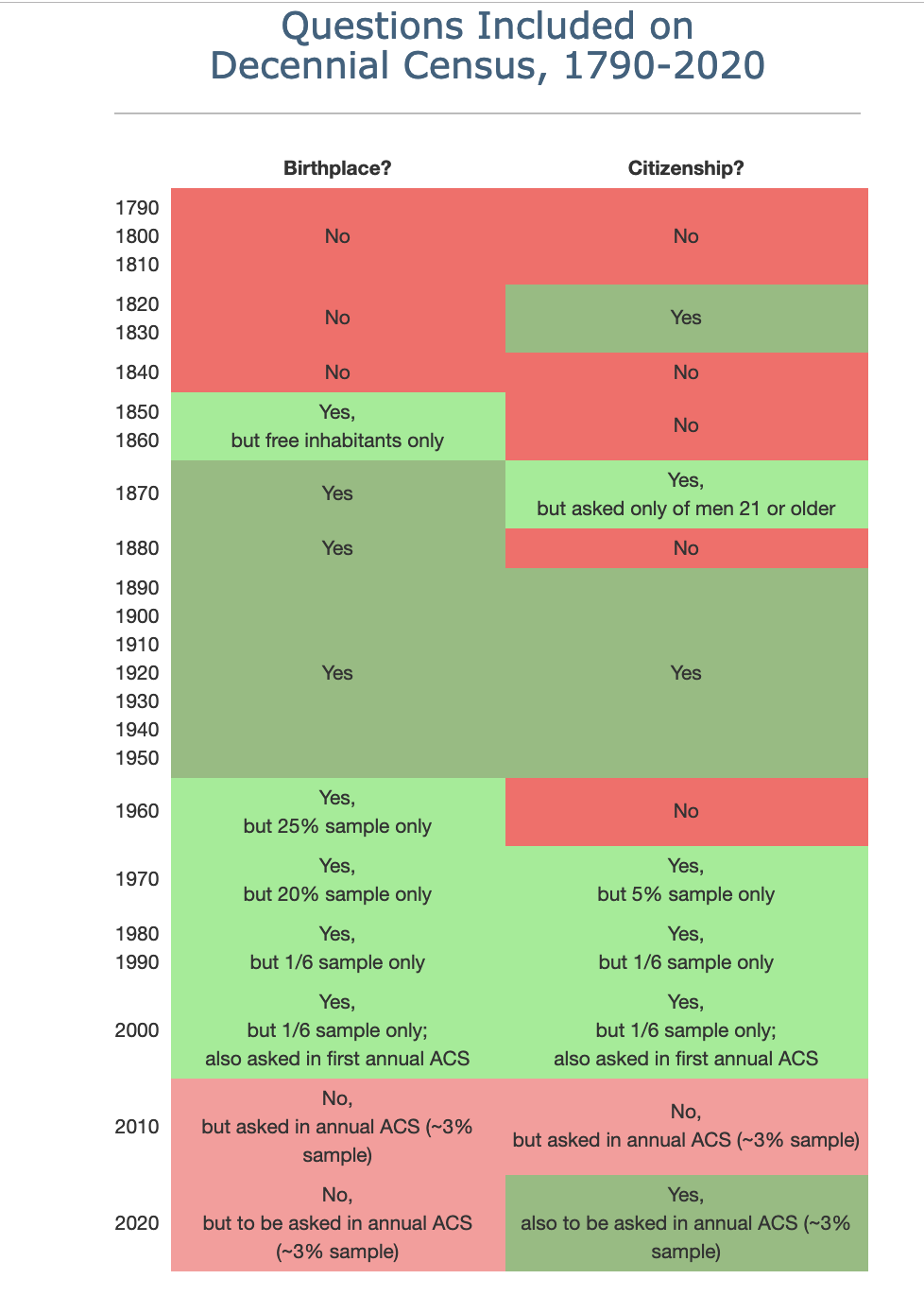
Asking about citizenship on the census is not new. The Chart below from the Center for Immigration Studies shows the citizenship question has been asked at various times during our nation’s history and to different percentages of the total census.

The annual American Community Survey (ACS) began in 2000. It covers approximately 3 percent of the U.S. population and is conducted separately from the decennial census.

In 1960, birthplace and citizenship were asked of the entire population of New York and Puerto Rico. Because this is not a representative sample of the United States, the citizenship cell still gets an unqualified “No”.


Parts of this post were first seen at Godfather Politics.

Tuesday, February 12, 2019

Obituary - Krause

Source: https://www.dignitymemorial.com/obituaries/manahawkin-nj/george-krause-8117928
OBITUARY

George Krause

January 7, 1948 – January 7, 2019

KRAUSE George M.

George M. Krause, 71, of Long Beach Island and formerly Delran, passed away on January 7, 2019. He was the beloved son of the late George L. Krause and Catherine D. Krause (Miller).

George was the beloved husband of Lynne, loving father to Michael (Jennifer) and Amanda, and step-father to Abbie McAleer (Tim). He was predeceased by daughter Kimberly and son Geoffrey. He is also survived by his loving grandchildren Brooke, Ryan, Gavin, Alexis, Olivia, Brennan and Benjamin; sister Barbara Horneff; and several nieces and nephews.

George was a graduate of Holy Cross High School and LaSalle University. He became a Certified Public Accountant and worked for Deloitte, Haskins and Sells until 1982 when he was appointed Chief Financial Officer of the New Jersey Department of Labor. He continued to serve in that capacity under eight administrations until retiring in 2011. George also was a proud member of the International Association of Approved Basketball Officials Camden District Board 34 and officiated high school basketball games in Burlington, Camden and Gloucester counties for over 20 years.

He enjoyed visiting Florida, playing golf, doing crossword puzzles, and was an avid Eagles fan.

Arrangements are under the direction of the Thos. L. Shinn Funeral Home in Manahawkin, New Jersey. Calling hours will be from 11:00 a.m to 1:00 p.m. with a funeral home service at 1:00pm on Sunday, January 13, 2019. In lieu of flowers, contributions may be made to the American Cancer Society.

To leave online condolences, please visit www.shinnfuneralhome.com


Krause

Maureen F. (nee McGrath), of Delran, N.J. on May 18, 1990, age 42, mother of Michael, Geoffrey and Amanda, and the late Kimberly; daughter of John and Loretta (nee Golden) McGrath; sister of John McGrath, Helene Toner and Loretta McGrath. Liturgy of Christian Burial will be held Tuesday, 9:30 A.M. at St. Peter's R.C. Church, Riverside. Int. Lakeview Memorial Park, Cinnaminson, N.J. Friends may call Monday, 7-9 P.M. at THE SWEENEY FUNERAL HOME, 337 Bridgeboro St., Riverside, N.J. In lieu of flowers, memorial donations should be to The American Cancer Soc., 400 Birchfield Drive, Suite 402, Mt. Laurel, N.J. 08504.

Source: Philadelphia Inquirer May 20, 1990

Sunday, January 06, 2019

How Not To Be A Lazy Slob By Mr. Groovy

Source: http://freedomisgroovy.com/not-lazy-slob/

October 25, 2016

My biggest fear in retirement is morphing into a teat-sucking layabout—that is, a lazy slob. Work, for all its faults, adds structure to your life. It gets you up early and out of the freakin’ house (or in my case, down the freakin’ stairs).

But I no longer have the spur of work. Sleeping late won’t get me fired. Binge watching Breaking Bad won’t threaten the household’s finances.

So what to do? How do I force myself to exert myself when my brain knows I don’t have to? Yes, waking up at 5:30 in the morning and doing something constructive will do wonders for my soul. But sleeping to 9 or 10 feels so damn good.

To avoid becoming a teat-sucking layabout, I devised the following strategy. It’s certainly tailored to my needs and circumstances, but I think the average reader will find it quite advantageous as well. Let’s begin.

Industry Begets Industry

Aristotle believed that to become a just person, one must repeatedly do just acts. He was an early proponent of the notion that habits are destiny. So if we take this wisdom and apply it to slothfulness, our remedy is simple. In order to avoid being a teat-sucking layabout, one must not waste one’s free time ensconced on a couch or glued to Facebook. One must get off one’s arse and do something constructive. Industry begets industry. Here, then, are four anti-teat-sucking constructive acts you need to do every day.

Clean something. If you have stuff, there’s something to clean. If you have a car, your own place, and a pet, there’s even more to clean. So clean something every day. Mrs. Groovy and I have a cleaning schedule for our house. Every day, we each hit a different part. Today I dusted, wiped the top of the refrigerator, and cleaned the microwave. Mrs. Groovy cleaned the stairs and the toilets (poor Mrs. Groovy). And your cleaning doesn’t have to be a deep cleaning. Just engage in 15-20 minutes of moderate effort. That’s all you need to do. Your stuff will never be immaculate. But it will be tidy, and you’ll begin the process of turning constructive acts into habits.

Exercise. Every day Mrs. Groovy and I walk two miles. On Monday, Wednesday, and Friday, I do my pull-ups and squats. Make exercise a part of your daily routine. And remember, exercise needn’t be grueling or time-consuming. Start out with 10 push-ups, 20 squats, and one minute of jumping up and down. Just do something physical. That’s the point. Less sitting and more moving.

Perform a random act of industry. Today, while I was walking past the kitchen sink, I noticed it contained a few unwashed dishes and utensils—the remnants of Mrs. Groovy’s breakfast. So I washed them. And while I was washing them, I noticed that our soap dispenser was getting low on soap. So I added soap to the dispenser. There, in five minutes I performed two random acts of industry. This is a great habit to get into. If you see something that needs to be done, do it—immediately. Don’t worry if it’s not your responsibility. Who cares about that. Remember, your goal here is not to become a teat-sucking layabout. And the more constructive acts you do in a day, the further you’ll be from being an actual teat-sucking layabout.

Learn something. Every day I do five Duolingo Spanish lessons. I also try to watch at least one Butterfly Spanish video on YouTube. Y mi español es todavía mal! Of course I want to become conversant in Spanish, but I know that might be a rather far-fetched goal at this point in my life. No, I humble myself daily with Spanish for two different reasons. First and foremost it’s another constructive act. And the more constructive acts you can cram into your day, the better. Second, I have an extreme bias toward learning. If you ain’t learning, you ain’t living. So please heed me on this one. Find something you want to be better at and practice it. Want to learn the piano? Play the piano for 30 minutes every day. Want to learn how to create your own widgets for your WordPress blog? Spend 30 minutes on wpbeginner.com every day. Want to learn personal finance? Read the three newest posts on Rockstar Finance every day.

There are only so many hours in the day, of course. And if you work or have kids, performing the above four constructive acts every day might not be feasible. But let’s say you’re an anti-teat-sucking-layabout rockstar. You not only perform these four constructive acts every day, you’re looking for even more to do. Well, if that’s the case, here are two bonus constructive acts for you.

Declutter or organize something. Do you have closets? Do you have kitchen drawers? Do you have a garage or attic? If you answered yes to any of these questions, you surely have something to declutter or organize. I currently have a basket stuffed with bills and medical records sitting on top of a file cabinet. My goal is to attack this basket for 10 minutes every day until everything is filed. Then I’m going to organize the cabinet beneath my kitchen sink.

Fix or improve something. Last week, Mrs. Groovy and I went around to every room in our house and made a punch list of things that needed to be done. Haven’t attacked the punch list yet. But that smudge on the bathroom wall that glares at me and mocks me while my arse is parked on the toilet will be painted over by Friday. So help me God!

Discipline Over Motivation

Motivation can only take you so far. When I worked in uptown Charlotte, a co-worker and I used to lunch occasionally at a Chinese restaurant that occupied a storefront right next to a mega gym. And every January 1, my co-worker and I would make note of how every stationary bike, treadmill, and, elliptical machine visible through the window was occupied—probably close to a hundred. We would then make note of how many were occupied on February 1. Invariably it was less than half. By March 1, only a handful of those machines were occupied.

Your best defense against the scourge of laziness is discipline, not motivation. So schedule your constructive acts for a set time every day, preferably in the morning. I wake up every morning at 5:30, and by 8:00 I’ve done my Spanish, my cleaning, and my exercise. Not exactly fun, but it’s a great way to make sure I have a good shot at “winning” the day. Remember: industry begets industry.

Another way to harness the power of discipline is to boycott television until a certain hour. There’s no hard and fast rule here, but if you can refrain from watching television until at least 9:00 pm every night, including the weekends, you’re very unlikely to become a teat-sucking layabout.

But a Little Motivation Never Hurts

Although you can’t depend on motivation for the long haul, it never hurts to have a little of it. It’s putting the “spring in Springfield,” so to speak.

To get my fix of motivation, then, I have two go-to podcasts: The Art of Manliness, hosted by Brett McKay, and The Tim Ferriss Show. Brett and Tim are both whack jobs, but in a good way. They both focus on how to become better human beings, and they’re not afraid to challenge conventional wisdom or take things to the extreme. And I especially like their podcasts that deal with mental toughness. Here are two recent examples of that.

Jocko Willink on Discipline, Leadership, and Overcoming Doubt

The Workout the World Forgot

I also get my motivation fix from YouTube. I’m fascinated with habits and willpower and how I can use these tools to my advantage. If you’re interested in this as well, I encourage you to YouTube the following people: Brian Johnson, Kelly McGonigal, and Charles Duhigg. Here are three great clips to get you started.

Meditations by Marcus Aurelius

How to Turn Stress Into an Advantage

The Power of Habit

Final Thoughts

“I spent most of my money on booze and women, and the rest I wasted.”

I don’t know who said this, but I used to love this quote when I was a younger man. But now I have second thoughts. Is being a complete libertine really the answer to a fulfilling life? Perhaps some can pull it off. But I think most who try it will end up being broken down sots with vile STDs. And that doesn’t strike me as very appealing.

No, to me, a fulfilling life is an active life—where one endeavors to create or build, where one is a hero to his or her family and community, and where one is curious about the world and eager to explore it. After all, why were we bestowed with such exquisite brains? So we could just eat, sleep, and rut?

Okay, groovy freedomists, that’s all I got. What say you? Is my strategy for avoiding the perils of laziness sound? Or am I missing something. Let me know what you think when you get a chance. Peace.


Alternative Goal Setting: How Free Spirits and Slow-Burners Can Achieve Their Health Visions By Mark Sisson

Source: https://www.marksdailyapple.com/alternative-goal-setting-how-free-spirits-and-slow-burners-can-achieve-their-health-visions/

January 10 2017

Inline_Alternative_Goal_Setting
I’m a type A personality, so setting and attaining goals comes naturally to me. I desire a thing, determine the steps necessary to attain it, and follow through. It’s how I work best. Thanks to some timely comments from my decidedly un-type-A wife, Carrie, I’ve realized something: much of my advice is unwittingly geared toward people with similar inclinations.

But that doesn’t describe everyone. What about the rest of you? What about the slow burners and dreamers? The free spirits? When it comes to achieving a vision, what characterizes and organizes your process from desire to attainment?

Conventional wisdom tells us significant changes require that we establish and adhere to a list of preset action items—all in a concrete trajectory toward success. The problem is, this falls flat with some people. They might adhere for a while but lose interest because being hemmed in doesn’t fit their lifestyle or their personality. They don’t lack motivation. Some of us are simply more exploratory and squirrel-ly by nature.

Chalk it up to the “perceiving” (or an intuitive perceiving) on the Myers-Briggs or whatever you will, but it’s different strokes for different folks. Aside from the basic physiological nuts and bolts, hominids can be frustratingly (and beautifully) variable that way. While some people just don’t want to get on the stick with their goals, others are motivated but operate without the stick entirely. Clearly, we’re not dealing in productivity metaphors in quite the same way.

Most people’s answer would be to get more disciplined, more specific, more nailed down—to tame those free spirit instincts and stop all the nonsense, to push along those ambling slow burners already.

That doesn’t always work. The regular advice—do this, make a list, map your future, aim for a goal off in the distance—doesn’t work for a large subset of the population. Yet, by and large, that’s what’s available.

As a coach, husband, business owner, and father, I’ve learned how futile it is to expect someone to work against their own instincts. You can ask them to journal, to write their 5-year plan, to adhere to this or that daily regimen. They might even acknowledge your method’s validity on an intellectual level—but if it doesn’t resonate with their nature, it’s not going to stick. And that’s when an outside party is cajoling them. Imagine the futility when the dreamers are trying to cajole themselves into action. It’s hard to engage someone when you expect them to work entirely outside that person’s dominant instincts.

Interestingly, I’ve found that the malleability of the Primal Blueprint tends to attract a lot of folks with this disposition: big picture people, highly independent thinkers, intuitive types, abstract dreamers—people for whom other health approaches never felt right.

And while their path might not look like the most efficient, they’re just as capable of reaching their health goals—likely with a little extra time and creativity. The ultimate purpose for any of us isn’t perfection after all, but claiming our most enjoyable and energetic lives. There’s more than one way to arrive at that vision.

But what does the actual process end up looking like? How does a slow burner get enough momentum to keep going? How does a free spirit put positive changes into place? How do they progress without a tight plan?

Well, it looks looser, more organic. It’s slower. Maybe it meanders a bit along the way. And maybe it looks freer and even a little more fun. There’s more space most days, more choice. This means there’s more room for “error,” but errors we can learn from.

As I’ve observed in the freest spirit I know—my wife, Carrie—these folks are often more comfortable “being” with a chosen intention than “doing” a set action.

Maybe running five kilometers doesn’t appeal as an objective today, but asking yourself “How do I feel like moving today?” does. They might draw on an informal list of options for the day, rather than a single action item that absolutely must be completed or else. When there’s an intent and a general window(s) of time to do it in, those spirited types might be just as likely to run the duration as anyone—or hit a yoga class, or swim at the Y, or ask a friend to go on a bike ride.

Some of us prefer to be with an intent. Others of us need to be with a directive. As long as we approach either with integrity, the end result will be essentially the same.

To a type A like me, “being” in an intention sounds like standing in the midst of absolute nothingness. But for others, it feels spacious, inviting, and empowering. “How do I want to be with my physical strength today?” For the free in spirit, this can be the most inspiring question ever.

To be sure, the clarity of the intention matters. Bringing a solid intention but leaving a certain margin of choice for the inclination of the moment maintains an all-important sense of freedom. As a result, for these folks, it feels more rooted and doable in the moment.

The ongoing question becomes then, “Where do my intent and interest connect right now?”

Let me take a stab at offering some suggestions for those who identify as free spirits, slow burners (and any other variety of naturally hard-to-nail-down). These are my observations, informed by life and a little coaching strategy. And let me know what you think.

Don’t make specific goals at all. Build systems instead.

Scott Adams of Dilbert fame popularized this concept. When he started blogging, he didn’t have a goal in mind. There was no end in sight. He was simply blogging to practice his writing because better writing is a helpful skill. As it turns out, he’s since published successful books, and continues to use blogging as a system for honing his craft, generating new ideas, and experimenting with different narrative voices.

A systems approach to weight loss would mean that instead of focusing on a goal like losing however many pounds/inches/belt notches, you’d design the system of appealing choices that all naturally support a healthier body composition. (Hmm…sounds a little familiar.)

Apply selective structure.

Free spirits obviously exist in the world, raise families, hold jobs, pay their bills. Life gets done. And it likely involves a certain amount of scheduling and routine. No one get through life without some structure.

Consider what areas or choices related to your health vision you most want freedom in and where you’d be willing to design some degree of regimen. Maybe you do better deciding on meals in the moment but see the need to routinize a block of time for fitness. There’s still space for choice, but you’re not needing to corral everything as a moving part each day.

Let your body decide.

Your conscious appraisal of reality is delayed by a few milliseconds. We’re always reacting to events that transpire. So when, say, you open up the fridge and decide what to eat for breakfast, your brain is already leaning toward a choice. That’s why you “know” you’re better off eating eggs and bacon instead of the gluten-free cereal. Your first impetus is to do the right thing—”I should…”. Simply opt to listen to it.

In the fitness world, they call this autoregulation training. You don’t hit a pre-meditated number of reps or sets. You go by feel. You lift, then stop when you hit a level of effort you don’t want to maintain. This also applies to sprinting and endurance training.

Of course, there is one small hurdle: It takes a premeditated decision and a committed mindfulness to listen to your body for this to work.

Pay attention to how you respond to certain behaviors/foods.

If running sprints in the morning made you feel great right after and led to a productive, good-natured day at work and a good night’s sleep, do it again.

If caving and eating a half slice of cheesecake (“Hey, I avoided the graham cracker crust!”) at night makes you feel bad afterwards, don’t do it again.

If watching four hours of TV after work makes you ashamed, take it as information and stop doing it.

If you lose yourself in an activity—if you reach “flow” while doing CrossFit WODs—that’s probably an activity you want to do more regularly.

Heed the way you instinctively respond to various actions and foods. Your mood, your shame, your elation, your sense of rightness or wrongness with the world—these are physiological feedback streams for what you should and should not be doing. When you see yourself in conversation with your environment, you are in a perfect position to heed the supportive cues it’s offering to you.

Don’t turn into a layabout.

Being a “free spirit” isn’t a free pass to do nothing. I mean, sure, you don’t have to do anything if you don’t want to, but you’re here. You’re reading. You’re interested in changing something. So, that’s not you.

If you’re a free spirit, don’t use your disposition as an excuse to chronically delay or dismiss your health vision. Even though you’re maybe not gunning after it with iron will and to-do lists in hand, live into it each day. Bring the lens of your intention to each choice. Commit to congruence.

And if you’re a type A personality, don’t tune out and think you’ve got it in the bag. You can reap the rewards of casual and free exploration. You can learn something from your intuition. And you should let your thoughts wander, too. Not all the time—it’s not in your nature—but the occasional injection of undisciplined exploration will lead to some really cool developments. Think of it as a short vacation for your mind, the kind where you come back refreshed with new ideas and insights. I’m a big fan of self-experimentation, and those are times when I do better stepping out of my type A approach.

In truth, all of us can likely find some sense and wisdom here—especially for days or moods when the usual routine won’t fit in the schedule or when we need a mental break from an otherwise established program.

The world is a finicky place. You cannot foresee all that will befall you. You can’t predict everything, nor will your plans all come to pass as intended. Being open to organic developments is simply good policy, especially as our world grows more complex and interconnected.

In the end, our health endeavors are less about the goals themselves than about how congruent we feel our lives are with our visions for them. Directed by purpose, we find many entry points that lead to the same end.

But more important than the end is the moment. This one right now. Apply your intention to it, and be well.

Thanks for reading, everyone. Let me know your thoughts here, and have a great week.


How to Stop Being a Loser

Source: https://www.wikihow.com/Stop-Being-a-Loser

November 3, 2018

Nobody wants to be a loser. Luckily, with just a little time and energy, no one has to! No matter who you are, turning your life around can be as easy as deciding that you're going to draw a line in the sand and make a change right now. Don't let people tell you you're a loser — instead, ignore their pettiness and work to be the best, happiest person you can be. You can become a winner. See Step 1 below to get started!


Value yourself.

If there's only one thing you do to improve yourself, make it this. When people genuinely value and respect themselves, it's obvious to everyone around them. These people may not all be bubbly and effervescent, but they all exude a sense of self-worth and confidence that makes it obvious that they don't consider themselves losers. Start by thinking of all of the good, valuable things about yourself — things you're good at, ways you enjoy yourself, and so on. Knowing that you have your own unique strengths and talents makes it so much easier to love yourself and so much harder to pay any attention to people who may try to put you down.

  • If you're feeling down and you're having trouble finding value in yourself, try the following exercise. Take a piece of paper and draw a vertical line down the middle. At the top of one side, write "pros", and at the top of the other, write "cons". Begin to write your positive and negative attributes in the appropriate columns. For each "con" you write, try to write two "pros". When you've filled your "pros" column, stop and review what you've written down. Your positive qualities should dwarf your negative ones.


Devote time to your hobbies and interests. People who spend time doing what they love have an easier time loving themselves. The fun and self-satisfaction you get from indulging your hobbies and interests is great for building confidence and increasing your sense of self-worth. If you're not already doing so, try to spend a little time every day or week doing something positive and fun that you love. If you can do your hobbies with other people, even better — your friends can take the entertainment level of your hobbies from "fun" to "let's do this again as soon as we can".
  • This advice is especially true if your work or school situation isn't ideal. It can be tricky to find a new job that you love or get a new group of friends at school, but it's not very hard, for instance, to spend a little time practicing piano every evening if you love music.
  • Try to tend towards skill-based activities that you can improve at over time. While watching TV and playing video games can be fun, they don't usually offer any serious potential for self-improvement.


Stay physically active. Believe it or not, the way you treat your physical body can have a noticeable effect on the way you view yourself emotionally. Exercise has been proven to cause the release of chemicals called endorphins in the brain which can help you feel positive and upbeat. Frequently devoting a little time and energy to your fitness can help you feel more relaxed, confident, and energetic. Additionally, exercise is known to help treat depression.[1] These qualities all make exercise a great option for people looking to increase their overall mood.
  • To be perfectly clear, you don't need to have a body like a professional athlete to be happy. Though everyone's fitness needs are different, the Centers for Disease Control recommend that adults should aim for about 1 1/4 hours - 2 1/2 hours of cardio exercise per week (depending on its intensity) in addition to strength-training exercise on two or more days each week.[2]


Work hard at your job or school. It's easiest to feel good about yourself if you're excelling at your personal and professional goals. Unless you're one of the fortunate few who can afford to live a life of leisure and luxury, odds are that you have some sort of professional obligations — for most people, this means work or school. Apply yourself when you tackle these responsibilities. Not only can this help you gain a better self image, but it can also lead to promotions, good grades, and so on, which in turn will increase your sense of self-worth. You don't have to kill yourself with effort to feel satisfied with yourself (for instance, don't miss the birth of your first child to squeeze in a few more hours at the desk), but you should make a habit of working hard and doing a great job at whatever you do.
  • If you've recently lost your job, don't be ashamed — instead, work hard to find another, better one. Don't forget the old cliché: "Finding a job is a job."
  • Beware of people who encourage you to neglect your work or school in favor of short term fun. While a little recreational activity is always a great idea, someone who consistently abandons his responsibilities for cheap thrills is the very definition of a loser.


Be responsibly social. People are social animals — we're meant to spend time with one another. In fact, social withdrawal is generally seen as one of the most common signs of depression.[3] If you've been feeling down on yourself lately, reaching out to friends or family members you haven't seen in a while can be a great way to get negative thoughts back on track. Spending just a single afternoon having a great time with people you're close to can completely re-orient your outlook on life.
  • While it's almost always a great idea to spend time hanging out with friends, try not to dwell exclusively on negative thoughts and emotions when you're with them. Good friends should be more than happy to talk with you about any serious problems you have, but making a habit of "dumping" your emotional issues on your friends can be very fatiguing for them. Instead, try talking to family members, role models you trust, like teachers, bosses, or religious figures who know you, or professional counselors.


Plan for your future. People who have their long-term responsibilities in order have an easier time enjoying themselves in the short term because they don't have to worry as much about the problems that tomorrow might bring. If you're working, don't put off saving for retirement — you'll never regret starting to save money at an early age, even if you can only afford to put away a little at first (for more information, see How to Save Money). If you're in school, spend a little time thinking about your plans for continuing education or employment. Ask yourself, "Will I proceed to the next level of education when I'm done with school, or will I start looking for a job?"
  • If you know the answer to either of these two questions, start looking for jobs or schools you might like. It's never to early to start planning for your future. Plus, you can always change your plans if you start to feel differently.


Surround yourself with good people. The people we hang out with can shape us. They can change our priorities, introduce us to people and things we wouldn't otherwise have encountered, and generally make our lives richer. However, if we spend a lot of time hanging out with people who have no goals, no hobbies, and negative attitudes about life, it's easy to get a distorted view of what's important. If you have a sneaking suspicion that you're spending your personal time, don't be afraid to limit the amount of time you spend with these people until you get your own life in order. You may find that once you've sorted things out for yourself, you suddenly are less interested in spending time with these people anyway. If you're unsure, look for these un-helpful attitudes in the people you're spending your time with:
  • Negative self-images (e.g. comments like, "Why can't I do anything right?")
  • Negative views of you (e.g. comments like, "Ugh, you again.")
  • A lack of personal hobbies or interests
  • Hobbies and interests solely related to drug use, "slacker" activities, etc.
  • An inactive lifestyle (e.g. lots of time spent on couch, watching TV, etc.)
  • A lack of goals or personal direction


Don't listen to the haters. Life's too short to worry about what petty people think of you. If someone's making you feel bad about yourself with the things he or she is saying, you don't have to accept it. Instead, let them know how their comments make you feel. Saying something simple like, "Hey, knock it off. Quit being a jerk!" is usually enough to let most people know that you don't appreciate their negativity. If they won't change, stop hanging out with them! You shouldn't feel any obligation to spend time with people you hate (outside of required functions like weddings, birthday parties, and so on, of course).
  • We all want to be the person we imagine, try being the best version of what you can manage. Simplify your life, and have fun.
  • Warnings

    • Don't become a mindless sheep following the crowd. Be who you are and who you want to be. That means not listening to mainstream music just to become a member of the crowd.
    • Don't get discouraged: you can improve yourself with some effort.

    References

    1. http://www.webmd.com/depression/guide/exercise-depression
    2. http://www.cdc.gov/physicalactivity/basics/adults/index.htm
    3. http://www.webmd.com/ahrq/depression-traps-and-pitfalls

    Thursday, January 03, 2019

    Motley Fool: Trading curbs deploy in frenzied market

    Source: https://www.dispatch.com/news/20181230/motley-fool-trading-curbs-deploy-in-frenzied-market

    December 30, 2018

    Q: Please explain "trading curbs." — H.S., New Orleans

    A: Trading curbs (also known as "circuit breakers" or "collars") are rules that restrict trading in the stock market in times of extreme volatility. When triggered, they can suspend trading for a specified period of time or halt trading for the rest of the day. The idea is that such breaks will stop or pause whatever trading frenzy or panic is underway, giving investors a chance to assess what's going on and make decisions in a calmer and more informed fashion.

    Trading curbs have been refined over time; the most recent rules halt market trading for 15 minutes if the S&P 500 drops more than 7 percent from its previous day's close — unless this happens at or after 3:25 p.m., in which case the markets will remain open until their regular 4 p.m. closing time. If the S&P 500 falls 20 percent below its previous day's close, trading is halted for the rest of the day. "Limit up, limit down" breakers, meanwhile, are designed to briefly restrict trading in a particular stock (or exchange-traded fund) within a defined band when triggered.

    Fool's school: Signs of trouble

    We spend a lot of time learning to identify great investments, but what about the stinkers? This review of red flags can help you spot, and steer clear of, bad investments.

    • A very low price: If a stock is priced below about $5 per share, it's generally a penny stock, known for volatility and often easily manipulated by scammers. A solid company with a stock price that low is likely to be experiencing a rough patch.

    • Over-the-top promotion: If you're seeing lots of capital letters and exclamation marks and you're being urged to act quickly, beware. Bad investments are often pitched with language such as "amazing breakthrough, "miracle cures" and "HUGE profits!"

    • Strangely specific claims about future returns: Examples include a "potential 3,227 percent gain" or an expected deal that "will soon push the stock above $20!" A newsletter might claim that its recommendation should rise "more than 40 percent in 30 days."

    • An unprofessional company website: Expect and demand clear, honest communication from companies you invest in. Their websites should include their audited financial statements, too. If a company's website features poor grammar and misspellings and pages that are "under construction" or absent, that's a red flag.

    If these companies being promoted were really such terrific opportunities, their shares would be greedily snapped up by savvy investors instead of being hawked to whoever will buy them. These so-called bargains that sound too good to be true are generally bad news.

    Remember, too, that a low share price doesn't mean a stock is a good value. A 50-cent stock can soon become a 5-cent one (and often does), while a $200 stock can grow to $400 — and keep growing.

    When researching possible investments, seek companies with growing sales and earnings, little debt, ample cash and sustainable competitive advantages. Don't just fall for an exciting story. Demand proven profits, not just possibilities.

    Name that company

    I trace my roots to the 1905 opening of the Star Furniture Co. in Zeeland, Michigan, where I'm still based. Over the years, I made things such as clocks and leg splints for the Navy. In 1968, I introduced "the world's first open-plan modular system of panels and attaching components." Today, I'm an office-furnishings leader, with a market value recently near $2 billion. My brands include my own name, along with Design Within Reach, Geiger International, Maharam, Nemschoff, Colebrook Bosson Saunders, naughtone, Maars Living Walls and HAY. Many of my designs are in museums. Who am I?

    Last week's answer

    I trace my roots to 1865, when a Scot founded a bank in Hong Kong and Shanghai that aimed to finance international trade. I was the first commercial bank in Thailand and printed its first banknotes. Many of my employees became prisoners of war during World War II. I bought Marine Midland Bank in the 1980s and, over the years, many other banks, too. Today, with a market value recently topping $160 billion, I serve more than 38 million customers via roughly 3,800 offices in 66 countries and territories. P.G. Wodehouse once worked for me. Who am I? (Answer: HSBC Holdings)

    Sunday, December 30, 2018

    End of Year Countdowns

    Good Evening,
    As I am typing this, I am listening to the late Casey Kasem counting down the Top 80 songs from 1972, part one, on 100.1 WJRZ, via internet. Growing up, it was one thing to look forward while off from school, tempting to hear how your favorite songs fared for such particular calendar year. Back in the day, you would have a local station do the local countdown, and the aforementioned Mr. Kasem doing the national version. As "The King of the Countdown" used to say, "Billboard ranks them, and AT 40 counts them down... ." All these years later, thanks to both internet radio and syndication, we get to enjoy and reminisce.

    Before I go further, if you were to listen to the original broadcast from 1972-73 and Google the survey today, they are not in syncopation. My guess is that statistics were kept differently back then, maybe some manipulation of sorts. On Saturday, I was listening to Don Tandler on his Pop Gold Radio station playing a revised "Famous 56" WFIL Top 100 from 1971. I was not born until 1975, so I wouldn't know what the before and after would look like without looking for it online. Either way, it was a blast listening to. I believe, nationally, "Joy to the World" by Three Dog Night was #1 nationally and for many local countdowns for the year ending 1971. However, it was only #7 on WFIL's year-end countdown that year. The #1 song for WFIL's year ending 1971 countdown belonged to Rod Stewart, with "Maggie May"/"Reason to Believe". Yes, it was a double-sided hit, which is something you don't hear much anymore. Chicago was #4 with "Beginnings"/"Colour My World" and Carole King was #3 with "It's Too Late/"I Feel the Earth Move" on the aforementioned survey. I would think that "King" George Michael was smiling from the heavens above. Thank you again, Don Tandler, for taking us back in "The Time Machine". Every Saturday at 3:00 PM ET, Don spotlights a countdown from yesteryear. For more information on upcoming countdowns, you can check out the website at popgoldradio.com.

    For a countdown you may have never heard of before, Rich Appel has his Top 100 of Top 100's this weekend. For times and stations carrying it, you can check www.thatthingshow.com for information. I know that Pop Gold Radio is playing the show, in its entirety, from 12 Noon until 7:00 PM on New Year's Eve. I don't listen to today's music much these days, but my guess for Billboard's #1 for 2018's year end countdown would be Drake's "God's Plan". I would be happy if it is Dua Lipa's "New Rules", as I like her music. I only say this because of Ariana Grande's "Thank U, Next" was released late in the year. Time will tell on a revised chart down the road.

    If I don't get to post again before this year wraps up, I want to take a moment to say, "Thank you!", for reading this and other posts on this blog. As we head into 2019, to quote Casey Kasem's closing line, "Keep your feet on the ground, and keep reaching for the stars."

    Friday, December 28, 2018

    Andrew L. Yarrow: It’s a lonely world, more for men


    Source: http://gulftoday.ae/portal/a9823aa4-a2cb-4922-b9aa-b0ee03a92681.aspx

    October 27, 2018

    Former Surgeon General Vivek Murthy called loneliness a major public-health problem. And it is — but more so for men than women. Many women are lonely and hurting, yes, but men are more likely to be isolated than women, and the scale and nature of their loneliness differs.

    When talking with divorced men and women for my new book, “Man Out: Men on the Sidelines of American Life,” I was struck by the striking post-divorce social difference between the sexes. Whereas men felt greater urgency to find a new partner, women had much more extensive and deeper support networks and were less eager to remarry. In one Eastern city, I found a tightly knit “divorced moms” group of 75 women living within about a mile’s radius of each other, whereas men generally had no such network. One of the rare divorced fathers’ groups I unearthed included less than a handful of men, and they participated irregularly and lived far apart.

    Similarly, single women are more content with being unattached than single men are. Not only is the number of men living alone higher than it is for women — a reversal from pre-1990 patterns — but the proportion of men living alone is double what it was in 1970.

    Men are less likely to acknowledge being lonely or reach out to others, as well, largely due to traditional masculine beliefs that admitting perceived weakness is unmanly.

    Signs of waning male social connection are all around.

    Once strong men’s civic associations have seen their memberships collapse. Take the Masons, for example: Its members have dropped from 4 million in the mid-1960s to 1.1 million in 2016. Men are also less likely to go to church or volunteer than women. And in one Wisconsin town I visited, the old taverns where guys gathered after the factory whistle blew are no more.

    Men generally have more trouble making friends than women, and male friends are less likely to be confidants than beer buddies or guys they meet up with on basketball or racquetball courts. Without close friends or strong real-life social networks, and fewer ties to their children, these men “can go down the rabbit’s hole without anyone even noticing,” Pierre Azzam, a University of Pittsburg psychiatrist, said.

    One man told me: “I am 42 years old and have no friends. I feel this makes me less attractive to the opposite sex and more likely to grow into a crazy old man.”

    For some men, rejection can lead to misogyny. While women tend to feel sad about being isolated, male unhappiness is more often expressed as irritability and anger.

    Even married men, when asked, “Who’s your best friend?” typically say, “my wife.” By contrast, women — who often take trips with longtime girlfriends, join book clubs and talk on the phone with each other — often name another woman. “Check the family calendar on the refrigerator,” David Figura of the Good Men Project said. “All the kids’ activities and the wife’s book club and the next girlfriend getaway are written down — and there’s nothing for you.”

    For many men, their kids aren’t even a big part of their lives. With high levels of non-marital childbearing or divorce, together with the greater likelihood that mothers have custody of children, unmarried fathers are considerably less likely to live with their children or see them as often as they would like.

    Bringing these guys back in from the cold is no easy task.

    A good start would be to cast aside old masculine ideas that a real man shouldn’t express feelings. Another would be to make national service — civilian or military — mandatory, which would instill social skills and create bonds leading to lifelong friendships for men and women. Employers could do more to build camaraderie at work.

    The Elks and Moose single-sex groups may not be hip, but don’t we have the creativity to develop new organisations where men can connect with other men? And bringing fathers back into their children’s lives would make millions of men and children happier.

    Such actions aren’t just feel good measures; loneliness is deadly. It’s associated with anger, depression and rising male suicide rates, but also heart disease, obesity, chronic diseases and a higher risk of dementia. It is also more likely to lead to early death than smoking 15 cigarettes a day, one researcher found.

    So men, speak up if you’re hurting, and we’ll do our best to listen.

    Tribune News Service